Choose the place and the species. The index, from 0 to 100, combines weather, sun, moon and tide with each fish's habits. Up to 28 days, with each day's confidence.
location
Sample location: choose yours to see the forecast for where you fish.
period
Reading the weather across 3 global models and 31 simulations…
0—
index Score from 0 to 100 for the fishing conditions of each hour. It reads weather, sun, moon, tide and the species' habits. It doesn't promise fish: it tells you when the water is on your side. 0–24 poor · 25–44 fair · 45–64 good · 65–84 very good · 85–100 excellent.
today
—
confidence —
confidence How much you can trust the weather forecast for the day. It drops with distance and when the models disagree. It is not the chance of catching fish.
models and trend Up to 16 days, three global weather models (the European ECMWF, the American GFS and a high-resolution blend) read hour by hour; when they disagree, the light band on the chart widens. Beyond that it's a trend: 31 runs of the American GEFS model. Confirm when it's 1 week out.
window Consecutive hours with the index near the day's peak and no danger alert. It is the time to have the bait in the water.
hour by hour
tap or drag on the chart to read each hour · on a keyboard, arrow keys
see hour-by-hour table
why this index at —?
next 7 days
choose the day
chart: bar height = day's index · line = variation between models · striped = trend · fainter = less confidence
Each card shows the day's index (0 to 100) and, below it, a strip with the index for each hour, from 0h to 23h. from poor to excellent.
4-week calendar
the fishing month at a glance
plan a trip
what's the best window for the crew?
Choose how many fishing days. We compare each stretch by its average index, discount days with a warning or closed season, and show the 3 best.
trend for the coming weeks
Line: the middle value of 31 simulations of the American GEFS model. Band: where 8 out of 10 fall. Narrow, firm trend; wide, high uncertainty.
the species
everything about the matrinxã
overview
who is the matrinxã
Matrinxã is a streamlined, fast and very jumpy fish, typical of fast rivers and banks with fruit trees. It eats fruit, seeds, flowers, insects that fall into the water and small fish. It migrates to spawn at the start of high water, when it swims upriver in large schools. In the dry season it stays in rapids, rocky bottoms and shaded banks. In sport fishing it is highly prized on light tackle and fly, since it strikes spoons, small lures and flies and fights with jumps and runs. It is also farmed and widely eaten in Amazonas.
fun facts
Helps disperse seeds of trees in the flooded forest.
In captivity it only spawns with hormone induction, because it needs migration to mature.
how to recognize it
identification
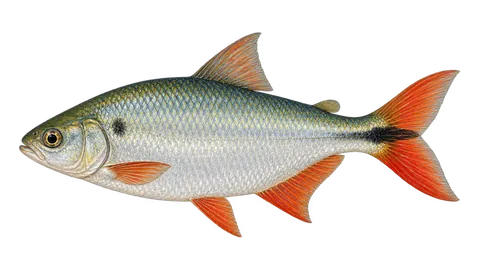
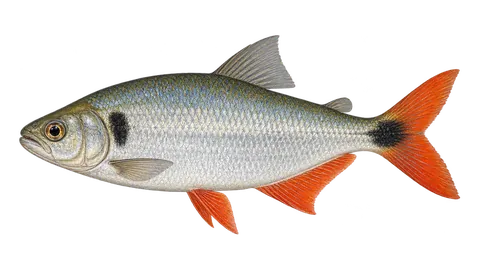
Elongated, silvery body, grey-olive back, diffuse dark blotch behind the head and dark caudal fin. Lower fins orange. Small scales and a mouth with teeth in several rows. The Pantanal piraputanga has a reddish tail with a black band and does not occur in the Amazon. On the Araguaia and the Teles Pires, the local matrinchã is usually another, very similar Brycon species.
Amazon channel and tributaries, including the Negro, Branco and Madeira. In Mato Grosso the name matrinchã also covers other Brycon species from the Teles Pires, Juruena and Araguaia.
Habitat: Rapids, rocky bottoms, banks with fruit trees, clearwater igarapés and flooded forest in high water.
Summary of the regulations we found, with the source for each. Rules change; before keeping or transporting fish, check with the state environmental agency. Conservation: Not on the national list (Portaria GM/MMA 1.667/2026). Other Brycon species are threatened, such as the Tocantins piabanha (B. gouldingi, VU).
Matrinxã closed season in the Amazon basin
capture, transport and sale banned15/11 to 15/03AMACAPROPAAmazon
Matrinxã is on the list of banned species from November 15 to March 15 in Amazonas, Acre and Amapá. In Rondônia (Madeira basin) and in Pará the ban appears under the name jatuarana.
catch and release mandatory; transport, storage and sale bannedMT
Until December 31, 2028, matrinchã (the whole genus Brycon) caught in Mato Grosso rivers may not be transported, stored or sold. Amateur anglers may only practice catch and release.
Annual closed season in AM for the species in Annex II of Portaria 48/2007: pirapitinga, mapará, sardine, pacu, aruanã and matrinxã. Tambaqui and arapaima (pirarucu) have their own rules (see the specific items and "prohibitions").
Annual closed season in AC for the species in Annex II: dourada, piraíba, pirapitinga, caparari, aruanã, jaraqui, mapará, sardine, matrinxã and pacu. On the Acre River, the closed season applies to all species (IN IBAMA 205/2008).
Transport, storage and sale are fully prohibited for 5 years from Jan 1, 2024 for: cachara, caparari, dorado, jaú, matrinchã (Brycon spp.), pintado/surubim (Pseudoplatystoma spp.), piraíba, piraputanga, pirarara, arapaima (pirarucu), trairão and peacock bass (tucunaré, Cichla spp.). For recreational anglers: catch and release only. These 12 species may not even be eaten on site, since the 2 kg or 1 fish limit excludes the art. 19-B list. The law cites jaú as Zungaro zungaro; we also include the Pantanal jaú (Z. jahu) out of caution. The list may still change: § 2 (exotic and predatory species), § 3 (review through study) and the 3-year assessment planned for 2027. A TJMT news report of Jun 2, 2026 confirms the 12 prohibited species. The STF denied a preliminary injunction in the ADIs against the law in 2024; we found no merits ruling.
piracema closures in the basins where the species lives
Spawning closure (piracema) in Mato Grosso (all basins)
01/10 to 31/01MT
Allowed: All fishing modalities are prohibited in rivers, including catch and release (Law 9.096/2009, art. 19-A). Exceptions: subsistence fishing from shore (3 kg or 1 fish, no transport or sale) and scientific fishing. Law 13.159/2025 now allows licensed sport fishing in UHE/PCH hydropower reservoirs, natural lakes and border rivers, subject to a scientific study and a license from the environmental agency. We have not confirmed whether these licenses are already being issued.
Allowed: Recreational anglers with handline or rod, line and hook are outside the Annex II prohibitions, with a bag limit of 5 kg + 1 fish, unless a stricter state rule applies.
catch and release Releasing the fish alive, quickly and with a wet hand. During a closed season it isn't always allowed: what the regulation says applies.
Sensitive fish: remove the hook in the water, without squeezing the belly, and release it quickly. Avoid letting it thrash on the bottom of the boat.
in the kitchen
Very tasty flesh, but with Y-shaped bones. Grilled over coals, fried in thin cuts or in fish stew.
calculator
how much it weighs without taking it out of the water
Length-weight relationship W = a·Lb (a = 0.01445, b = 3.06; FishBase (bayesiano, espécie + gênero)). It's an average: a fat or lean fish can vary by 10% to 20%.
estimated weight
—
sources and references
The season weights (months), the time of day and the sensitivities (cold, pressure, moon, wind, rain, tide, strong light, murky water and noise) are the app's editorial estimates, based on the literature below and on the field experience of anglers and guides. They are not official data nor a measurement made for this species, and they may vary by region and year. Closed seasons and legal rules appear in the rules section, with the norm and a link.
The weather comes from three independent global models, cross-checked hour by hour: when they agree, confidence goes up; when they diverge, the band between them shows on the chart. Beyond 16 days, we use the GEFS ensemble of 31 simulations: if 20 of the 31 predict rain, the chance of rain is 65%. Sun and moon are calculated astronomically, with no uncertainty.
The index adds up, weighted for each species: time of day (species curve anchored to real sunrise and sunset), moon (transits, rise and set, phase), pressure (3 h trend and 24 h swing), water temperature (in rivers, estimated from air temperature; at sea, estimated by an ocean model), wind, rain, clouds, tide and the month in the species' cycle.
Accuracy measured in the reference project (4 regions, 93 days, forecast vs. observed): maximum temperature is off by 0.6 °C on average the next day and 1.7 °C at 7 days; rain of 5 mm or more is detected 76% of the time the next day and 57% at 7 days. Detection isn't everything: the false alarm rate isn't published here yet, and 93 days in 4 regions is still a small sample. We now also measure every day, at the app's destinations:
where are you going fishing?
Your location is saved only on this device and feeds the forecast, the map and the "today" on the home page.