Skip to content
fishing forecast

longfin yellowtail

Seriola dorsalis · Carangidae · predator

Sea

The California yellowtail, the emblematic fish of boat fishing in Baja California and the Gulf of California. It fights hard and pulls toward the rocks; it takes jigs, surface lures and live sardines.

Also called: olhete-da-califórnia, jurel, yellowtail, California yellowtail

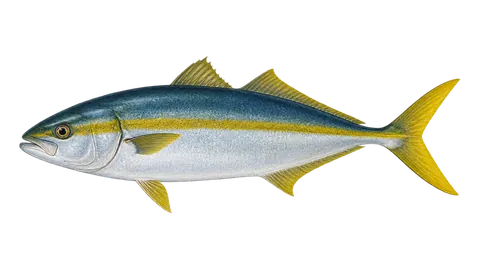
Scientific illustration of Longfin yellowtail
common size
60–100 cm
maximum
155 cm
common weight
3–13 kg
record/max.
36.3 kg
depth
3–80 m
ideal water
18–24 °C
location

Sample location: choose yours to see the forecast for where you fish.

period

Reading the weather across 3 global models and 31 simulations…

the species

everything about the longfin yellowtail

overview

who is the longfin yellowtail

For a long time it was treated as the same species as the southern hemisphere yellowtail (Seriola lalandi). Genetic studies in 2015 split out three species, and the northeastern Pacific one, from southern California to the Pacific coast of Baja California and the Gulf of California, became S. dorsalis. It lives in schools or small groups near islands, rocky shores, kelp forests and reefs, and sometimes enters bays. It eats sardines, anchovies, mackerel, squid and pelagic crabs. It is one of the most sought-after sport fish in northwestern Mexico: caught from boats with metal jigs, surface lures and live sardines, it fights hard and tries to cut the line on the rocks.

fun facts

  • In 2015 genetics showed that the 'yellowtail' known worldwide was actually three species: S. lalandi in the southern hemisphere, S. aureovittata in the northwestern Pacific and S. dorsalis in the northeastern Pacific.
  • It is raised in captivity in California and Mexico for aquaculture.
how to recognize it

identification

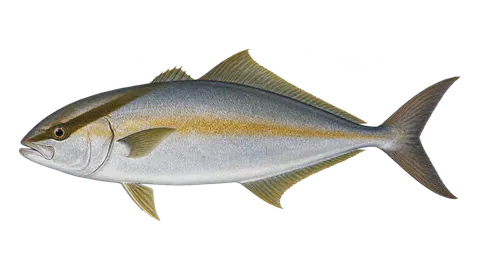
Fusiform, elongated body, dark blue to olive-green back, silvery flank, a yellow stripe from snout to tail and a deeply forked yellow tail. No scutes on the lateral line. It is identical to the southern hemisphere yellowtail (S. lalandi), from which it was separated by genetics; in practice, the difference is geographic. The longfin yellowtail (S. rivoliana), common in Mexico, has a deeper body, a dark diagonal band on the nape and longer dorsal and anal fin lobes.

distribution

where found

open on the large map

Not found in Brazil (the Brazilian yellowtail is S. lalandi). Northeastern Pacific: southern California (USA), the Pacific coast of Baja California and the Gulf of California (Mexico), with islands and reefs as strong points.

Habitat: Islands, rocky shores, kelp forests, reefs and banks offshore; schools of juveniles in open sea, sometimes near floating objects.

calendar and clock

when to fish

best season

time of yearbest: Apr–Oct
JanFebSeaAprMayJunJulAugSepOctNovDec

On the Pacific coast of Baja California the strong season runs from spring to autumn, with warmer water. In parts of the Gulf of California the best time is usually late winter to spring.

best time of day

0h6h12h18h sunrise ~6amsunset ~6pm

Daytime, with peaks at dawn and dusk. Hunts by day, with peaks at dawn and dusk, when sardine schools rise.

weather, water and behavior

what affects the longfin yellowtail
sensitivity The little bars show how much each factor affects this species. Five full: it feels it a lot.

cold and cold fronts

Upwelling of cold water (below about 16 °C) drives the schools away.

atmospheric pressure

Little direct effect; calm sea makes it easier to find the fish.

moon

Strong moons move more water over the shoals.

rain

Little effect in open sea.

water level

Does not apply at sea. The equivalent is current over islands and shoals.

noise

A school at the surface sinks when the motor is on top of it; approach from the outside and cast far.

wind

Rough seas make vertical jigging and keeping the boat over the shoal difficult.

tide

Moderate current over the rock concentrates bait and yellowtails.

depth

From the surface down to about 80 m over the shoals; near islands, 10 to 40 m.

technique, gear and bait

how to fish

rod
6'6" to 7'6", 30 to 60 lb (jig and live bait); long casting rod for surface lures
spinning / baitcasting reel
medium conventional baitcasting reel or 8000 to 14000 spinning reel with a strong drag
line
braided line 50 to 80 lb
leader
fluorocarbon 40 to 80 lb, 1.5 to 3 m
hook
circle hook 2/0 to 5/0 for live bait; assist hooks on the jig

lures

  • metal jig 100 to 250 g
  • heavy spoon (surface iron)
  • stickbait and popper 15 to 20 cm

natural baits

  • live sardine and mackerel
  • lula

accessories

  • fighting belt
  • bicheiro
  • alicate

tip from an angler

When hooking up near the rock, don't give line: lock the drag and bring the fish up from the bottom in the first few meters, or it will cut the line on the rocks and kelp.

what the law says

rules for the longfin yellowtail

Summary of the regulations we found, with the source for each. Rules change; before keeping or transporting fish, check with the state environmental agency.
Conservation: The species has not yet been assessed on its own by the IUCN.

Mexico: up to 5 per species and 10 saltwater fish per day

5 specimens of the species per angler per day, within the limit of 10 saltwater fish

In recreational sport fishing in Mexican federal waters, each angler may keep up to 10 saltwater fish per day, no more than 5 of the same species. The California yellowtail (jurel) is not among the species reserved for sport fishing under art. 68 of the General Law of Sustainable Fishing and Aquaculture, and has no quota of its own. Fish over the limit must be returned alive to the water, and sport-caught fish may not be sold. Anglers fishing from a boat need a Conapesca permit.
Source: Amendment to NOM-017-PESC-1994 (recreational sport fishing in federal waters of Mexico), published in the DOF on Nov 25, 2013, items 4.9.1 and 4.9.5 (Sagarpa/Conapesca)

catch and release
catch and release Releasing the fish alive, quickly and with a wet hand. During a closed season it isn't always allowed: what the regulation says applies.

It fights to the end and arrives exhausted: keep it in the water, remove the hook quickly and release it head-down, toward the bottom.

in the kitchen

Firm, tasty flesh, excellent raw (sashimi and ceviche), grilled or smoked.

calculator

how much it weighs without taking it out of the water

Length-weight relationship W = a·Lb (a = 0.01862, b = 2.93; FishBase (relação de Seriola lalandi no sentido amplo, que incluía esta espécie)). It's an average: a fat or lean fish can vary by 10% to 20%.

estimated weight

—

sources and references

The season weights (months), the time of day and the sensitivities (cold, pressure, moon, wind, rain, tide, strong light, murky water and noise) are the app's editorial estimates, based on the literature below and on the field experience of anglers and guides. They are not official data nor a measurement made for this species, and they may vary by region and year. Closed seasons and legal rules appear in the rules section, with the norm and a link.

  1. scientific FishBase — Seriola lalandi (ficha da espécie)Names, distribution, biology, length-weight relationship, list of countries and references. Page checked 13/10/2026. FishBase still treats S. dorsalis as a synonym of S. lalandi, but notes that Martinez-Takeshita et al. (2015) consider it valid, restricted to California, the Pacific coast of Baja California and the Gulf of California. The biology data apply to the complex.
  2. scientific Martinez-Takeshita, N. et al. (2015). A tale of three tails: cryptic speciation in a globally distributed marine fish of the genus Seriola. Copeia 103(2): 357-368.DOI checked in Crossref.
  3. scientific IUCN Red List — Seriola lalandi (avaliação global: Pouco Preocupante, LC, 09/03/2015)Global assessment made for S. lalandi in the broad sense, before S. dorsalis was split off.
  4. scientific Baxter, J. L. (1960). A study of the yellowtail Seriola dorsalis (Gill). Fish Bulletin 110. California Department of Fish and Game.Printed work cited by the Wikipedia encyclopedia (Seriola dorsalis entry) for the heaviest specimen, 80 lb (36.3 kg), and by Miller & Lea (1972) for the longest observed length, about 155 cm. We did not check the original works.
  5. official DOF — Modificação da NOM-017-PESC-1994, para regular a pesca deportivo-recreativa em águas de jurisdição federal do México (publicada em 25/11/2013)Daily limits at sea (item 4.9.1) and in fresh water (4.9.2), one rod in inland waters (4.6 b), ban on live fish as bait in inland waters (4.7 c) and on fishing in closed areas and seasons (4.10).
don't confuse

similar species