

- common size
- 20–35 cm
- maximum
- 48 cm
- common weight
- 0.1–0.4 kg
- record/max.
- 1.4 kg
- depth
- 0–40 m
- ideal water
- 20–28 °C

the right time
to be on the water
Choose the place and the species. The index, from 0 to 100, combines weather, sun, moon and tide with each fish's habits. Up to 28 days, with each day's confidence.
Loading the forecast…
—
Looking for alerts within 30 km…
Looking for what anglers have logged near here…
what you need to fish herelicense, certification and boat documents
fish likely at this spot
Tap a fish to see its forecast.
hour by hour
slide your finger or mouse over the chart to see each hoursee hour-by-hour table
why this index at —?
choose the day
the fishing month at a glance
what's the best window for the crew?
Choose how many fishing days. We compare each stretch by its average index, discount days with a warning or closed season, and show the 3 best.
trend for the coming weeks
Line: the middle value of 31 simulations of the American GEFS model. Band: where 8 out of 10 fall. Narrow, firm trend; wide, high uncertainty.
everything about the gulf kingcroaker
how to recognize it
Elongated, rounded body, greyish-brown on top and silver below, without strong dark bands. Protruding snout, mouth underneath and a single short, thick barbel shaped like a peg at the tip of the lower jaw, with a pore at its tip. Belly scales are smaller than the flank scales. The betara (Menticirrhus americanus) is darker and has oblique V-shaped bands on the flanks; the croaker has a deeper body and more than one barbel.
Also called: papa-terra-branco, betara-branca, papa-terra, betara, Gulf kingcroaker
don't confuse with:
where found
open on the large mapWhere to look: Open-sea beaches, gutters and surf channels with sand and mud bottoms; enters estuaries. Juveniles stay in the surf zone.
Western Atlantic: from Virginia (USA) and the mainland Gulf of Mexico coast to Rio Grande do Sul. In Latin America it appears from Mexico and Central America to Colombia, Venezuela and the Guianas. In Brazil it occurs on beaches and in estuaries along the whole coast.
coast
states
Amapá, Pará, Maranhão, Piauí, Ceará, Rio Grande do Norte, Paraíba, Pernambuco, Alagoas, Sergipe, Bahia, Espírito Santo, Rio de Janeiro, São Paulo, Paraná, Santa Catarina, Rio Grande do Sul
when to fish
best season
It can be fished all year; it generally does best in the warm season, with water above about 20 °C, and slows down in the cold months of the South.
best time of day
Night and twilight. On the beach it does best at dawn, dusk and at night, with the water rising. Scientific sources do not detail the timing; the indication comes from surf casting practice.
what affects the gulf kingcroaker
cold and cold fronts
A cold front that drops water temperature keeps fish away from the surf for a few days.
atmospheric pressure
Stable pressure helps; the drop ahead of the front usually gives a short spike.
moon
Small effect; spring tides stir the bottom more and bring food.
rain
Light rain does not bother; runoff coming down the gutters muddies the water and scatters the fish.
water level
Does not apply at sea. The equivalent is the tide height in the gutters.
noise
Not very sensitive, but footsteps at the gutter's edge and a silhouette on the jetty spook the fish.
wind
Onshore wind raises waves and sand; a little swell helps, but too much gets in the way of the cast.
tide
The rising tide and the backwash after wave sets are the right moments.
depth
Shallow: in the gutter just past the first break, in 1 to 3 m of water.
how to fish
natural baits
- tatuí (sand crab)
- corrupto
- beach worm (polychaete)
- shrimp
- marisco
tip from an angler
Dig up tatuí (sand crab) on the same beach where you will fish and cast short, into the gutter just past the first break: the fish feeds close to the shore.
- rod
- 3.9 to 4.2 m (13 to 14 ft), 60 to 150 g
- spinning / baitcasting reel
- 5000 to 6000 surf reel
- line
- monofilament 0.28 to 0.33 mm
- leader
- 0.50 mm shock leader; rig of 2 or 3 hooks
- hook
- maruseigo or chinu no. 1 to 1/0
accessories
- grapnel sinker 60 to 120 g
- corrupto pump
- tatuí sieve
- rod holder
catch and release
Small fish swallow the hook deep: use a circle hook or a long-shank hook, back it out with pliers, and release it into the foam, without leaving the fish on dry sand.
rules for the gulf kingcroaker
Rules change; before keeping or transporting fish, check with the state environmental agency.
Federal minimum size of 20 cm for papa-terra-branco (Espírito Santo to Rio Grande do Sul)
20 cm (TL)ESRJSPPRSCRS details
Annex II of IN MMA 53/2005 lists the papa-terra-branco or betara (Menticirrhus littoralis) at 20 cm total length. Fishing for, keeping aboard and landing smaller specimens is prohibited along the coast from Espírito Santo to Rio Grande do Sul. The 20% tolerance in Annex II applies to landing inspections: the amateur angler must release the small ones. The rule does not apply to trawl fishing.
Mexico: up to 5 per species and 10 saltwater fish per day
5 specimens of the species per angler per day, within the limit of 10 saltwater fish details
In recreational sport fishing in Mexican federal waters, each angler may keep up to 10 marine fish per day, no more than 5 of the same species. The papa-terra-branco (berrugata) is not among the species with their own limit (billfish, sharks, giant pescada, tarpon, dorado, roosterfish and baya). Fish above the limit must be returned alive to the water, and sport-caught fish may not be sold. Fishing from a boat requires a permit, and sport fishing is banned in closed zones and seasons.
Conservation: Not on the Brazilian national list (Ministerial Ordinance GM/MMA No. 1.667/2026).
how much it weighs without taking it out of the water
estimated weight
—
how we calculate
Length-weight relationship W = a·Lb (a = 0.00794, b = 3.05; FishBase (relação peso-comprimento bayesiana, estimativa da própria espécie)). It's an average: a fat or lean fish can vary by 10% to 20%.
more about the gulf kingcroaker
The papa-terra-branco, or betara-branca, is a croaker (family Sciaenidae) with an elongated body, that lives in coastal waters over sandy and muddy bottoms and sometimes enters estuaries. Juveniles are abundant in the surf zone. It feeds mostly on worms and crustaceans that it digs up from the bottom, with a protruding snout and a mouth underneath. It matures at about 23 cm, has a common length of 30 cm and reaches 48 cm and 1.4 kg. In the western Atlantic it ranges from Virginia, USA, and from the Gulf of Mexico to Rio Grande do Sul. For surf anglers it belongs to the same group as the betara, and FishBase describes it as an excellent table fish. IN MMA 53/2005 cites it by its scientific name and sets a minimum size of 20 cm.
Family: Sciaenidae · predator
fun facts
- IN MMA 53/2005 cites the betara-branca by its scientific name, which separates it from the betara-preta in the minimum-size annex.
- Juveniles are abundant in the surf zone, where they eat worms and crustaceans.
- The single chin barbel has a pore at the tip and helps find food on the bottom.
in the kitchen
FishBase considers it an excellent table fish. Light, delicate flesh, good fried whole or as milanesa-style breaded fillets.
similar species
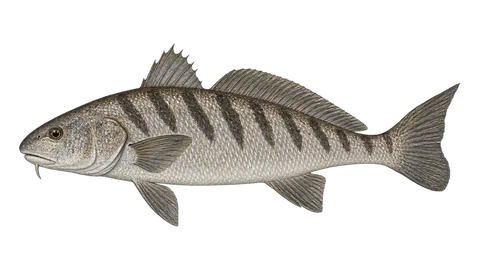
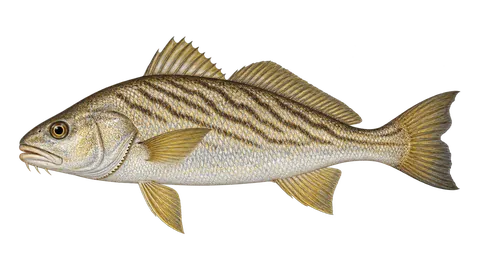
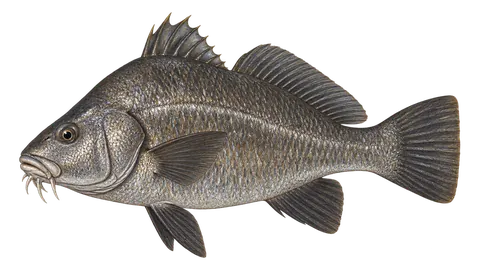

sources and references (5)
The season weights (months), the time of day and the sensitivities (cold, pressure, moon, wind, rain, tide, strong light, murky water and noise) are the app's editorial estimates, based on the literature below and on field experience from anglers and guides. They are not official data or measurements made for this species and may vary by region and year. Closed seasons and legal rules appear in the rules section, with the rule and link. The fishing depth range, the common size and the ideal water temperature range, when FishBase does not give a value, are editorial estimates based on the species' biology.
- scientific FishBase: Menticirrhus littoralis (ficha da espécie)Size, length-weight, depth, habitat, distribution, biology, and IUCN status. Page checked on Oct 13, 2026.
- scientific FishBase: nomes populares de Menticirrhus littoralisNames by country and language. The name papa-terra-branco follows IN MMA 53/2005 (papa-terra branco or betara).
- official Portaria GM/MMA nº 1.667, de 27 de abril de 2026: Lista Nacional Oficial de Espécies da Fauna Ameaçadas de Extinção (peixes e invertebrados aquáticos)The species is not on the list. Checked in the DOU of April 28, 2026.
- official NOM-017-PESC-1994, Para regular las actividades de pesca deportivo-recreativa en las aguas de jurisdicción federal de los Estados Unidos Mexicanos (modificação de 2013)Daily limit of 10 marine fish and 5 per species (item 4.9.1), return of the excess (4.9.5), closed seasons (4.10) and sales ban (4.11). Text checked in the DOF on Oct 13, 2026.
- official Instrução Normativa MMA nº 53, de 22 de novembro de 2005: tamanhos mínimos de captura no Sudeste e SulAnnex II: papa-terra-branco or betara (Menticirrhus littoralis), 20 cm total length, 20% tolerance in enforcement; the rule does not apply to trawl fishing.
how we calculatewhere each number comes from
The weather comes from three independent global models, cross-checked hour by hour: when they agree, confidence goes up; when they diverge, the band between them shows on the chart. Beyond 16 days, we use the GEFS ensemble of 31 simulations: if 20 of the 31 predict rain, the chance of rain is 65%. Sun and moon are calculated astronomically, with no uncertainty.
The index adds up, weighted for each species: time of day (species curve anchored to real sunrise and sunset), moon (transits, rise and set, phase), pressure (3 h trend and 24 h swing), water temperature (in rivers, estimated from air temperature; at sea, estimated by an ocean model), wind, rain, clouds, tide and the month in the species' cycle.
sources for this lookup
how accurate the forecast is
Accuracy measured in the reference project (4 regions, 93 days, forecast vs. observed): maximum temperature is off by 0.6 °C on average the next day and 1.7 °C at 7 days; rain of 5 mm or more is detected 76% of the time the next day and 57% at 7 days. Detection isn't everything: the false alarm rate isn't published here yet, and 93 days in 4 regions is still a small sample. We now also measure every day, at the app's destinations: