

- common size
- 50–100 cm
- maximum
- 160 cm
- common weight
- 3–15 kg
- record/max.
- 59.9 kg
- depth
- 5–245 m
- ideal water
- 20–26 °C

the right time
to be on the water
Choose the place and the species. The index, from 0 to 100, combines weather, sun, moon and tide with each fish's habits. Up to 28 days, with each day's confidence.
Loading the forecast…
—
Looking for alerts within 30 km…
Looking for what anglers have logged near here…
what you need to fish herelicense, certification and boat documents
fish likely at this spot
Tap a fish to see its forecast.
hour by hour
slide your finger or mouse over the chart to see each hoursee hour-by-hour table
why this index at —?
choose the day
the fishing month at a glance
what's the best window for the crew?
Choose how many fishing days. We compare each stretch by its average index, discount days with a warning or closed season, and show the 3 best.
trend for the coming weeks
Line: the middle value of 31 simulations of the American GEFS model. Band: where 8 out of 10 fall. Narrow, firm trend; wide, high uncertainty.
everything about the almaco jack
how to recognize it
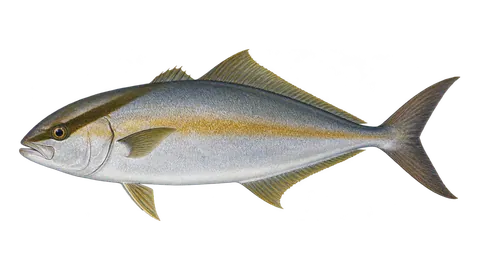
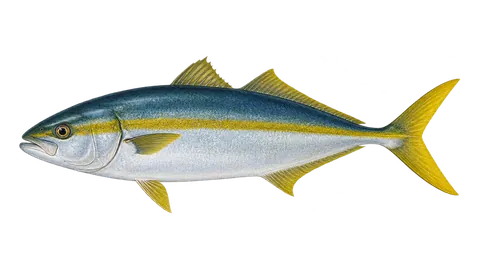
Taller and more compressed body than the greater amberjack and the yellowtail amberjack. Brown, blue-green or olive back, light belly, often with a yellow band along the flank and a dark oblique band from the nape to the eye. The long, sickle-shaped lobes at the front of the second dorsal and anal fins. Juveniles have six dark bars. The greater amberjack is more elongated and has short lobes; the yellowtail amberjack is more spindle-shaped and has a yellow tail.
Also called: pitangola, pitagol, remeiro, arabaiana-chata, olhete-bacamarte, almaco jack
don't confuse with:
where found
open on the large mapWhere to look: Reef slopes, shoals, wrecks and outer shelf banks; juveniles near drifting objects.
Along the whole Brazilian offshore coast, on shoals, wrecks, banks and shelf edges, from the Northeast to the South. It extends to northern Argentina.
coast
states
Ceará, Rio Grande do Norte, Paraíba, Pernambuco, Alagoas, Sergipe, Bahia, Espírito Santo, Rio de Janeiro, São Paulo, Paraná, Santa Catarina, Rio Grande do Sul
when to fish
best season
Available year-round on the shoals; current and clear water matter more than the month.
best time of day
Daytime, with peaks at dawn and dusk. Attacks jigs by day, with peaks in the first hour of light and at current changes; when the water is still, fishing drops off.
what affects the almaco jack
cold and cold fronts
A cold thermocline over the shoal leaves the fish lazy and on the bottom.
atmospheric pressure
A cold front brings rough seas and makes it hard to hold position over the spot.
moon
Spring tides bring more current over the shoal, which usually helps.
rain
No effect at depth.
water level
Not applicable at sea. The equivalent is the current over the shoal.
noise
A boat sitting over the wreck for a long time scares the school; make short drifts.
wind
Strong wind speeds up the drift and pulls the jig off vertical.
tide
Moderate current is best; very strong current requires a heavier jig.
depth
For most catches, from 30 to 120 m.
how to fish
lures
- jig of 150 to 400 g (vertical and slow pitch)
- large popper when the school rises
natural baits
- scad or live sardine
- lula
tip from an angler
After the hookset, lock your arm and reel hard in the first 10 m: the longfin yellowtail tries to return to the rock and cuts the line on the wreck's hull.
- rod
- jigging PE 3 to 6 or slow pitch PE 2 to 4
- spinning / baitcasting reel
- jigging baitcasting reel or spinning reel 8000 to 14000 with strong drag
- line
- braided PE 3 to 6 (40 to 80 lb)
- leader
- fluorocarbon 60 to 100 lb, 3 to 5 m
- hook
- assist hooks 5/0 to 8/0; circle 7/0 to 9/0 on live bait
accessories
- luvas
- fighting belt
- descender (fish descender)
catch and release
A fish brought up from more than 30 m may have barotrauma: release it with a descender. Hold it by the base of the tail and the belly, never by the gills.
rules for the almaco jack
Rules change; before keeping or transporting fish, check with the state environmental agency.
We found no species-specific rule beyond the region's general rules.
Conservation: Not on the national list (Portaria GM/MMA 1.667/2026). We found no specific federal rule for this species.
how much it weighs without taking it out of the water
estimated weight
—
how we calculate
Length-weight relationship W = a·Lb (a = 0.0182, b = 2.92; FishBase (estimativa bayesiana para a subfamília e o formato do corpo, comprimento total)). It's an average: a fat or lean fish can vary by 10% to 20%.
more about the almaco jack
The longfin yellowtail (pitangola) is a seriola of the same family as the greater amberjack and the yellowtail amberjack, found in warm waters of all oceans. In the western Atlantic it ranges from Cape Cod to northern Argentina. Adults live near reef slopes, shoals and banks away from the coast, from 5 to over 160 m, in small groups; juveniles accompany drifting objects. It eats mainly fish, and also squid and crustaceans. It is one of the most sought-after targets of vertical jigging and slow pitch on shoals and wrecks, where it dashes for the bottom right after the hookset. It can exceed 1.5 m and 50 kg. In commercial fishing it is caught on line and longline.
Family: Carangidae · predator
fun facts
- In Mexico and the Caribbean it is called medregal limón.
- The FAO English name, longfin yellowtail, comes from its long fins.
in the kitchen
Light, firm flesh, good grilled, baked or raw. Specimens from reef areas have already caused ciguatera.
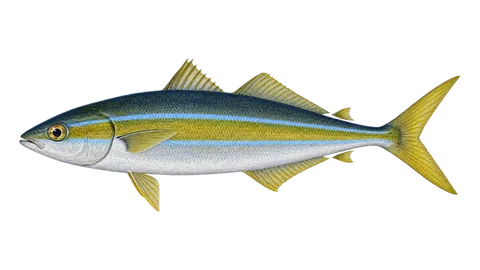
similar species
sources and references (5)
The season weights (months), the time of day and the sensitivities (cold, pressure, moon, wind, rain, tide, strong light, murky water and noise) are the app's editorial estimates, based on the literature below and on the field experience of anglers and guides. They are not official data nor a measurement made for this species, and they may vary by region and year. Closed seasons and legal rules appear in the rules section, with the norm and a link.
- scientific FishBase — Seriola rivoliana (ficha da espécie)Names, distribution, biology, length-weight relationship, country list and references. Page checked on Oct 13, 2026.
- official Portaria GM/MMA nº 1.667, de 27 de abril de 2026 — Lista Nacional Oficial de Espécies da Fauna Ameaçadas de Extinção (peixes e invertebrados aquáticos)Most recent national list. The species is not on it (search by scientific name in the text published in the DOU, checked on October 13, 2026).
- official ICMBio/SALVE — Ficha de Seriola rivoliana (avaliação nacional do risco de extinção)National assessment by ICMBio, published in 2023. DOI verified on Crossref.
- scientific IUCN Red List — Seriola rivoliana (avaliação global: Pouco Preocupante, LC, 21/08/2012)Global assessment. Link given on the FishBase entry (Red List, version 2025-2).
- scientific Carpenter, K. E. (org.) (2002). The living marine resources of the Western Central Atlantic. Vol. 3: Bony fishes part 2 (Opistognathidae to Molidae). FAO Species Identification Guide for Fishery Purposes. Roma: FAO.Chapter Carangidae (Smith-Vaniz, W. F.).
how we calculatewhere each number comes from
The weather comes from three independent global models, cross-checked hour by hour: when they agree, confidence goes up; when they diverge, the band between them shows on the chart. Beyond 16 days, we use the GEFS ensemble of 31 simulations: if 20 of the 31 predict rain, the chance of rain is 65%. Sun and moon are calculated astronomically, with no uncertainty.
The index adds up, weighted for each species: time of day (species curve anchored to real sunrise and sunset), moon (transits, rise and set, phase), pressure (3 h trend and 24 h swing), water temperature (in rivers, estimated from air temperature; at sea, estimated by an ocean model), wind, rain, clouds, tide and the month in the species' cycle.
sources for this lookup
how accurate the forecast is
Accuracy measured in the reference project (4 regions, 93 days, forecast vs. observed): maximum temperature is off by 0.6 °C on average the next day and 1.7 °C at 7 days; rain of 5 mm or more is detected 76% of the time the next day and 57% at 7 days. Detection isn't everything: the false alarm rate isn't published here yet, and 93 days in 4 regions is still a small sample. We now also measure every day, at the app's destinations: