


the right time
to be on the water
Choose the place and the species. The index, from 0 to 100, combines weather, sun, moon and tide with each fish's habits. Up to 28 days, with each day's confidence.
Loading the forecast…
—
hour by hour
slide your finger or mouse over the chart to see each hoursee hour-by-hour table
why this index at —?
choose the day
the fishing month at a glance
what's the best window for the crew?
Choose how many fishing days. We compare each stretch by its average index, discount days with a warning or closed season, and show the 3 best.
trend for the coming weeks
Line: the middle value of 31 simulations of the American GEFS model. Band: where 8 out of 10 fall. Narrow, firm trend; wide, high uncertainty.
everything about the tambacu
how to recognize it
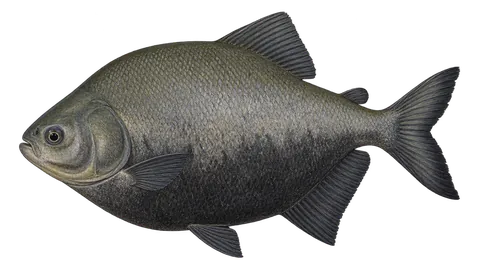
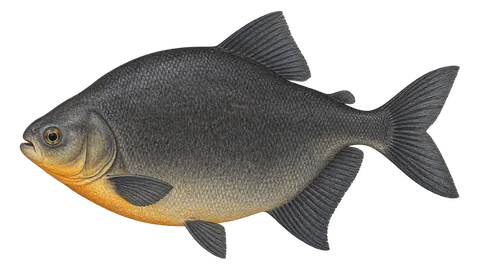
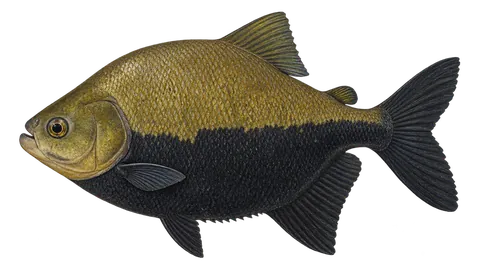
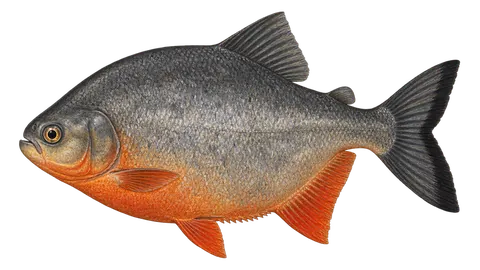
Tall, round body, between pacu and tambaqui. Head larger than the pacu's. Dark back; the lower flank and belly are darker than the pacu's, without the sharp, dark lower half of the tambaqui. In practice: if it isn't clearly a pacu (grey with a light belly) or a tambaqui, at a pay lake it is a tambacu. Only genetic testing confirms it.
Also called: tambacu, tambacu de pesqueiro
don't confuse with:
where found
open on the large mapWhere to look: Pay lake ponds, tanks and reservoirs; in rivers, near fish farms.
Pay lakes and fish farms in SP, MG, GO, MS, MT and PR. Escapes recorded in rivers and reservoirs of the Paraná, Paraguay, São Francisco and Tocantins-Araguaia basins.
introduced in
states
São Paulo, Minas Gerais, Goiás, Mato Grosso do Sul, Mato Grosso, Paraná
famous destinations
when to fish
best season
Warm months. In winter it eats little, especially in SP and southern MG.
best time of day
Daytime, with peaks at dawn and dusk. Feeds during the day; at pay lakes, feeding time with pellets and late afternoon are best.
what affects the tambacu
cold and cold fronts
Water below 22 °C reduces activity.
atmospheric pressure
Hot, muggy days are the best.
moon
Little effect.
rain
Cold rain slows activity; summer rain may activate it.
water level
Not very relevant at pay lakes.
noise
Used to people, but it spooks at a thump on the deck.
wind
Wind pushes the feed and concentrates the fish on the downwind bank.
depth
At the surface when it eats feed; mid-water and bottom in the cold.
how to fish
lures
- artificial EVA pellet
- rubber fruit lure
natural baits
- pellet feed
- feed dough
- fruit (guava, grape)
- green corn
tip from an angler
Groundbait float with feed and hook 20 to 40 cm away. Strike when the float moves off and hold the first run.
- rod
- 6' to 7', medium-heavy action, 17 to 40 lb
- spinning / baitcasting reel
- spinning reel 4000 to 5000 or baitcasting reel 200
- line
- monofilament 0.40 to 0.50 mm or braided 30 to 40 lb
- leader
- fluorocarbon or monofilament 50 to 60 lb
- hook
- 2/0 to 5/0 heavy, chinu or maruseigo type
accessories
- groundbait float
- alicate
- boga-grip
- large passaguá
catch and release
At pay lakes, follow the house rules. In rivers, don't return it: it is a hybrid outside its natural environment.
rules for the tambacu
Rules change; before keeping or transporting fish, check with the state environmental agency.
Releasing it into the natural environment without a license is an offense
releasing or introducing fish into rivers, reservoirs and lakes is prohibitedSPMGGOMSMTPRconfirm with the agency details
Introducing an exotic species, or one outside its natural range, without a technical opinion and a license is a federal environmental offense. This includes releasing a fish from a tank, pay lake or aquarium into a river or reservoir. In MG, the IEF states that stocking without a license is prohibited.
Source: Lei federal nº 9.605/1998, art. 31, and Decreto federal nº 6.514/2008, art. 25
MT: introducing an exotic species without a license carries a fine
fine of R$6,000 to R$100,000MT details
Mato Grosso's fishing law penalizes anyone who introduces native, exotic or non-native species without authorization from the environmental agency, with a surcharge per kilogram or per fish.
Source: Lei estadual MT nº 9.096/2009, art. 46 (as amended by Lei nº 12.197/2023) - Sema-MT
MS: tambacu (hybrid) outside the native-fish limit
specimens may be added to the limit, subject to the closed seasonMS details
In MS, tambacu (hybrid) is on the list of exotic, allochthonous and hybrid species whose specimens may be added to the angler's limit (1 native + 5 piranhas), subject to the closed season.
MT: catch and transport of exotics have their own rules
under Cepesca Resolution No. 02/2024MT details
Cepesca Resolution No. 02/2024 regulates the catch and transport of exotic fish in the rivers of the Paraguay, Amazon and Araguaia-Tocantins basins in MT. Check with Sema-MT on the municipalities and conditions before transporting.
Source: Resolução Cepesca-MT nº 02/2024 (cited in the official Sema-MT table of Jun 6, 2025)
Conservation: Risk of hybridization with native pacu if released into the wild.
how much it weighs without taking it out of the water
estimated weight
—
how we calculate
Length-weight relationship W = a·Lb (a = 0.0235, b = 3.0; estimado (média de pacu e tambaqui, FishBase)). It's an average: a fat or lean fish can vary by 10% to 20%.
more about the tambacu
Hybrid produced in fish farming by crossing a female tambaqui with a male pacu. Grows fast, tolerates cold better than the tambaqui, and became the base fish of pay lakes in the Center-South. Fights with strong, heavy runs. It doesn't exist in nature: when it turns up in a river, it has escaped from a tank or been released illegally. Because it is a hybrid of species that live in the Center-South, it can breed with native pacu and mix the genetics. Releasing tambacu into a river, lake or reservoir without a license is an environmental offense. At pay lakes, follow the house rules.
Family: Serrasalmidae · omnivore
fun facts
- It is made from a female tambaqui and a male pacu; the reverse cross is called paqui.
- It can be fertile, so releasing it threatens the genetics of the pacu.
in the kitchen
Fatty, tasty meat; ribs and belly grilled over coals.
similar species
sources and references (3)
The season weights (months), the time of day and the sensitivities (cold, pressure, moon, wind, rain, tide, strong light, murky water and noise) are the app's editorial estimates, based on the literature below and on the field experience of anglers and guides. They are not official data nor a measurement made for this species, and they may vary by region and year. Closed seasons and legal rules appear in the rules section, with the norm and a link.
- scientific FishBase — Colossoma macropomum (ficha do tambaqui, espécie parental)Tambacu is a captive hybrid and has no FishBase entry of its own. Page checked on Oct 13, 2026.
- scientific FishBase — Piaractus mesopotamicus (ficha do pacu, espécie parental)Tambacu is a captive hybrid and has no FishBase entry of its own. Page checked on Oct 13, 2026.
- scientific Hashimoto, D. T.; Senhorini, J. A.; Foresti, F.; Porto-Foresti, F. (2012). Interspecific fish hybrids in Brazil: management of genetic resources for sustainable use. Reviews in Aquaculture 4: 108–118.Fish farm hybrids in Brazil, including tambaqui and pacu crosses.
how we calculatewhere each number comes from
The weather comes from three independent global models, cross-checked hour by hour: when they agree, confidence goes up; when they diverge, the band between them shows on the chart. Beyond 16 days, we use the GEFS ensemble of 31 simulations: if 20 of the 31 predict rain, the chance of rain is 65%. Sun and moon are calculated astronomically, with no uncertainty.
The index adds up, weighted for each species: time of day (species curve anchored to real sunrise and sunset), moon (transits, rise and set, phase), pressure (3 h trend and 24 h swing), water temperature (in rivers, estimated from air temperature; at sea, estimated by an ocean model), wind, rain, clouds, tide and the month in the species' cycle.
sources for this lookup
how accurate the forecast is
Accuracy measured in the reference project (4 regions, 93 days, forecast vs. observed): maximum temperature is off by 0.6 °C on average the next day and 1.7 °C at 7 days; rain of 5 mm or more is detected 76% of the time the next day and 57% at 7 days. Detection isn't everything: the false alarm rate isn't published here yet, and 93 days in 4 regions is still a small sample. We now also measure every day, at the app's destinations: