

- common size
- 40–65 cm
- maximum
- 80 cm
- common weight
- 2–7 kg
- record/max.
- 10.0 kg
- depth
- 3–70 m
- ideal water
- 19–25 °C

the right time
to be on the water
Choose the place and the species. The index, from 0 to 100, combines weather, sun, moon and tide with each fish's habits. Up to 28 days, with each day's confidence.
Loading the forecast…
—
Looking for alerts within 30 km…
Looking for what anglers have logged near here…
what you need to fish herelicense, certification and boat documents
fish likely at this spot
Tap a fish to see its forecast.
hour by hour
slide your finger or mouse over the chart to see each hoursee hour-by-hour table
why this index at —?
choose the day
the fishing month at a glance
what's the best window for the crew?
Choose how many fishing days. We compare each stretch by its average index, discount days with a warning or closed season, and show the 3 best.
trend for the coming weeks
Line: the middle value of 31 simulations of the American GEFS model. Band: where 8 out of 10 fall. Narrow, firm trend; wide, high uncertainty.
everything about the sharpnose grouper
how to recognize it
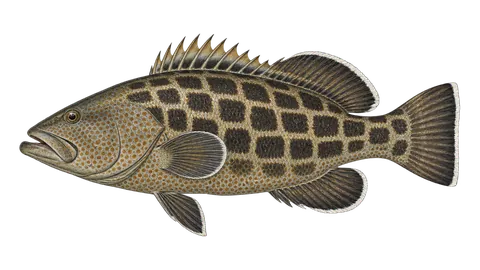
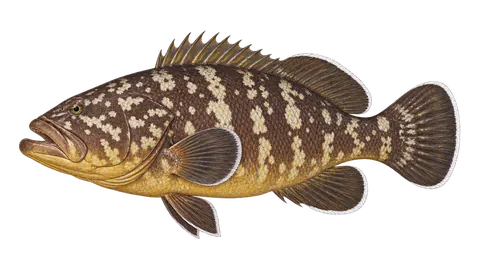
Elongated, compressed body, grayish brown, with irregular white spots and blotches. Three or four dark brown streaks run from the eye backwards and continue as wavy lines on the lower half of the body; another streak runs from the mouth corner to the edge of the preopercle. Dark fins with white spots. The badejo-quadrado has rectangular blotches; the true grouper (garoupa-verdadeira) has a deeper body and large pale spots.
Also called: badejo-mira, mira, saltão, badejete, serigado-tapoã, comb grouper
don't confuse with:
where found
open on the large mapWhere to look: Rocky shores, islands and rock bottoms with strong relief; juveniles in seagrass, mangroves and shallow reefs.
In Brazil it is a traditional fish of the rocky shores, islands and ledges of the Southeast and South.
coast
states
Espírito Santo, Rio de Janeiro, São Paulo, Paraná, Santa Catarina
when to fish
best season
In the Southeast and South, the clear water of late summer and autumn is usually the best time to find it. Since October 25, 2026, only for those who photograph and release.
best time of day
Daytime, with peaks at dawn and dusk. An ambush hunter by day, with peaks at dawn and dusk, near the rocks.
what affects the sharpnose grouper
cold and cold fronts
Cold upwelling shuts down activity on the rocky shores.
atmospheric pressure
Right after a cold front, with a churned sea, fishing drops off.
moon
Small effect; spring tides increase the current on the rocky shore.
rain
Not much relevant at sea; a storm on the rocky shore is dangerous.
water level
Surge muddies the water and stops rocky-shore fishing for days.
noise
Very sensitive to motor noise over shallow rock.
wind
Strong onshore wind makes the rocky shore dangerous and hampers drifting.
tide
Current at a rock corner brings bait and pulls the fish out of its hole.
depth
On the rocky shore, from 3 to 20 m; on ledges, down to about 50 m.
how to fish
lures
- jig 40 to 120 g
- jig head with shad
natural baits
- live sardine
- lula
- shrimp
tip from an angler
Since October 25, 2026, the badejo-mira may not be kept: if it takes your bait, bring it up quickly, remove the hook in the water and release it with a descender if there is barotrauma.
- rod
- shore: 9' to 11', 30 to 50 lb; boat: 6' to 6'6", 30 to 50 lb
- spinning / baitcasting reel
- spinning reel 6000 to 8000 or baitcasting reel 300
- line
- braid 40 to 65 lb
- leader
- fluorocarbon 60 to 80 lb
- hook
- circle 4/0 to 7/0, preferably barbless
accessories
- descender (fish descender)
- long-nose pliers
- luvas
catch and release
Release alive and quickly: bring the fish up without delay, remove the hook with the fish in the water and, if it comes from more than 15 m with barotrauma, release it with a descender. Do not puncture the swim bladder.
rules for the sharpnose grouper
Rules change; before keeping or transporting fish, check with the state environmental agency.
Endangered: catch, transport, and sale prohibited since October 25, 2026
catch prohibited since October 25, 2026North CoastNortheast CoastSoutheast CoastSouth Coast details
The badejo-mira entered the national list in 2026 as Endangered (EN). Under Portaria 1.666/2026, VU, EN and CR species have full protection: catch, transport, storage, processing and trade are prohibited. For species not on the previous list, the prohibitions apply 180 days after publication (April 28, 2026): they have been in force since October 25, 2026. Incidental catch: release alive immediately.
Source: Portaria GM/MMA nº 1.667/2026 (list); Portaria GM/MMA nº 1.666/2026, arts. 3º and 12
Minimum size of 23 cm until the prohibition takes effect
23 cm (TL)ESRJSPPRSCRS details
Until the national list prohibition takes effect, IN MMA 53/2005 prohibited fishing for, keeping on board and landing badejo-mira under 23 cm total length on the coast from Espírito Santo to Rio Grande do Sul (the rule does not apply to trawling). Since October 25, 2026, no specimen may be kept.
Source: Instrução Normativa MMA nº 53/2005, art. 2º and Annex I
Conservation: Entered the list in 2026; the prohibitions have applied since October 25, 2026 (Portaria 1.666/2026, art. 12). Global assessment: LC (IUCN, 2016).
how much it weighs without taking it out of the water
estimated weight
—
how we calculate
Length-weight relationship W = a·Lb (a = 0.01023, b = 3.03; FishBase (estimativa bayesiana para o gênero e o formato do corpo, comprimento total)). It's an average: a fat or lean fish can vary by 10% to 20%.
more about the sharpnose grouper
The badejo-mira is a medium-sized grouper of the western Atlantic, from Bermuda and the northwest Gulf of Mexico to Brazil. Juveniles live in seagrass beds, mangroves and shallow reefs; adults stay on rocky shores and rock bottoms with strong relief, from 3 to 70 m. It is a traditional species in rocky-shore, boat and spearfishing in the Southeast and South of Brazil, where specimens of 4 to 7 kg are common. In 2026 it was added to the national list of threatened species as Endangered. Since it was not on the previous list, the ban on catch, transport and trade started 180 days after publication, on October 25, 2026. Since then, if you catch one, release it alive.
Family: Epinephelidae · predator
fun facts
- FishBase considers the 4 kg maximum weight given in old sources too low: in southern Brazil, fish of 4 to 7 kg are common.
- The spearfishing record cited by FishBase is 10.1 kg.
in the kitchen
White, highly prized flesh, but since October 25, 2026 the species may not be kept.
similar species
sources and references (7)
The season weights (months), the time of day and the sensitivities (cold, pressure, moon, wind, rain, tide, strong light, murky water and noise) are the app's editorial estimates, based on the literature below and on the field experience of anglers and guides. They are not official data nor a measurement made for this species, and they may vary by region and year. Closed seasons and legal rules appear in the rules section, with the norm and a link.
- scientific FishBase — Mycteroperca acutirostris (ficha da espécie)Names, distribution, biology, length-weight relationship, country list and references. Page checked on Oct 13, 2026.
- official Portaria GM/MMA nº 1.667, de 27 de abril de 2026 — Lista Nacional Oficial de Espécies da Fauna Ameaçadas de Extinção (peixes e invertebrados aquáticos)The species is listed as EN (verified in the text published in the DOU of April 28, 2026, section 1, p. 96). Marked with an asterisk in the annex, like the species added to the list in 2026.
- official Portaria GM/MMA nº 1.666, de 27 de abril de 2026 — regras e restrições para as espécies ameaçadas de peixes e invertebrados aquáticosArts. 3, 11 and 12: full protection for threatened species; current recovery plans remain in force during the review; for species newly added to the list, the prohibitions start 180 days after publication.
- official Instrução Normativa MMA nº 53, de 22 de novembro de 2005 — tamanho mínimo de captura de espécies marinhas e estuarinas do litoral Sudeste e SulAnnex I: badejo-mira (Mycteroperca acutirostris), 23 cm total length, from Espírito Santo to Rio Grande do Sul. Text checked October 13, 2026.
- official ICMBio/SALVE — Ficha de Mycteroperca acutirostris (avaliação nacional do risco de extinção)National assessment by ICMBio, published in 2024. DOI verified on Crossref.
- scientific IUCN Red List — Mycteroperca acutirostris (avaliação global: Pouco Preocupante, LC, 20/11/2016)Global assessment. Link given on the FishBase entry (Red List, version 2025-2).
- scientific Heemstra, P. C.; Randall, J. E. (1993). FAO species catalogue. Vol. 16. Groupers of the world (family Serranidae, subfamily Epinephelinae). FAO Fisheries Synopsis 125(16). Roma: FAO.
how we calculatewhere each number comes from
The weather comes from three independent global models, cross-checked hour by hour: when they agree, confidence goes up; when they diverge, the band between them shows on the chart. Beyond 16 days, we use the GEFS ensemble of 31 simulations: if 20 of the 31 predict rain, the chance of rain is 65%. Sun and moon are calculated astronomically, with no uncertainty.
The index adds up, weighted for each species: time of day (species curve anchored to real sunrise and sunset), moon (transits, rise and set, phase), pressure (3 h trend and 24 h swing), water temperature (in rivers, estimated from air temperature; at sea, estimated by an ocean model), wind, rain, clouds, tide and the month in the species' cycle.
sources for this lookup
how accurate the forecast is
Accuracy measured in the reference project (4 regions, 93 days, forecast vs. observed): maximum temperature is off by 0.6 °C on average the next day and 1.7 °C at 7 days; rain of 5 mm or more is detected 76% of the time the next day and 57% at 7 days. Detection isn't everything: the false alarm rate isn't published here yet, and 93 days in 4 regions is still a small sample. We now also measure every day, at the app's destinations: