overview
who is the smallmouth bass
Elongated centrarchid, a cousin of the largemouth bass (Micropterus salmoides), but typical of colder, clearer waters with rock and gravel bottoms. It is native to eastern North America, the Great Lakes, and the Mississippi basin, and has been moved to many countries for sport fishing. FishBase records introductions in Mexico (1975, established population) and Belize (1969, probably established), and Conabio treats it as an exotic species present in Mexico, with invasion risk rated very high in 2017. It occupies stretches of flowing river and clear, deep lakes, where it hunts crayfish, insects, and fish and shelters among rocks. Males build nests on sand, gravel, or rock bottoms and guard eggs and fry. It reaches 69 cm and 5.4 kg and can live 26 years, but the common fish caught measures 25 to 45 cm. We found no current source on populations or targeted fishing for the species in Mexico or Belize.
fun facts
- A successful nest can produce from 1,000 to more than 5,000 young, guarded by the male until they disperse.
- It can live more than 20 years: FishBase records a maximum age of 26 years.
- Conabio's assessment notes that, as a voracious predator, the species can reduce native fish and affect recreational fishing.
how to recognize it
identification
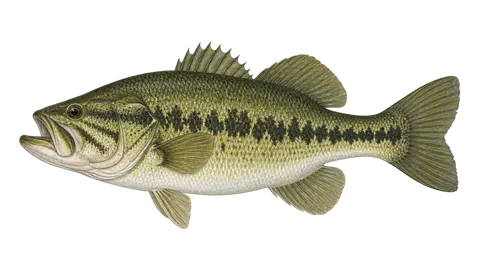
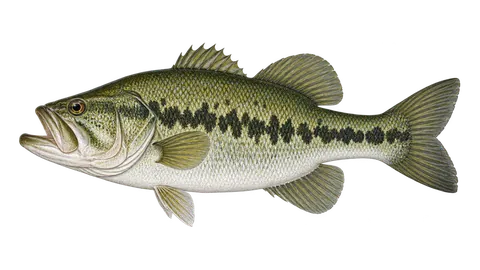
Elongated, slightly compressed body, olive-green to bronze on the back and yellowish white below, with 9 to 16 brown vertical bars on the flanks and an orange-red eye. The mouth is large, but the maxilla reaches at most to below the eye, and the two dorsal fin parts have only a shallow notch between them. The largemouth bass (M. salmoides) has a continuous dark lateral stripe, a larger mouth, and a deep notch between the dorsal fins; the spotted bass (M. punctulatus) also has a lateral stripe.
how smallmouth bass fishing looks
Loading the next 7 days…
Each card shows the day's index (0 to 100) and, below it, a strip with the index for each hour, from 0h to 23h. from poor to excellent.