Skip to content
catalog Xiphiidae · predator

swordfish

Xiphias gladius

SeaIUCN global: NT · near threatened

The swordfish, with a flat, long bill like a sword. It descends to hundreds of meters by day and rises at night; a target of longline and of night and deep-water sport fishing.

Also called: espadarte, meca, agulhão-espadarte, swordfish

Scientific illustration of Swordfish
common size
150–300 cm
maximum
455 cm
common weight
40–150 kg
record/max.
650.0 kg
depth
0–550 m
ideal water
18–22 °C
overview

who is the swordfish

The espadarte, or swordfish, is the only member of the family Xiphiidae: an oceanic fish with a long, flat bill, no pelvic fins, and no scales as an adult, exceeding 4 m and hundreds of kilograms. It lives in all oceans, from tropical to temperate waters, and makes long migrations. It descends to great depths by day and rises near the surface at night, hunting fish and squid, which it can strike with its bill. Large fish accumulate a lot of mercury in their flesh. In Brazil it is a traditional target of pelagic longline, and the South Atlantic stock is managed by ICCAT. Sport fishing is done at night, with squid baits drifting, or by day, with baits hundreds of meters deep.

fun facts

  • Adults have no scales or pelvic fins.
  • Warms its eyes and brain with a special tissue, which helps it hunt in cold, dark water.
how to recognize it

identification

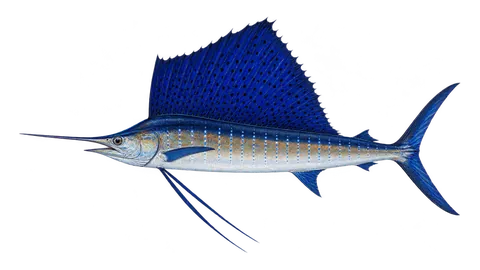
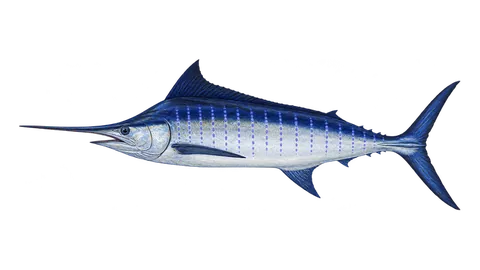
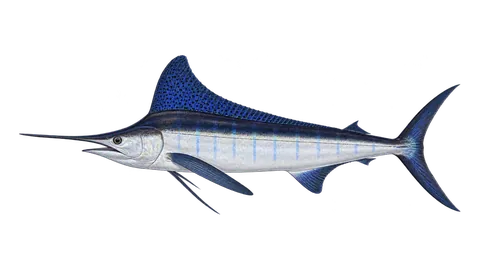
Elongated, rounded body, no scales as an adult, dark brown to black on the back, fading toward the belly. Long, flat, smooth bill, like a blade. Tall, stiff first dorsal fin that does not fold down; no pelvic fins; a single large keel on each side of the tail base. Differs from the marlins and the sailfish, which have a round bill and pelvic fins.

how swordfish fishing looks

Loading the next 7 days…

Each card shows the day's index (0 to 100) and, below it, a strip with the index for each hour, from 0h to 23h. from poor to excellent.

distribution

where found

open on the large map

Open sea along the whole coast, over the slope, seamounts, and oceanic fronts.

Habitat: Open sea and slope; by day at great depths, at night near the surface; thermal fronts and seamounts.

coast

North CoastNortheast CoastSoutheast CoastSouth Coastoceanic

states

Amapá, Pará, Maranhão, Piauí, Ceará, Rio Grande do Norte, Paraíba, Pernambuco, Alagoas, Sergipe, Bahia, Espírito Santo, Rio de Janeiro, São Paulo, Paraná, Santa Catarina, Rio Grande do Sul

calendar and clock

when to fish

best season

time of year
JanFebSeaAprMayJunJulAugSepOctNovDec

Present all year in open sea; trips depend on calm seas.

best time of day

0h6h12h18h sunrise ~6amsunset ~6pm

Nighttime. At night it rises to hunt near the surface; by day it stays hundreds of meters down.

weather, water and behavior

what affects the swordfish
sensitivity The little bars show how much each factor affects this species. Five full: it feels it a lot.

cold and cold fronts

Tolerates cold water at depth.

atmospheric pressure

A cold front brings rough seas.

moon

On full-moon nights, night hunting tends to be deeper; dark nights are preferred for surface fishing.

rain

Not very sensitive.

water level

Follows thermal fronts and slope breaks.

noise

Not very sensitive in open sea.

wind

Rough seas prevent drift fishing.

tide

No significant tide in the ocean; current is what matters.

depth

By day, 300 m or more; at night, 0 to 100 m.

technique, gear and bait

how to fish

rod
stand-up 50 to 80 lb or deep drop rod
spinning / baitcasting reel
50 to 80 lb baitcaster or electric reel (deep drop)
line
braided 80 to 130 lb or monofilament 80 lb
leader
monofilament 200 to 300 lb, 5 to 10 m
hook
circle 10/0 to 14/0

lures

  • silicone squid with light

natural baits

  • whole squid
  • whole mackerel or bonito

accessories

  • chemical light or depth LED
  • 2 to 6 kg sinker with breakaway line (deep drop)
  • fighting belt and harness
  • bicheiro
  • luvas

tip from an angler

At night, drift with baits at several depths and chemical light near the hook; the bite usually comes as a sudden slack in the line.

what the law says

rules for the swordfish

Summary of the regulations we found, with the source for each. Rules change; before keeping or transporting fish, check with the state environmental agency.
Conservation: Not on the national list (Portaria GM/MMA 1.667/2026). Global assessment: Near Threatened (IUCN, 2021). The South Atlantic stock is managed by ICCAT.

Minimum size 125 cm or 25 kg

125 cm (lower jaw to fork) or 25 kgNorth CoastNortheast CoastSoutheast CoastSouth Coastconfirm with the agency

Catching swordfish is prohibited on the Brazilian coast when weighing less than 25 kg or measuring less than 125 cm, measured from the lower jaw to the tail fork. The ordinance tolerates up to 15% of fish below the size limit in the total catch. We have not found an act that revokes it, but confirm that it is in force with the competent agency.
Source: Portaria IBAMA nº 56, of Aug 2, 1995, art. 1º

catch and release
catch and release Releasing the fish alive, quickly and with a wet hand. During a closed season it isn't always allowed: what the regulation says applies.

Release it in the water, without bringing it aboard: cut the leader near the hook if you cannot remove it safely. The bill can injure: never hold it by the bill while the fish is still active.

in the kitchen

Firm flesh, excellent in grilled steaks. Large fish accumulate mercury, so consumption should be moderate, especially for pregnant women and children.

calculator

how much it weighs without taking it out of the water

Length-weight relationship W = a·Lb (a = 0.0038, b = 3.14; FishBase (estimativa bayesiana por forma do corpo na família, comprimento total)). It's an average: a fat or lean fish can vary by 10% to 20%.

estimated weight

—

sources and references

The season weights (months), the time of day and the sensitivities (cold, pressure, moon, wind, rain, tide, strong light, murky water and noise) are the app's editorial estimates, based on the literature below and on the field experience of anglers and guides. They are not official data nor a measurement made for this species, and they may vary by region and year. Closed seasons and legal rules appear in the rules section, with the norm and a link.

  1. scientific FishBase — Xiphias gladius (ficha da espécie)Names, distribution, biology, length-weight relationship and references. Page checked on October 13, 2026.
  2. official Portaria GM/MMA nº 1.667, de 27 de abril de 2026 — Lista Nacional Oficial de Espécies da Fauna Ameaçadas de Extinção (peixes e invertebrados aquáticos)Most recent national list. The species is not on it (search by scientific name in the text published in the DOU, checked on October 13, 2026).
  3. official ICMBio/SALVE — Ficha de Xiphias gladius (avaliação nacional do risco de extinção)ICMBio national assessment, published in 2026. DOI checked on Crossref.
  4. scientific IUCN Red List — Xiphias gladius (avaliação global: Quase Ameaçada, NT, 01/05/2021)Global assessment. Link given on the FishBase entry (Red List, version 2025-2).
  5. official Portaria IBAMA nº 56, de 2 de agosto de 1995 — tamanho mínimo de captura do espadarteCopy of the text in Cetesb's legislation repository, checked October 13, 2026.
  6. scientific Nakamura, I. (1985). FAO species catalogue. Vol. 5. Billfishes of the world. FAO Fisheries Synopsis 125(5). Roma: FAO.
  7. technical ICCAT Manual, cap. 2.1.9 — Swordfish (Xiphias gladius). International Commission for the Conservation of Atlantic Tunas.Biology and fishery of the species in the Atlantic.
  8. scientific Figueiredo, J. L.; Menezes, N. A. (2000). Manual de peixes marinhos do sudeste do Brasil. VI. Teleostei (5). São Paulo: Museu de Zoologia da USP. 116 p.Printed work; the URL is the bibliographic record on FishBase, which cites this work for the species.
don't confuse

similar species