

chilean jack mackerel
Trachurus murphyi
The South Pacific jack mackerel, the base of one of the world's largest fisheries. It comes to schools near the piers and rocks of Chile and Peru and takes jigs, sabiki and natural bait.
- common size
- 25–45 cm
- maximum
- 70 cm
- common weight
- 0.2–1 kg
- record/max.
- 2.7 kg
- depth
- 0–70 m
- ideal water
- 15–20 °C
how to recognize it
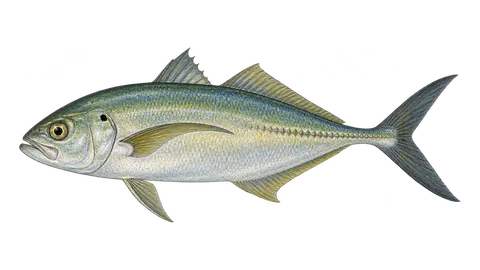
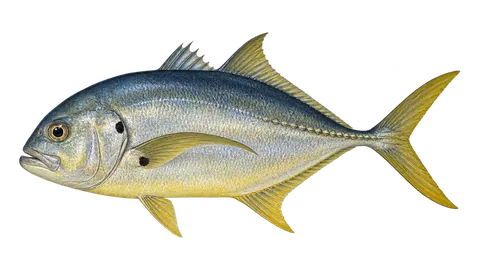
Elongated, slightly compressed body, metallic blue or dark gray back, silvery flanks and belly. Black spot on the upper edge of the gill cover. Lateral line fully covered in scales, which become large, hard scutes at the rear. Long, sickle-shaped pectoral fin; darkened fins. Differs from the xerelete and the greater amberjack in its slimmer body and the line of scutes along the whole lateral line.
Also called: jurel-chileno, jurel, carapau-chileno
don't confuse with:
where found
open on the large mapWhere to look: From the coast to open sea, in schools; comes close to jetties, piers, bays and rocky points when the water and bait favor it.
Does not occur in Brazil. South Pacific, mainly off Peru and Chile, with records from Ecuador, southern Argentina and New Zealand.
when to fish
next 7 days
Loading the next 7 days…
best season
The arrival of schools on the coast varies greatly from year to year with sea temperature and El Niño; in central Chile it is usually better in summer and autumn.
best time of day
Daytime, with peaks at dawn and dusk. Bites by day, with peaks at dawn and late afternoon; at night, light on the water attracts the schools.
what affects the chilean jack mackerel
cold and cold fronts
Strong changes in sea temperature shift the schools.
atmospheric pressure
Rough sea hurts jetty and rock fishing.
moon
Dark nights favor light fishing.
rain
Little effect at sea.
water level
Not applicable at sea.
noise
Not very sensitive when the school is feeding.
wind
Strong wind makes casting light lures difficult.
tide
Moving tide and current at jetty points concentrate the schools.
depth
From the surface to 30 m in amateur fishing.
how to fish
lures
- sabiki
- metal jig, 20 to 60 g
- colherinha
natural baits
- anchoveta in pieces
- squid strips
- shrimp
tip from an angler
When the school comes close, a sabiki with a jig on the end can bring in several fish at once; respect the minimum size and release the small ones.
- rod
- 2.4 to 3.6 m for jetty and rock, or 6'6" to 7'0" from a boat, 10 to 20 lb
- spinning / baitcasting reel
- spinning reel 2500 to 4000
- line
- braid 12 to 20 lb or monofilament 0.25 to 0.30 mm
- leader
- fluorocarbon 0.30 to 0.40 mm
- hook
- hooks sizes 2 to 2/0; sabiki for schools
accessories
- alicate
- bucket with ice
catch and release
It handles release well if done quickly: remove the hook in the water or with the fish wet, and let it go right away.
rules for the chilean jack mackerel
Rules change; before keeping or transporting fish, check with the state environmental agency.
Peru: minimum size 31 cm
31 cm (total length) details
In Peru the minimum catch size for jack mackerel is 31 cm total length, the value from R.M. nº 209-2001-PE, which also appears in the current Ministry of Production table. It is prohibited to extract, transport and sell below the size.
Source: R.M. nº 209-2001-PE, Annex I (Peru); PRODUCE minimum size table
Chile: minimum size 26 cm (fork length)
26 cm (fork length)confirm with the agency details
In Chile the minimum extraction size for jack mackerel is 26 cm fork length, set by D.S. nº 458/1981, according to a technical report from the Subsecretaría de Pesca (Subpesca). The report dates from 2012 and discusses revising the measure; we have not confirmed later changes for recreational fishing.
Source: D.S. nº 458/1981 (Chile Ministry of Economy), per Technical Report R.PESQ. nº 107/2012 of Subpesca
Conservation: Old global assessment. The South Pacific stock is managed by SPRFMO, with annual quotas for industrial fishing.
how much it weighs without taking it out of the water
estimated weight
—
how we calculate
Length-weight relationship W = a·Lb (a = 0.01122, b = 2.92; FishBase (estimativa bayesiana com dados da espécie e do gênero, comprimento total); peso máximo calculado por esta relação). It's an average: a fat or lean fish can vary by 10% to 20%.
more about the chilean jack mackerel
The Chilean jack mackerel is a carangid of the genus Trachurus, the genus of the jack mackerels, which lives in the South Pacific, mainly off Peru and Chile, with records from Ecuador, New Zealand and southern Argentina. It forms large schools from the coast out to open sea and eats fish larvae and small crustaceans. It reaches 70 cm and lives up to 16 years, but the usual size near the coast is well below that. It supports an enormous industrial purse-seine fishery, for human consumption and fishmeal, managed in international waters by the South Pacific Regional Fisheries Management Organisation (SPRFMO). For amateur anglers, it turns up at jetties, piers and rocks when the schools come close, and from boats with jigs.
Family: Carangidae · predator
fun facts
- It can live up to 16 years.
- The bony scutes on the rear of the lateral line are hard and sharp: hold the fish with a cloth.
in the kitchen
Dark, oily, tasty flesh; fried, grilled, pickled and widely canned.
similar species
sources and references (5)
The season weights (months), the time of day and the sensitivities (cold, pressure, moon, wind, rain, tide, strong light, murky water and noise) are the app's editorial estimates, based on the literature below and on the field experience of anglers and guides. They are not official data nor a measurement made for this species, and they may vary by region and year. Closed seasons and legal rules appear in the rules section, with the norm and a link.
- scientific FishBase — Trachurus murphyi (ficha da espécie)Names, distribution, biology, length-weight relationship, country list and references. Page checked on Oct 13, 2026.
- scientific IUCN Red List — Trachurus murphyi (avaliação global: Dados Insuficientes, DD, 30/04/2008)Global assessment. Link given on the FishBase entry (Red List, version 2025-2).
- official Resolução Ministerial nº 209-2001-PE (Peru) — tamanhos mínimos de captura e tolerância de juvenis dos principais peixes marinhosCopy of the original text in the FAOLEX database, checked on 13/10/2026. Several values in Annex I were later changed by specific resolutions.
- official Ministério da Produção do Peru (PRODUCE) — Pesca y Consumo Responsable: tallas mínimas de capturaOfficial minimum size table for consumers, checked on 13/10/2026. The page does not indicate the rule behind each value.
- official Subpesca (Chile) — Informe Técnico R.PESQ. nº 107/2012: revisão da talla mínima do jurelTechnical report from the Subsecretaría de Pesca y Acuicultura, checked on 13/10/2026. Cites D.S. nº 458/1981, with a minimum size of 26 cm fork length.