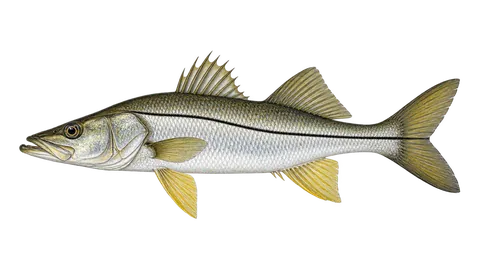
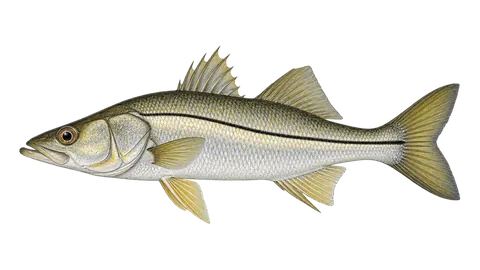
striped bass
Morone saxatilis
Anadromous predator with dark, continuous stripes along its flanks, native to the east coast of North America and one of its major sport-fishing targets. FishBase lists it as introduced in Mexico, Ecuador and Argentina, with no confirmed sport fishing in those countries.
Also called: robalo-listrado, striped bass, striper, rockfish

- common size
- 50–100 cm
- maximum
- 200 cm
- common weight
- 1.5–12 kg
- record/max.
- 57.0 kg
- depth
- 0–30 m
- ideal water
- 12–20 °C
who is the striped bass
The striped bass is an anadromous fish of the Atlantic coast of North America, from the St. Lawrence River in Canada to Lake Pontchartrain in Louisiana, and south to the rivers of Florida. Adults live in coastal waters and bays and enter rivers in spring to spawn; some populations are landlocked in lakes and reservoirs. It is a voracious, opportunistic predator: it eats fish (shad, herring, eels, flounder), squid, crabs and marine worms. It reaches 200 cm and 57 kg and lives up to 30 years. FishBase records introductions in Mexico (1886), in Ecuador and, less certainly, in Argentina (Entre Ríos), all with no reported ecological effects. We found no source confirming sport fishing for the species in those countries: the classic striped bass fishery is on the east coast of the USA and Canada.
fun facts
- Anadromous: lives at sea and runs up rivers to spawn, and feeding stops shortly before spawning (FishBase).
- NOAA gives 5 feet (about 152 cm) and 77 pounds (about 35 kg) as the maximum size; FishBase gives 200 cm and 57 kg.
- In the US, federal waters (3 to 200 miles) are closed to commercial and recreational striped bass fishing (NOAA).
identification
Robust, fusiform body with seven to eight dark, continuous, horizontal stripes from the operculum to the tail, olive-green, steel-blue or dark back and a silvery-white belly. Two well-separated dorsal fins, the first with spines. The Brazilian robalo (Centropomus) has a dark lateral line that reaches the tip of the tail and a taller first dorsal fin; the white perches (Morone chrysops and M. mississippiensis) are smaller and have broken stripes.
Loading the next 7 days…
Each card shows the day's index (0 to 100) and, below it, a strip with the index for each hour, from 0h to 23h. from poor to excellent.
where found
Native to the western Atlantic, from the St. Lawrence River (Quebec, Canada) to Lake Pontchartrain (Louisiana) and south through Florida, to the St. Johns and Suwannee rivers (FishBase). It does not occur in Brazil. FishBase lists it as introduced in Mexico (1886, established), Ecuador (1975 to 1999, established) and Argentina (Entre Ríos, probably established).
Habitat: Coastal waters, bays, estuaries and rivers during spawning, almost always shallow, over sand, gravel and rock bottoms. Some populations are landlocked in lakes and reservoirs.
when to fish
best season
On the US East Coast, fishing is in spring and fall: adults run up rivers in spring to spawn (feeding stops just before) and migrate along the coast in fall. In summer they stay in deeper, colder water.
best time of day
Night and twilight. Feeds at dawn, in the late afternoon and at night; during the day it stays in deeper, shaded water.
what affects the striped bass
sensitivity The little bars show how much each factor affects this species. Five full: it feels it a lot.
cold and cold fronts
Temperate-water species (8 to 25 °C, according to FishBase): outside that range, activity drops.
atmospheric pressure
A pressure drop ahead of a front tends to fire up the bite; after the front, the fish get harder to catch.
moon
Full and new moons bring bigger tides and strong currents at bars and river mouths, which are the fishing spots.
rain
Light rain doesn't hurt; runoff from heavy rain muddies the estuary.
water level
Doesn't apply at sea. The equivalent is the tide and the current at bars and river mouths.
noise
A wary fish that moves away from noise in shallow water: be quiet in the surf and on the flats.
wind
A bit of surf in front of the beach helps; wind that is too strong prevents casting and bait presentation.
tide
Fishing concentrates on the moving tide, at river mouths and bars, where the current carries the bait.
depth
Shallow, 0 to 30 m in most cases; in summer it moves into deeper water.
how to fish
- rod
- 7' to 9' medium-heavy for boat and plugs; 9' to 11' for surf, 15 to 40 lb
- spinning / baitcasting reel
- spinning reel 4000 to 8000 or low-profile baitcasting reel, with good line capacity
- line
- braided line 20 to 50 lb
- leader
- fluorocarbon 30 to 60 lb, 1 to 1.5 m
- hook
- circle hook 4/0 to 8/0 for natural bait; reinforced treble hooks on plugs
lures
- surface and mid-water plug, 15 to 20 cm
- lead jig, 30 to 80 g
- silicone soft-plastic lure with lead head
- umbrella rig, trolled
natural baits
- live or dead eel
- sardine or anchovy
- minhoca-do-mar
- shrimp
accessories
- long-nose pliers
- boga-grip
- luvas
tip from an angler
Look for bars, river mouths and sandy points on a rising or falling tide, and fish at dawn, late afternoon or at night.
rules for the striped bass
Summary of the regulations we found, with the source for each. Rules change; before keeping or transporting fish, check with the state environmental agency.
Conservation: It does not occur in Brazil, so it is not on the national list (Portaria GM/MMA nº 1.667/2026). The IUCN rates it Least Concern (2019 assessment). In the US, NOAA reports that the Atlantic stock is overfished but not undergoing overfishing, per the 2024 assessment. We found no specific fishing rule for the species in Mexico, Ecuador or Argentina; in the US and Canada, rules vary by state and by year.
We found no species-specific rule beyond the region's general rules.
catch and release
catch and release Releasing the fish alive, quickly and with a wet hand. During a closed season it isn't always allowed: what the regulation says applies.
A high-value sport species, now overfished in the US: release it. Use barbless circle hooks, wet your hands before touching the fish, keep it in the water, avoid holding it vertically by the jaw, and release it facing into the current.
in the kitchen
Eaten fresh, grilled or baked, according to FishBase.
how much it weighs without taking it out of the water
Length-weight relationship W = a·Lb (a = 0.00933, b = 3.05; FishBase (relação peso-comprimento bayesiana, estimativa da própria espécie)). It's an average: a fat or lean fish can vary by 10% to 20%.
estimated weight
—
sources and references
The season weights (months), the time of day and the sensitivities (cold, pressure, moon, wind, rain, tide, strong light, murky water and noise) are the app's editorial estimates, based on the literature below and on the field experience of anglers and guides. They are not official data nor a measurement made for this species, and they may vary by region and year. Closed seasons and legal rules appear in the rules section, with the norm and a link.
- scientific FishBase: Morone saxatilis (ficha da espécie)Size, length-weight, depth, habitat, distribution, biology, and IUCN status. Page checked on Oct 13, 2026.
- scientific FishBase: nomes populares de Morone saxatilisNames by country and language.
- scientific FishBase: introduções de Morone saxatilisIntroduction records in Mexico (1886), Ecuador (1975 to 1999) and Argentina (Entre Ríos). FishBase does not report the purpose of the introductions. Page checked on Oct 13, 2026.
- official NOAA Fisheries: Atlantic Striped BassAppearance, anadromous migration, diet, maximum size, stock status (2024) and US rules. Page checked on Oct 13, 2026.
- scientific IUCN Red List: Morone saxatilis (avaliação global: Pouco Preocupante, 2019)Search of the Red List by scientific name; classification per FishBase (version 2025-2).