

- common size
- 50–100 cm
- maximum
- 200 cm
- common weight
- 1.5–12 kg
- record/max.
- 57.0 kg
- depth
- 0–30 m
- ideal water
- 12–20 °C

the right time
to be on the water
Choose the place and the species. The index, from 0 to 100, combines weather, sun, moon and tide with each fish's habits. Up to 28 days, with each day's confidence.
Loading the forecast…
—
Looking for alerts within 30 km…
Looking for what anglers have logged near here…
what you need to fish herelicense, certification and boat documents
fish likely at this spot
Tap a fish to see its forecast.
hour by hour
slide your finger or mouse over the chart to see each hoursee hour-by-hour table
why this index at —?
choose the day
the fishing month at a glance
what's the best window for the crew?
Choose how many fishing days. We compare each stretch by its average index, discount days with a warning or closed season, and show the 3 best.
trend for the coming weeks
Line: the middle value of 31 simulations of the American GEFS model. Band: where 8 out of 10 fall. Narrow, firm trend; wide, high uncertainty.
everything about the striped bass
how to recognize it
Robust, fusiform body with seven to eight dark, continuous, horizontal stripes from the operculum to the tail, olive-green, steel-blue or dark back and a silvery-white belly. Two well-separated dorsal fins, the first with spines. The Brazilian robalo (Centropomus) has a dark lateral line that reaches the tip of the tail and a taller first dorsal fin; the white perches (Morone chrysops and M. mississippiensis) are smaller and have broken stripes.
Also called: robalo-listrado, striped bass, striper, rockfish
don't confuse with:
where found
open on the large mapWhere to look: Coastal waters, bays, estuaries and rivers during spawning, almost always shallow, over sand, gravel and rock bottoms. Some populations are landlocked in lakes and reservoirs.
Native to the western Atlantic, from the St. Lawrence River (Quebec, Canada) to Lake Pontchartrain (Louisiana) and south through Florida, to the St. Johns and Suwannee rivers (FishBase). It does not occur in Brazil. FishBase lists it as introduced in Mexico (1886, established), Ecuador (1975 to 1999, established) and Argentina (Entre Ríos, probably established).
when to fish
best season
On the US East Coast, fishing is in spring and fall: adults run up rivers in spring to spawn (feeding stops just before) and migrate along the coast in fall. In summer they stay in deeper, colder water.
best time of day
Night and twilight. Feeds at dawn, in the late afternoon and at night; during the day it stays in deeper, shaded water.
what affects the striped bass
cold and cold fronts
Temperate-water species (8 to 25 °C, according to FishBase): outside that range, activity drops.
atmospheric pressure
A pressure drop ahead of a front tends to fire up the bite; after the front, the fish get harder to catch.
moon
Full and new moons bring bigger tides and strong currents at bars and river mouths, which are the fishing spots.
rain
Light rain doesn't hurt; runoff from heavy rain muddies the estuary.
water level
Doesn't apply at sea. The equivalent is the tide and the current at bars and river mouths.
noise
A wary fish that moves away from noise in shallow water: be quiet in the surf and on the flats.
wind
A bit of surf in front of the beach helps; wind that is too strong prevents casting and bait presentation.
tide
Fishing concentrates on the moving tide, at river mouths and bars, where the current carries the bait.
depth
Shallow, 0 to 30 m in most cases; in summer it moves into deeper water.
how to fish
lures
- surface and mid-water plug, 15 to 20 cm
- lead jig, 30 to 80 g
- silicone soft-plastic lure with lead head
- umbrella rig, trolled
natural baits
- live or dead eel
- sardine or anchovy
- minhoca-do-mar
- shrimp
tip from an angler
Look for bars, river mouths and sandy points on a rising or falling tide, and fish at dawn, late afternoon or at night.
- rod
- 7' to 9' medium-heavy for boat and plugs; 9' to 11' for surf, 15 to 40 lb
- spinning / baitcasting reel
- spinning reel 4000 to 8000 or low-profile baitcasting reel, with good line capacity
- line
- braided line 20 to 50 lb
- leader
- fluorocarbon 30 to 60 lb, 1 to 1.5 m
- hook
- circle hook 4/0 to 8/0 for natural bait; reinforced treble hooks on plugs
accessories
- long-nose pliers
- boga-grip
- luvas
catch and release
A high-value sport species, now overfished in the US: release it. Use barbless circle hooks, wet your hands before touching the fish, keep it in the water, avoid holding it vertically by the jaw, and release it facing into the current.
rules for the striped bass
Rules change; before keeping or transporting fish, check with the state environmental agency.
We found no species-specific rule beyond the region's general rules.
Conservation: It does not occur in Brazil, so it is not on the national list (Portaria GM/MMA nº 1.667/2026). The IUCN rates it Least Concern (2019 assessment). In the US, NOAA reports that the Atlantic stock is overfished but not undergoing overfishing, per the 2024 assessment. We found no specific fishing rule for the species in Mexico, Ecuador or Argentina; in the US and Canada, rules vary by state and by year.
how much it weighs without taking it out of the water
estimated weight
—
how we calculate
Length-weight relationship W = a·Lb (a = 0.00933, b = 3.05; FishBase (relação peso-comprimento bayesiana, estimativa da própria espécie)). It's an average: a fat or lean fish can vary by 10% to 20%.
more about the striped bass
The striped bass is an anadromous fish of the Atlantic coast of North America, from the St. Lawrence River in Canada to Lake Pontchartrain in Louisiana, and south to the rivers of Florida. Adults live in coastal waters and bays and enter rivers in spring to spawn; some populations are landlocked in lakes and reservoirs. It is a voracious, opportunistic predator: it eats fish (shad, herring, eels, flounder), squid, crabs and marine worms. It reaches 200 cm and 57 kg and lives up to 30 years. FishBase records introductions in Mexico (1886), in Ecuador and, less certainly, in Argentina (Entre Ríos), all with no reported ecological effects. We found no source confirming sport fishing for the species in those countries: the classic striped bass fishery is on the east coast of the USA and Canada.
Family: Moronidae · predator
fun facts
- Anadromous: lives at sea and runs up rivers to spawn, and feeding stops shortly before spawning (FishBase).
- NOAA gives 5 feet (about 152 cm) and 77 pounds (about 35 kg) as the maximum size; FishBase gives 200 cm and 57 kg.
- In the US, federal waters (3 to 200 miles) are closed to commercial and recreational striped bass fishing (NOAA).
in the kitchen
Eaten fresh, grilled or baked, according to FishBase.
similar species
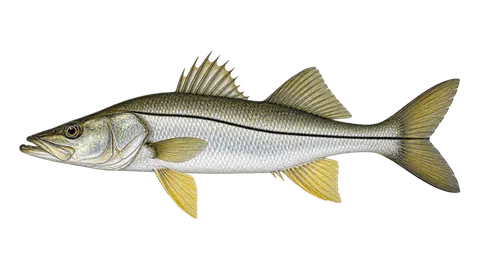
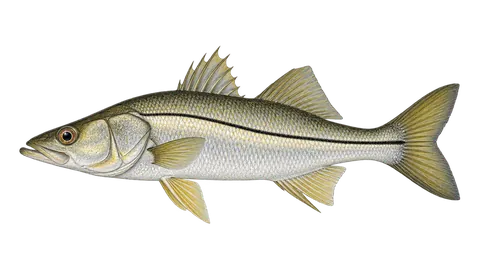


sources and references (5)
The season weights (months), the time of day and the sensitivities (cold, pressure, moon, wind, rain, tide, strong light, murky water and noise) are the app's editorial estimates, based on the literature below and on the field experience of anglers and guides. They are not official data nor a measurement made for this species, and they may vary by region and year. Closed seasons and legal rules appear in the rules section, with the norm and a link.
- scientific FishBase: Morone saxatilis (ficha da espécie)Size, length-weight, depth, habitat, distribution, biology, and IUCN status. Page checked on Oct 13, 2026.
- scientific FishBase: nomes populares de Morone saxatilisNames by country and language.
- scientific FishBase: introduções de Morone saxatilisIntroduction records in Mexico (1886), Ecuador (1975 to 1999) and Argentina (Entre Ríos). FishBase does not report the purpose of the introductions. Page checked on Oct 13, 2026.
- official NOAA Fisheries: Atlantic Striped BassAppearance, anadromous migration, diet, maximum size, stock status (2024) and US rules. Page checked on Oct 13, 2026.
- scientific IUCN Red List: Morone saxatilis (avaliação global: Pouco Preocupante, 2019)Search of the Red List by scientific name; classification per FishBase (version 2025-2).
how we calculatewhere each number comes from
The weather comes from three independent global models, cross-checked hour by hour: when they agree, confidence goes up; when they diverge, the band between them shows on the chart. Beyond 16 days, we use the GEFS ensemble of 31 simulations: if 20 of the 31 predict rain, the chance of rain is 65%. Sun and moon are calculated astronomically, with no uncertainty.
The index adds up, weighted for each species: time of day (species curve anchored to real sunrise and sunset), moon (transits, rise and set, phase), pressure (3 h trend and 24 h swing), water temperature (in rivers, estimated from air temperature; at sea, estimated by an ocean model), wind, rain, clouds, tide and the month in the species' cycle.
sources for this lookup
how accurate the forecast is
Accuracy measured in the reference project (4 regions, 93 days, forecast vs. observed): maximum temperature is off by 0.6 °C on average the next day and 1.7 °C at 7 days; rain of 5 mm or more is detected 76% of the time the next day and 57% at 7 days. Detection isn't everything: the false alarm rate isn't published here yet, and 93 days in 4 regions is still a small sample. We now also measure every day, at the app's destinations: