Skip to content
catalog Lutjanidae · predator

northern red snapper

Lutjanus campechanus

SeaIUCN global: VU · vulnerable

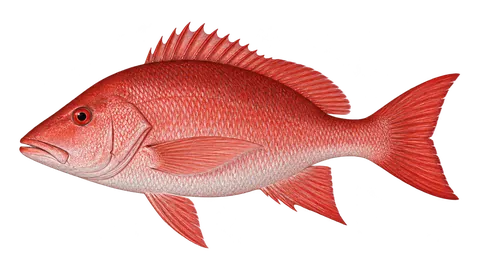
The northern red snapper: a pinkish-red fish with a triangular face and canine teeth, living near structures on the shelf, from 30 to 130 m. One of the most sought-after bottom fish in the Gulf, classified as Vulnerable (VU) by the IUCN. It does not occur in Brazil.

Also called: pargo-do-golfo, vermelho, northern red snapper, red snapper, Mexican red snapper, Pensacola red snapper

Scientific illustration of Northern red snapper
common size
40–60 cm
maximum
100 cm
common weight
0.8–2.5 kg
record/max.
22.8 kg
depth
30–130 m
ideal water
18–26 °C
overview

who is the northern red snapper

The Gulf red snapper (northern red snapper, huachinango del Golfo) is the red snapper of the Gulf of Mexico and the US East Coast, where it is heavily fished and now protected by strict rules. Adults live near hard structures on the continental shelf, usually between 30 and 130 m; juveniles use shallow water over sand or mud. They eat fish, shrimp, crabs, worms and cephalopods. It reaches 100 cm and 22.8 kg and can live past 50 years. It matures at about 39 cm. The IUCN classifies it as Vulnerable (2015). It is fished from a boat with natural bait and jigs, and its flesh is highly valued. There are reports of ciguatera. In Brazil "pargo" is another species, Lutjanus purpureus.

fun facts

  • It can live past 50 years: NOAA cites ages of up to 57 in the Gulf.
  • Older authors used the name Lutjanus aya; Rivas showed that Bodianus aya, of Bloch, is not a snapper but probably a fish of the croaker family (FishBase).
  • In Mexico it is the huachinango de Castilla, and the term "huachinango" also applies to the Pacific relative (Lutjanus peru).
how to recognize it

identification

Light pinkish-red, darker on the back, and redder in deep-water fish. Long, triangular face, jaws even or with the lower one slightly protruding, and large canine teeth. Pointed anal fin; the scale rows on the back rise diagonally. Fish under about 30 to 35 cm have a large dark spot under the first soft rays of the dorsal fin. The Brazilian snapper (Lutjanus purpureus), from another coast, is a relative in the same genus; the saçupema has a spot at the base of the pectoral fin.

how northern red snapper fishing looks

Loading the next 7 days…

Each card shows the day's index (0 to 100) and, below it, a strip with the index for each hour, from 0h to 23h. from poor to excellent.

distribution

where found

open on the large map

Gulf of Mexico and the US East Coast, north to Massachusetts (rare north of the Carolinas), with populations throughout the Gulf and along the Florida coasts (FishBase). FishBase lists Cuba, Mexico and Trinidad and Tobago as native countries, not Brazil.

Habitat: Adults stay near hard structures on the continental shelf (reefs, wrecks, oil platforms and rocky bottoms), from 30 to 130 m; juveniles use shallow water over sand and mud.

calendar and clock

when to fish

best season

time of yearbest: Apr–Sep
JanFebSeaAprMayJunJulAugSepOctNovDec

Spawning runs from May to October, depending on the place (NOAA); fishing tends to pick up as the water warms.

best time of day

0h6h12h18h sunrise ~6amsunset ~6pm

Daytime, with peaks at dawn and dusk. Feeds by day and late afternoon near the structure; fishing does best with moderate current and a sea with little chop.

weather, water and behavior

what affects the northern red snapper
sensitivity The little bars show how much each factor affects this species. Five full: it feels it a lot.

cold and cold fronts

A cold front with strong wind slows fishing for a few days; bottom water changes more slowly.

atmospheric pressure

A rapid rise in pressure after the front usually shuts the bite down for a day or two.

moon

Moderate effect, due to the tidal current over the structures.

rain

Little effect on the fish at 50 m or deeper.

water level

Does not apply at sea. The equivalent is the current: with still water the fish stays at the bottom of the structure.

noise

On shallow structures, noisy anchoring and an engine running spook the fish; be discreet.

wind

Strong wind compromises the drift over the structure. Prefer calm seas.

tide

A moving tide sets up the current and makes the fish rise in the water column over the structure.

depth

Adults at 30 to 130 m, hugging the structure; small ones shallower.

technique, gear and bait

how to fish

rod
6' to 7', heavy action, 40 to 80 lb
spinning / baitcasting reel
deep-sea baitcasting reel 4/0 to 6/0 or large spinning reel, with 250 to 400 m of line
line
braided line 50 to 80 lb
leader
fluorocarbon 60 to 100 lb, 1.5 to 2 m
hook
circle hook 7/0 to 9/0

lures

  • bottom jig of 100 to 250 g
  • silicone lure with a 60 to 150 g head

natural baits

  • whole or cut sardine
  • lula
  • cavalinha

accessories

  • sinker of 150 to 400 g depending on the current
  • descender
  • pliers and gloves

tip from an angler

Fish the lure one or two meters off the bottom beside the structure, and lift the fish quickly so it does not go back into the rock.

what the law says

rules for the northern red snapper

Summary of the regulations we found, with the source for each. Rules change; before keeping or transporting fish, check with the state environmental agency.
Conservation: It does not occur in Brazil, so it is not on the national list (Portaria GM/MMA nº 1.667/2026). The IUCN global assessment, from 2015, classifies it as Vulnerable (A2bd). In the US, NOAA describes the Gulf stock as "still recovering" (2018 assessment). In Mexico we found no minimum size or federal closed season specific to the species, only the general sport-fishing rules and the grouper and associated-species rule.

Mexico: up to 5 per species and 10 saltwater fish per day

5 specimens of the species per angler per day, within the limit of 10 saltwater fish

In recreational sport fishing in Mexican federal waters, each angler may keep up to 10 marine fish per day, no more than 5 of the same species. The Gulf snapper (huachinango del Golfo) is not among the species reserved for sport fishing (marlin, sailfish, swordfish, dorado, roosterfish and tarpon) and has no quota of its own. Fish above the limit must be returned alive to the water, and sport-caught fish is for personal consumption, not for sale. Anglers fishing from a boat need a Conapesca permit.

Source: Amendment to NOM-017-PESC-1994 (recreational sport fishing in federal waters of Mexico), published in the DOF on Nov 25, 2013, items 4.9.1 and 4.9.5 (Sagarpa/Conapesca)

Mexico (Gulf and Caribbean): up to 3 kg per day for domestic-consumption fishing

3 kg per angler per day, combining groupers and associated species

In federal waters of the Gulf of Mexico and the Mexican Caribbean, the grouper rule lists the species (Gulf snapper, huachinango del Golfo or de Castilla) among the "associated species." For domestic-consumption fishing, each angler may take up to 3 kg per day of any grouper or associated species, only for personal and family consumption, not for sale, with equipment one person can operate alone. The Feb 1 to Mar 31 closure of that rule applies to groupers, not to associated species.

Source: NOM-065-SAG/PESC-2014 (DOF Jul 3, 2015), items 4.1 and 4.13 (Sagarpa/Conapesca)

catch and release
catch and release Releasing the fish alive, quickly and with a wet hand. During a closed season it isn't always allowed: what the regulation says applies.

Brought up from 30 m or deeper, it arrives with barotrauma. If you release it, use a descending device and return the fish to the bottom without delay; NOAA also encourages venting and recompression tools. Since the species is classified as Vulnerable, keep only what you will eat.

in the kitchen

White flesh with a delicate flavor, among the most prized in the Gulf; sold fresh and good steamed, grilled, baked or as ceviche. There are reports of ciguatera in the species.

calculator

how much it weighs without taking it out of the water

Length-weight relationship W = a·Lb (a = 0.01479, b = 2.96; FishBase (relação peso-comprimento bayesiana, estimativa da própria espécie)). It's an average: a fat or lean fish can vary by 10% to 20%.

estimated weight

—

sources and references

The season weights (months), the time of day and the sensitivities (cold, pressure, moon, wind, rain, tide, strong light, murky water and noise) are the app's editorial estimates, based on the literature below and on the field experience of anglers and guides. They are not official data nor a measurement made for this species, and they may vary by region and year. Closed seasons and legal rules appear in the rules section, with the norm and a link.

  1. scientific FishBase: Lutjanus campechanus (ficha da espécie)Size, length-weight, depth, habitat, distribution, biology, and IUCN status. Page checked on Oct 13, 2026.
  2. scientific FishBase: nomes populares de Lutjanus campechanusNames by country and language.
  3. official NOAA Fisheries: Red Snapper (Lutjanus campechanus)Appearance, size, longevity, habitat, diet, spawning and stock status in the US. Page checked on October 13, 2026.
  4. scientific IUCN Red List: Lutjanus campechanus (avaliação global: Vulnerável, A2bd, 2015)Search of the Red List by scientific name; classification per FishBase (version 2025-2).
  5. official Portaria MPA nº 532, de 23 de setembro de 2025: nomes científicos e nomes comuns das principais espécies de peixes de interesse comercialAnnex: Lutjanus campechanus, names "Vermelho" and "Pargo" (checked in the Annex text). The species is on the list of names because it is an imported fish; the Brazilian pargo is Lutjanus purpureus.
  6. scientific Allen, G. R. (1985). FAO species catalogue. Vol. 6. Snappers of the world. FAO Fisheries Synopsis 125(6). Roma: FAO.Reference catalogue of the snappers of the world (family Lutjanidae).
  7. official NOM-017-PESC-1994 e sua modificação: pesca deportivo-recreativa em águas de jurisdição federal do MéxicoItem 4.9.1: up to 10 marine fish per angler per day, no more than 5 per species. The original text (DOF May 9, 1995) was also read at https://platiica.economia.gob.mx/normalizacion/wp-content/uploads/sites/2/PDF_Normas_Publicas/017-pesc.pdf.
  8. official NOM-065-SAG/PESC-2014: aproveitamento de meros e espécies associadas no Golfo do México e Mar Caribe (DOF 03/07/2015)Item 4.1 (list of associated species) and item 4.13 (domestic-consumption fishing: 3 kg per angler per day). We did not check whether there were changes after the 2015 text.
don't confuse

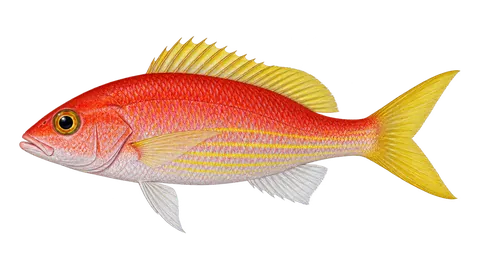
similar species