

striped bonito
Sarda orientalis
Schooling bonito of coastal waters, with almost horizontal stripes on the back and an all-black second dorsal fin. Found from the Gulf of California to Peru, and caught by corrico (trolling), with jigs and casting lures.
- common size
- 45–65 cm
- maximum
- 102 cm
- common weight
- 1–3.5 kg
- record/max.
- 10.7 kg
- depth
- 1–167 m
- ideal water
- 18–25 °C
how to recognize it
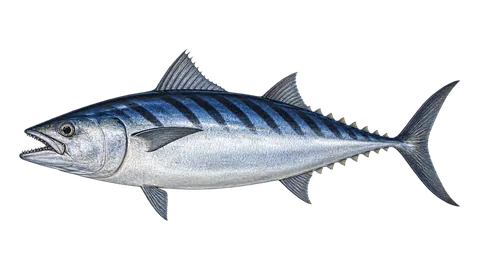
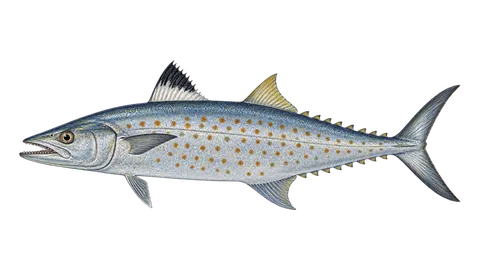
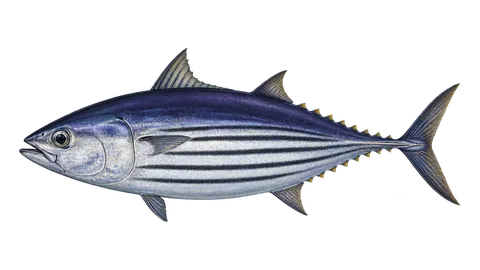
Elongated, rounded body, steel blue on top, with 8 to 11 dark, almost horizontal stripes on the back (the lower ones in broken lines), silvery flanks and belly, and an all-black second dorsal fin. Large, visible conical teeth, two dorsal fins close together (the first with 17 to 19 spines), 6 to 8 finlets and an armor of large scales at the front of the body. The Pacific bonito (Sarda chiliensis) has about 7 slightly oblique stripes, a white tip on the second dorsal fin and 23 to 27 gill rakers (here they are 8 to 13). The black skipjack (Euthynnus lineatus) has few stripes, only on the rear of the back, and dark spots between the pectoral and pelvic fins.
Also called: sarda-oriental, bonito-de-listras-horizontais, striped bonito, oriental bonito
don't confuse with:
where found
open on the large mapWhere to look: Coastal and island waters, near the surface, in mixed schools with small tunas.
Not found in Brazil. Indo-Pacific, in scattered patches. In the eastern Pacific, from the Gulf of California to Peru, including the oceanic islands (except Clipperton), passing through all the Pacific coast countries between Mexico and Peru.
when to fish
next 7 days
Loading the next 7 days…
best season
No documented season in the eastern Pacific. Fishing follows the sardine patches and water around 18 to 25 °C; check with local guides when the school arrives.
best time of day
Daytime, with peaks at dawn and dusk. Hunts at the surface by day, with peaks at dawn and late afternoon, when the sardine schools rise; diving birds and boiling water mark the school.
what affects the striped bonito
cold and cold fronts
The school flees very cold water; a sudden temperature change drives the fish away from the coast.
atmospheric pressure
Little direct effect; a front with a turning sea breaks up the bait schools.
moon
Little effect.
rain
Little effect in open sea; muddy runoff water drives the school away from the shore.
water level
Not applicable at sea.
noise
A fast motor over the school makes the fish sink; approach with the motor low.
wind
Strong wind and choppy sea hinder the cast and the trail of birds.
tide
Little effect; a current that gathers sardines at a point or island attracts the school.
depth
Almost always at the surface and in the first 30 m, but there are records down to more than 100 m.
how to fish
lures
- metal jig, 30 to 80 g
- metal spoon
- popper and surface zara
- squid or feather jig for corrico
natural baits
- live or dead sardine
- lula
- small anchovy
tip from an angler
When the birds dive, cast the metal past the school and retrieve quickly, with the rod tip low: the bonito chases the lure at speed and strikes at the surface.
- rod
- 6'6" to 7'6", fast action, 15 to 30 lb
- spinning / baitcasting reel
- 4000 to 6000 spinning reel with smooth drag and good line capacity
- line
- braided line 20 to 40 lb
- leader
- fluorocarbon 30 to 50 lb, 1 m (the teeth cut thin leader)
- hook
- treble hook 1/0 to 3/0 on lures; single hook 2/0 to 4/0 on natural bait
accessories
- long-nose pliers
- boga
- ice to bleed and cool the fish right away
catch and release
Bonito suffers from handling out of the water: if you plan to release it, keep the fish in the water, remove the hook with pliers and let it go quickly. If you plan to keep it, bleed it and put it on ice right away.
rules for the striped bonito
Rules change; before keeping or transporting fish, check with the state environmental agency.
Mexico: up to 5 per species and 10 saltwater fish per day
5 specimens of the species per angler per day, within the limit of 10 saltwater fish details
In recreational sport fishing in Mexican federal waters, each angler may keep up to 10 marine fish per day, no more than 5 of the same species. The Eastern Pacific bonito (bonito mono) is not among the species reserved for sport fishing (marlin, sailfish, swordfish, tarpon, roosterfish and dorado, up to 50 nautical miles from shore, item 0.3 of the standard) and has no quota of its own. Fish over the limit go back alive, and sport-caught fish may not be sold. From shore no permit is needed; from a boat, one is (Federal Duties Law permits, item 4.3).
how much it weighs without taking it out of the water
estimated weight
—
how we calculate
Length-weight relationship W = a·Lb (a = 0.01, b = 3.05; FishBase (relação peso-comprimento bayesiana, estimativa da própria espécie)). It's an average: a fat or lean fish can vary by 10% to 20%.
more about the striped bonito
Coastal bonito with a wide Indo-Pacific range but irregular occurrence. In the eastern Pacific it ranges from the Gulf of California to Peru and reaches the oceanic islands; in northern Peru it appears mainly in El Niño years, according to FishBase. It forms schools with small tunas, near the coast and islands, and eats sardines and other fish, squid and crustaceans. It reaches about 1 m and 10 kg, but the typical fish is around 55 cm. It takes metal jigs, spoons, poppers and corrico baits, and fights hard for its size. The commercial fishery is small (corrico, purse seines and drift nets) and fresh fish is sold in the markets.
Family: Scombridae · predator
fun facts
- The world all-tackle line-class record is 10.65 kg, according to STRI.
- FishBase describes the Indo-Pacific distribution as wide, but full of gaps.
in the kitchen
Dark, firm, tasty flesh when handled promptly: bleed and chill right away. Good grilled, as sashimi or ceviche, and canned. FishBase lists it as sold fresh, dry-salted, canned and frozen.
similar species

sources and references (6)
The season weights (months), the time of day and the sensitivities (cold, pressure, moon, wind, rain, tide, strong light, murky water and noise) are the app's editorial estimates, based on the literature below and on the field experience of anglers and guides. They are not official data nor a measurement made for this species, and they may vary by region and year. Closed seasons and legal rules appear in the rules section, with the norm and a link.
- scientific FishBase: Sarda orientalis (ficha da espécie)Size, length-weight, depth, habitat, distribution, biology and IUCN status. Page checked on 13/10/2026. FishBase gives a fork length of up to 102 cm; STRI cites up to 117 cm without giving the measurement, and we kept FishBase's value.
- scientific FishBase: nomes populares de Sarda orientalisNames by country and language.
- scientific Robertson, D. R. & Allen, G. R. (2024). Shorefishes of the Eastern Pacific online information system. Smithsonian Tropical Research Institute: Sarda orientalisDescription, colors (8 to 11 stripes on the back, all-black second dorsal fin), size (up to 117 cm and line-class record of 10.65 kg), depth (0 to 30 m) and distribution (Gulf of California to Peru and the oceanic islands, except Clipperton). Page checked on 13/10/2026.
- scientific Robertson, D. R. & Allen, G. R. (2024). Shorefishes of the Eastern Pacific online information system. Smithsonian Tropical Research Institute: Sarda chiliensis (comparação: 7 listras oblíquas, 23 a 27 rastros branquiais, ponta branca na segunda dorsal)Used only for identification differences. Page checked on 13/10/2026.
- scientific Collette, B. B.; Nauen, C. E. (1983). FAO Species Catalogue. Vol. 2. Scombrids of the world. An annotated and illustrated catalogue of tunas, mackerels, bonitos and related species known to date. FAO Fisheries Synopsis 125(2). Roma: FAO.FishBase's main reference for the description, biology and uses.
- official DOF: Modificação da NOM-017-PESC-1994, para regular a pesca deportivo-recreativa em águas de jurisdição federal do México (publicada em 25/11/2013)Species reserved for sport fishing (item 0.3), permits (4.3 and 4.14), rod and hooks (4.6), bait (4.7), daily quotas at sea (4.9.1) and in fresh water (4.9.2), catch and release (4.9.5), closed areas and seasons (4.10) and the ban on selling the fish (4.11). Text checked Oct 13, 2026. The text carries the signature date of Oct 14, 2013; the DOF publication date (Nov 25, 2013) is the one the catalog already uses.