

bigeye trevally
Caranx sexfasciatus
Bigeye trevally with a blue-green back that stays in schools, almost motionless, along reef edges by day and hunts at night. Takes poppers, jigs and live bait, and pulls hard.
- common size
- 40–80 cm
- maximum
- 120 cm
- common weight
- 1–7 kg
- record/max.
- 18.0 kg
- depth
- 0–146 m
- ideal water
- 26–30 °C
how to recognize it
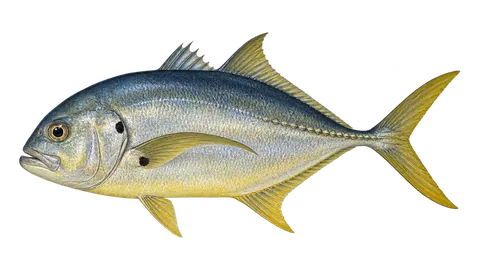
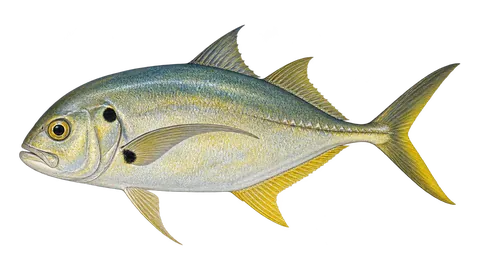
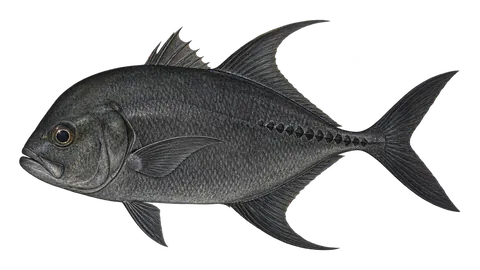
Relatively elongated, compressed body, iridescent blue-green back and silvery belly; large eye with a well-developed adipose eyelid. A small dark spot at the top of the gill opening, much smaller than the pupil, and a dark second dorsal lobe with a white tip. Lateral line with 27 to 36 strong scutes in its straight part and a fully scaled chest. The bluefin trevally (Caranx melampygus) has dark blue spots on the back and a smaller eye; the Pacific crevalle jack (Caranx caninus) has an almost scaleless chest.
Also called: xaréu-olhudo, xaréu-de-olho-grande, bigeye trevally, bigeye crevalle-jack
don't confuse with:
where found
open on the large mapWhere to look: Reef edges, islands, rocks and banks; juveniles in estuaries and river mouths, sometimes upriver.
Does not occur in Brazil. Indo-Pacific, from the Red Sea and East Africa to Hawaii and Australia. In the eastern Pacific, from the Gulf of California to Ecuador and the oceanic islands (Galápagos, Cocos, Revillagigedo).
when to fish
next 7 days
Loading the next 7 days…
best season
Fishable all year. Bait schools near the reef and moderate current matter more than the month.
best time of day
Night and twilight. By day it stays in schools, almost motionless, along reef edges; it hunts alone at night. At dawn and dusk the schools move and strike surface casts.
what affects the bigeye trevally
cold and cold fronts
Cold upwelling water pushes the schools away from reef edges.
atmospheric pressure
Little direct effect.
moon
New-moon and full-moon tides move more water over islands and rocks.
rain
Little effect in open sea; heavy rain muddies river mouths.
water level
Not applicable at sea.
noise
Running the motor over the school drives it down; approach from the outside and cast far.
wind
A light chop helps the popper; strong wind makes casting and anchoring harder.
tide
Moving current at points and passages concentrates the schools.
depth
Surface and midwater along the edges; the larger fish drop down close to the reef bottom.
how to fish
lures
- popper 12 to 18 cm
- stickbait
- metal jig 40 to 120 g
- mid-water jerkbait
natural baits
- live sardine or mackerel
- lula
tip from an angler
Hooked near the rock, the fish runs for the bottom: lock the drag in the first few meters and pump short. It turns sideways and uses its broad body.
- rod
- 7' to 8', 20 to 50 lb
- spinning / baitcasting reel
- spinning reel 6000 to 10000 with strong drag, or medium baitcasting reel
- line
- braid 40 to 65 lb
- leader
- fluorocarbon 50 to 80 lb, 1 to 1.5 m
- hook
- reinforced treble hooks or single hooks 4/0 to 7/0; circle 5/0 to 8/0 for live bait
accessories
- alicate
- luvas
- fighting belt for large fish
catch and release
A tough fish that tires out quickly: keep it in the water, take the hook out with pliers and release it head down until it swims off.
rules for the bigeye trevally
Rules change; before keeping or transporting fish, check with the state environmental agency.
Mexico: up to 5 per species and 10 saltwater fish per day
5 specimens of the species per angler per day, within the limit of 10 saltwater fish details
In recreational sport fishing in Mexican federal waters, each angler may keep up to 10 marine fish per day, no more than 5 of the same species. The bigeye trevally is not among the species reserved for sport fishing (marlin, sailfish, swordfish, sábalo, roosterfish and dorado, up to 50 nautical miles from shore, item 0.3 of the regulation) and has no bag limit of its own. Fish over the limit go back alive to the water, and sport-caught fish may not be sold. Anglers fishing from a boat need an individual permit; from the shore, they do not.
Colombia: AUNAP license and catch-and-release in sport fishing
Individual AUNAP license; catch-and-release guidanceconfirm with the agency details
AUNAP Resolution 0549 of 2022 sets the guidelines for recreational sport fishing in Colombia. Anglers need a permit: for an individual, Colombian or foreign, it is a personal, non-transferable card. The rule makes "catch and release" the guidance and admits keeping only part of the catch for personal consumption, respecting the minimum sizes it sets. We did not confirm the daily limit or the minimum sizes by species: check with AUNAP before keeping fish.
how much it weighs without taking it out of the water
estimated weight
—
how we calculate
Length-weight relationship W = a·Lb (a = 0.01738, b = 2.96; FishBase (relação peso-comprimento bayesiana, estimativa da própria espécie)). It's an average: a fat or lean fish can vary by 10% to 20%.
more about the bigeye trevally
Carangid with a wide distribution in the Indo-Pacific, from the Red Sea and East Africa to the Americas. In the eastern Pacific it ranges from the Gulf of California to Ecuador and the oceanic islands. Adults live in coastal and offshore waters linked to reefs, in schools that circle almost motionless by day along reef edges; at night they hunt alone for fish, squid and crustaceans. Juveniles enter estuaries and sometimes swim up rivers. It is caught with line and hook, gillnets and purse seines, and sold fresh, dried, salted or frozen. In sport fishing it is a target for poppers, stickbaits and jigs around rocks, islands and estuary mouths. There are records of ciguatera with this species.
Family: Carangidae · predator
fun facts
- The schools circle almost motionless by day along reef edges and only hunt at night.
- Juveniles enter estuaries and sometimes swim far up rivers, well away from the sea.
- FishBase records hybrids with the bluefin trevally in Hawaii.
in the kitchen
Sold fresh, dried, salted or frozen; usually grilled over coals or roasted. There are records of ciguatera: ask local fishers before eating large reef specimens.
similar species

sources and references (5)
The season weights (months), the time of day and the sensitivities (cold, pressure, moon, wind, rain, tide, strong light, murky water and noise) are the app's editorial estimates, based on the literature below and on the field experience of anglers and guides. They are not official data nor a measurement made for this species, and they may vary by region and year. Closed seasons and legal rules appear in the rules section, with the norm and a link.
- scientific FishBase: Caranx sexfasciatus (ficha da espécie)Size, length-weight, depth, habitat, distribution, biology, and IUCN status. Page checked on Oct 13, 2026.
- scientific FishBase: nomes populares de Caranx sexfasciatusNames by country and language.
- scientific Robertson, D. R. & Allen, G. R. (2024). Shorefishes of the Eastern Pacific online information system, versão 3.0. Smithsonian Tropical Research Institute: Caranx sexfasciatusDescription, colors, size, depth and distribution in the eastern Pacific. Page checked Oct 13, 2026. Cites at least 14.3 kg and 120 cm; describes the species as nocturnal.
- official DOF: Modificação da NOM-017-PESC-1994, para regular a pesca deportivo-recreativa em águas de jurisdição federal do México (publicada em 25/11/2013)Reserves species for sport fishing (item 0.3), permits (4.3 and 4.14), rods and hooks (4.6), bait (4.7), daily limits at sea (4.9.1) and in fresh water (4.9.2), catch and release (4.9.5), closed zones and seasons (4.10), and a ban on selling the catch (4.11). Text checked on Oct 13, 2026; the publication date (Nov 25, 2013) comes from Secretaría de Economía rules that cite the amendment.
- official AUNAP (Colômbia): Resolução 0549 de 2022, lineamientos de ordenación pesquera para la pesca deportiva con fines recreativosWe reviewed, in a partial transcript of the text, what the rule says about the personal license (art. 6) and the catch-and-release guidance (arts. 8 to 10). We could not read the articles on the daily bag limit and minimum sizes; the draft rule provided for a personal-consumption limit that AUNAP said it would revise, so those figures are left out.