

- common size
- 25–40 cm
- maximum
- 55 cm
- common weight
- 0.3–1.1 kg
- record/max.
- 2.8 kg
- depth
- 3–100 m
- ideal water
- 22–28 °C

the right time
to be on the water
Choose the place and the species. The index, from 0 to 100, combines weather, sun, moon and tide with each fish's habits. Up to 28 days, with each day's confidence.
Loading the forecast…
—
Looking for alerts within 30 km…
Looking for what anglers have logged near here…
what you need to fish herelicense, certification and boat documents
fish likely at this spot
Tap a fish to see its forecast.
hour by hour
slide your finger or mouse over the chart to see each hoursee hour-by-hour table
why this index at —?
choose the day
the fishing month at a glance
what's the best window for the crew?
Choose how many fishing days. We compare each stretch by its average index, discount days with a warning or closed season, and show the 3 best.
trend for the coming weeks
Line: the middle value of 31 simulations of the American GEFS model. Band: where 8 out of 10 fall. Narrow, firm trend; wide, high uncertainty.
everything about the green jack
how to recognize it
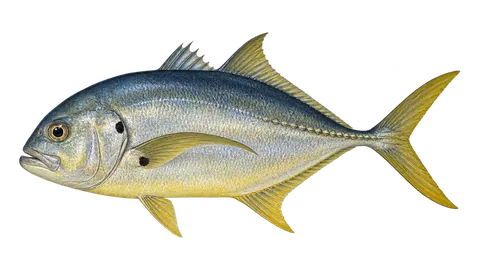
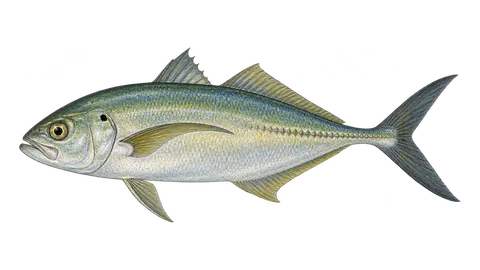
Moderately compressed and relatively slender body, light olive to dark blue-green back, silvery-grey to golden flanks and pale fins. Black spot on the gill cover; juveniles have about seven dark bars. Well-developed transparent adipose eyelid, chest fully scaled and 45 to 56 strong scutes in the straight part of the lateral line, more than in other jacks. It is smaller and slimmer than the Pacific crevalle jack (Caranx caninus) and the bigeye trevally (Caranx sexfasciatus).
Also called: xerelete-verde, green jack
don't confuse with:
where found
open on the large mapWhere to look: Schools over soft bottoms near shore and in deeper water; juveniles in estuaries.
Does not occur in Brazil. Eastern Pacific: from southern California (United States) to Peru, including the Gulf of California and the Galápagos Islands. It has already been recorded in large numbers in Hawaii, without becoming established.
when to fish
best season
Fished all year. Bait schools near the beach and diving birds count for more than the month.
best time of day
Daytime, with peaks at dawn and dusk. Feeds by day, in active schools at the surface and in midwater, with peaks at dawn and late afternoon.
what affects the green jack
cold and cold fronts
Cold upwelling water pushes the schools away from shore.
atmospheric pressure
Little direct effect.
moon
Small effect.
rain
Little effect; tolerates muddy water from river mouths.
water level
Not applicable at sea.
noise
Not very sensitive when the school is feeding.
wind
A light chop helps; strong wind makes casting light lures harder.
tide
Running tide at mouths and points concentrates the schools.
depth
Surface and midwater, down to about 30 m in sport fishing.
how to fish
lures
- metal jig 20 to 60 g
- small popper 8 to 12 cm
- sabiki
- heavy spoon
natural baits
- live sardine or anchoveta, or cut pieces
- shrimp
- squid strips
tip from an angler
When the school boils at the surface, cast the jig past it and reel in fast. Release small fish: a study done in Panama recommended raising the minimum landing size to protect the larger spawners.
- rod
- 6'6" to 7'6", 10 to 20 lb
- spinning / baitcasting reel
- 3000 to 5000 spinning reel
- line
- braided line 15 to 30 lb
- leader
- fluorocarbon 20 to 40 lb, 1 m
- hook
- treble hooks 1/0 to 3/0 or circle 2/0 to 4/0 for live bait
accessories
- alicate
- ruler to check the size
catch and release
Tough fish: take the hook out quickly with pliers, keeping it in the water, and release it head down. Return the small ones.
rules for the green jack
Rules change; before keeping or transporting fish, check with the state environmental agency.
Mexico: up to 5 per species and 10 saltwater fish per day
5 specimens of the species per angler per day, within the limit of 10 saltwater fish details
In recreational sport fishing in Mexican federal waters, each angler may keep up to 10 marine fish per day, no more than 5 of the same species. The green jack is not among the species reserved for sport fishing (marlin, sailfish, swordfish, sábalo, roosterfish and dorado, up to 50 nautical miles from shore, item 0.3 of the regulation) and has no bag limit of its own. Fish over the limit go back alive to the water, and sport-caught fish may not be sold. Anglers fishing from a boat need an individual permit; from the shore, they do not.
Colombia: AUNAP license and catch-and-release in sport fishing
Individual AUNAP license; catch-and-release guidanceconfirm with the agency details
AUNAP Resolution 0549 of 2022 sets the guidelines for recreational sport fishing in Colombia. Anglers need a permit: for an individual, Colombian or foreign, it is a personal, non-transferable card. The rule makes "catch and release" the guidance and admits keeping only part of the catch for personal consumption, respecting the minimum sizes it sets. We did not confirm the daily limit or the minimum sizes by species: check with AUNAP before keeping fish.
Conservation: Of little concern globally, but a 2012 study (Mair et al.) concluded that the species is overfished in the Las Perlas archipelago, Panama.
how much it weighs without taking it out of the water
estimated weight
—
how we calculate
Length-weight relationship W = a·Lb (a = 0.01862, b = 2.98; FishBase (relação peso-comprimento bayesiana, estimativa da própria espécie)). It's an average: a fat or lean fish can vary by 10% to 20%.
more about the green jack
Small schooling carangid of the eastern Pacific, from southern California to Peru, including the Gulf of California and the oceanic islands. It moves in schools over soft bottoms, close to shore but also in deeper water down to about 100 m, and enters estuaries; juveniles are common in estuarine waters. It eats mainly silver fish, but also squid, shrimp and other invertebrates. It reaches about 55 cm and 2.8 kg and lives up to 8 years. It is sold fresh, salted, dried or smoked, and is also processed into meal and oil. In sport fishing it is a light-tackle and jig fish, fast and easy to find. A 2012 study in the Las Perlas archipelago, Panama, concluded that it is overfished there.
Family: Carangidae · predator
fun facts
- It is called cocinero in Guatemala, Mexico, Nicaragua and Peru, and caballa in Colombia, Costa Rica, Ecuador and Guatemala.
- It has been seen in large numbers in Hawaii, where it did not become established.
- Lives up to 8 years, according to FishBase; in Panama it spawns two to three times a year.
in the kitchen
Sold fresh, salted, dried or smoked; goes well fried or roasted soon after catching.
similar species


sources and references (6)
The season weights (months), the time of day and the sensitivities (cold, pressure, moon, wind, rain, tide, strong light, murky water and noise) are the app's editorial estimates, based on the literature below and on the field experience of anglers and guides. They are not official data nor a measurement made for this species, and they may vary by region and year. Closed seasons and legal rules appear in the rules section, with the norm and a link.
- scientific FishBase: Caranx caballus (ficha da espécie)Size, length-weight, depth, habitat, distribution, biology, and IUCN status. Page checked on Oct 13, 2026.
- scientific FishBase: nomes populares de Caranx caballusNames by country and language.
- scientific Robertson, D. R. & Allen, G. R. (2024). Shorefishes of the Eastern Pacific online information system, versão 3.0. Smithsonian Tropical Research Institute: Caranx caballusDescription, colors, size, depth and distribution in the eastern Pacific. Page checked Oct 13, 2026. Cites a length of at least 70 cm; we kept FishBase's 55 cm (FL).
- scientific Mair, J. M., Cipriani, R., Guzman, H. M. & Usan, D. (2012). Fishery of the Green Jack Caranx caballus (Osteichthyes: Carangidae) in Las Perlas Archipelago, Pacific Panama. Revista de Biología Tropical 60(3): 1271-1288.We read the abstract: 4,990 fish measured in landings between 2005 and 2006, mean length 36.1 cm, half the population mature at 38.8 cm (standard length), spawning two to three times a year, and a conclusion of overfishing in the archipelago. We have not checked the full article.
- official DOF: Modificação da NOM-017-PESC-1994, para regular a pesca deportivo-recreativa em águas de jurisdição federal do México (publicada em 25/11/2013)Reserves species for sport fishing (item 0.3), permits (4.3 and 4.14), rods and hooks (4.6), bait (4.7), daily limits at sea (4.9.1) and in fresh water (4.9.2), catch and release (4.9.5), closed zones and seasons (4.10), and a ban on selling the catch (4.11). Text checked on Oct 13, 2026; the publication date (Nov 25, 2013) comes from Secretaría de Economía rules that cite the amendment.
- official AUNAP (Colômbia): Resolução 0549 de 2022, lineamientos de ordenación pesquera para la pesca deportiva con fines recreativosWe reviewed, in a partial transcript of the text, what the rule says about the personal license (art. 6) and the catch-and-release guidance (arts. 8 to 10). We could not read the articles on the daily bag limit and minimum sizes; the draft rule provided for a personal-consumption limit that AUNAP said it would revise, so those figures are left out.
how we calculatewhere each number comes from
The weather comes from three independent global models, cross-checked hour by hour: when they agree, confidence goes up; when they diverge, the band between them shows on the chart. Beyond 16 days, we use the GEFS ensemble of 31 simulations: if 20 of the 31 predict rain, the chance of rain is 65%. Sun and moon are calculated astronomically, with no uncertainty.
The index adds up, weighted for each species: time of day (species curve anchored to real sunrise and sunset), moon (transits, rise and set, phase), pressure (3 h trend and 24 h swing), water temperature (in rivers, estimated from air temperature; at sea, estimated by an ocean model), wind, rain, clouds, tide and the month in the species' cycle.
sources for this lookup
how accurate the forecast is
Accuracy measured in the reference project (4 regions, 93 days, forecast vs. observed): maximum temperature is off by 0.6 °C on average the next day and 1.7 °C at 7 days; rain of 5 mm or more is detected 76% of the time the next day and 57% at 7 days. Detection isn't everything: the false alarm rate isn't published here yet, and 93 days in 4 regions is still a small sample. We now also measure every day, at the app's destinations: