Skip to content
fishing forecast

yellowfin grouper

Mycteroperca venenosa · Epinephelidae · predator

SeaIUCN global: NT · near threatened

Caribbean grouper with oval clusters of dark spots and a yellow pectoral fin tip. Near Threatened worldwide, it has closed seasons in Puerto Rico and Mexico and is closely linked to ciguatera.

Also called: badejo-ferro, serigado-ferro, yellowfin grouper

Scientific illustration of Yellowfin grouper
common size
45–75 cm
maximum
100 cm
common weight
2–8 kg
record/max.
18.5 kg
depth
2–137 m
ideal water
24–28 °C
location

Sample location: choose yours to see the forecast for where you fish.

period

Reading the weather across 3 global models and 31 simulations…

the species

everything about the yellowfin grouper

overview

who is the yellowfin grouper

The badejo-ferro (guajil), called yellowfin grouper in English, lives in the western Atlantic, from Bermuda, the Gulf of Mexico and the Caribbean to São Paulo. Adults stay on coral and rock reefs, usually at 5 to 35 m, and juveniles in shallow seagrass beds. It has two color forms: a greenish one from shallow water and a reddish one from deeper waters. It eats mostly reef fish and squid. It grows slowly and lives up to about 15 years, which makes it sensitive to fishing; the IUCN rates it Near Threatened. It takes natural bait and jigs near the bottom and sometimes strikes trolling baits at the surface. In the Caribbean it is one of the species most often cited in ciguatera cases.

fun facts

  • The scientific epithet, venenosa (venomous), recalls its reputation as a fish that can cause ciguatera.
  • Changes color with depth: greenish in the shallows and reddish on the bottom.
how to recognize it

identification

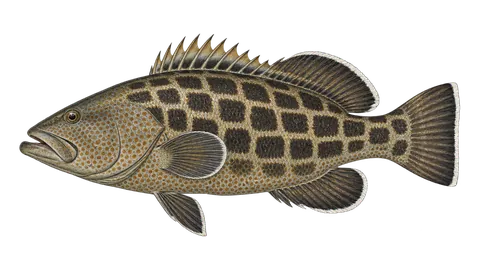
Robust body, olive-green or reddish, with rounded dark spots grouped into ovals on the head and body. The outer third of the pectoral fin is bright yellow, the easiest mark. In Brazil the name badejo-amarelo is used in the regulations for another species, Mycteroperca interstitialis, which is brown and has yellow around the mouth. The badejo-quadrado has rectangular blotches and no yellow pectoral fin.

distribution

where found

open on the large map

In Brazil, the literature records the species as far as São Paulo, on reefs and shoals; it is easily confused with other groupers.

Habitat: Coral and rock reefs; juveniles in shallow seagrass beds.

coast

Northeast CoastSoutheast Coastcoastalshelf

states

Ceará, Rio Grande do Norte, Paraíba, Pernambuco, Alagoas, Sergipe, Bahia, Espírito Santo, Rio de Janeiro, São Paulo

calendar and clock

when to fish

best season

time of year
JanFebSeaAprMayJunJulAugSepOctNovDec

In the Caribbean, Puerto Rico closes fishing from February to April, and Mexico from February to March. Brazil has no specific closed season.

best time of day

0h6h12h18h sunrise ~6amsunset ~6pm

Daytime, with peaks at dawn and dusk. Hunts by day, with peaks at dawn and in the late afternoon.

weather, water and behavior

what affects the yellowfin grouper
sensitivity The little bars show how much each factor affects this species. Five full: it feels it a lot.

cold and cold fronts

A tropical reef fish; cold fronts reduce its activity.

atmospheric pressure

A churned sea after a cold front shuts down bottom fishing.

moon

Effect poorly known; spring tides move more bait on the reef.

rain

Little effect at depth.

water level

Not applicable at sea.

noise

Anchor and hull knocking on the reef scare fish.

wind

Strong wind makes it hard to hold position over the spot.

tide

Moderate current activates feeding at the reef edge.

depth

Usually 5 to 35 m.

technique, gear and bait

how to fish

rod
6' to 7', 30 to 60 lb
spinning / baitcasting reel
baitcasting reel 300 to 400 or spinning reel 6000 to 8000, with the drag almost locked
line
braided line 50 to 65 lb
leader
fluorocarbon 60 to 100 lb, 1.5 m
hook
circle 5/0 to 8/0

lures

  • jig 80 to 200 g
  • trolling plug with a long barbel over the reef

natural baits

  • small live fish
  • lula

accessories

  • descender (fish descender)
  • long-nose pliers
  • luvas

tip from an angler

On feeling the strike, lift the fish in the first few meters: once it is in its hole, it cuts the line on the coral.

what the law says

rules for the yellowfin grouper

Summary of the regulations we found, with the source for each. Rules change; before keeping or transporting fish, check with the state environmental agency.
Conservation: Near Threatened in the global assessment, which has no legal effect in Brazil. We found no specific Brazilian federal rule for the species.

Puerto Rico: guajil closed season Feb 1 to Apr 30

fishing and possession prohibited from Feb 1 to Apr 3001/02 to 30/04

In Puerto Rico, fishing for badejo-ferro (guajil) is prohibited from February 1 to the end of April, and fish caught must be returned to the sea, alive or dead. In federal waters around the island, beyond 9 miles, the same period applies to yellowfin, red, black, tiger and yellowedge grouper.

Source: Puerto Rico Fishing Regulation nº 7949 (DRNA, 2010), art. 8.48; 50 CFR 622.439(b)(1) (NOAA Fisheries)

Mexico: grouper closed season from Feb 1 to Mar 31

catch prohibited from Feb 1 to Mar 3101/02 to 31/03

In Mexico, catching all grouper species, a group in which the official standard includes the badejo-ferro (cuna de piedra), is prohibited from February 1 to March 31 in federal waters of the Gulf of Mexico and the Caribbean off Tabasco, Campeche, Yucatán and Quintana Roo, up to the Belize border. Bottom longlines are also prohibited during the period.

Source: Grouper closed-season agreement (DOF Feb 14, 2007), amended Mar 3, 2017 (Sagarpa/Conapesca); NOM-065-SAG/PESC-2014

Puerto Rico (federal waters): up to 5 per person per day

5 per person per day; 15 per boat with 3 or more people

In federal waters around Puerto Rico, beyond 9 miles from the coast, the recreational angler may keep a maximum of 5 fish per day from groupers, snappers and parrotfish combined (up to 15 per boat when there are 3 or more people aboard). The limit does not apply to anyone with a commercial license from Puerto Rico or the U.S. Virgin Islands.

Source: 50 CFR 622.444(a)(1) (NOAA Fisheries, US)

catch and release
catch and release Releasing the fish alive, quickly and with a wet hand. During a closed season it isn't always allowed: what the regulation says applies.

If it comes from more than 15 to 20 m, use a descender. Support its belly and do not hold large fish by the mouth alone.

in the kitchen

White, prized flesh, but it is one of the species most associated with ciguatera in the Caribbean: follow local guidance on size and area before eating it.

calculator

how much it weighs without taking it out of the water

Length-weight relationship W = a·Lb (a = 0.01096, b = 3.04; FishBase (estimativa bayesiana para o gênero e o formato do corpo, comprimento total)). It's an average: a fat or lean fish can vary by 10% to 20%.

estimated weight

—

sources and references

The season weights (months), the time of day and the sensitivities (cold, pressure, moon, wind, rain, tide, strong light, murky water and noise) are the app's editorial estimates, based on the literature below and on the field experience of anglers and guides. They are not official data nor a measurement made for this species, and they may vary by region and year. Closed seasons and legal rules appear in the rules section, with the norm and a link.

  1. scientific FishBase — Mycteroperca venenosa (ficha da espécie)Names, distribution, biology, length-weight relationship, country list and references. Page checked on Oct 13, 2026.
  2. official Portaria GM/MMA nº 1.667, de 27 de abril de 2026 — Lista Nacional Oficial de Espécies da Fauna Ameaçadas de Extinção (peixes e invertebrados aquáticos)Most recent national list. The species is not on it (search by scientific name in the text published in the DOU, checked on October 13, 2026).
  3. official Portaria Interministerial SG-PR/MMA nº 59-C, de 9 de novembro de 2018The regulation uses the name badejo-amarelo for Mycteroperca interstitialis, not for this species.
  4. official ICMBio/SALVE — Ficha de Mycteroperca venenosa (avaliação nacional do risco de extinção)National assessment by ICMBio, published in 2024. DOI verified on Crossref.
  5. scientific IUCN Red List — Mycteroperca venenosa (avaliação global: Quase Ameaçada, NT, 12/03/2018)Global assessment. Link given on the FishBase entry (Red List, version 2025-2).
  6. official Reglamento de Pesca de Puerto Rico, nº 7949 (Departamento de Recursos Naturales y Ambientales, 2010)Copy of the regulation published by the Caribbean Fishery Management Council; it applies in Puerto Rico waters up to 9 miles. Art. 8 (general limitations) checked October 13, 2026.
  7. official Code of Federal Regulations, 50 CFR Part 622, Subpart S — Regulations specific to the Puerto Rico Management Area (NOAA Fisheries, EUA)Consolidated text in the eCFR, checked October 13, 2026: §622.438 (prohibited species), §622.439 (area and time closures) and §622.444 (quotas). It applies in federal waters, beyond 9 miles from the coast.
  8. official México — NOM-065-SAG/PESC-2014, para regular o aproveitamento das espécies de mero e espécies associadas no Golfo do México e no Mar do Caribe (DOF de 03/07/2015)Text published in the Official Journal of the Federation, in a copy from the Secretaría de Economía. Item 4.1 (list of grouper species), 4.8 (minimum size of red grouper) and 4.13 (fishing for domestic consumption).
  9. official México — Acordo que modifica a veda de todas as espécies de mero no Golfo do México e no Caribe (DOF de 03/03/2017; acordo original de 14/02/2007)Sets the closed season from February 1 to March 31, since 2018, in federal waters off Tabasco, Campeche, Yucatán and Quintana Roo. We found no later amendment; confirm each season with Conapesca.
  10. scientific Heemstra, P. C.; Randall, J. E. (1993). FAO species catalogue. Vol. 16. Groupers of the world (family Serranidae, subfamily Epinephelinae). FAO Fisheries Synopsis 125(16). Roma: FAO.
don't confuse

similar species