

- common size
- 20–35 cm
- maximum
- 50 cm
- common weight
- 0.1–0.5 kg
- record/max.
- 1.1 kg
- depth
- 0.5–20 m
- ideal water
- 19–27 °C

the right time
to be on the water
Choose the place and the species. The index, from 0 to 100, combines weather, sun, moon and tide with each fish's habits. Up to 28 days, with each day's confidence.
Loading the forecast…
—
Looking for alerts within 30 km…
Looking for what anglers have logged near here…
what you need to fish herelicense, certification and boat documents
fish likely at this spot
Tap a fish to see its forecast.
hour by hour
slide your finger or mouse over the chart to see each hoursee hour-by-hour table
why this index at —?
choose the day
the fishing month at a glance
what's the best window for the crew?
Choose how many fishing days. We compare each stretch by its average index, discount days with a warning or closed season, and show the 3 best.
trend for the coming weeks
Line: the middle value of 31 simulations of the American GEFS model. Band: where 8 out of 10 fall. Narrow, firm trend; wide, high uncertainty.
everything about the southern kingfish
how to recognize it
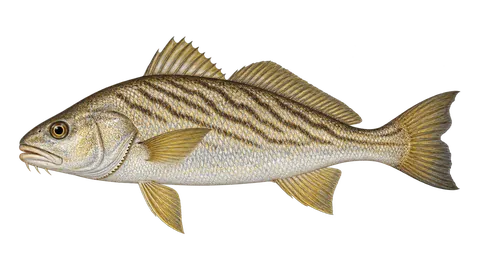
Elongated, rounded body, rounded snout that projects past the mouth, which is underneath, and a single short thick barbel on the chin. Silvery grey to dark, with dark V-shaped oblique bands on the flanks. Tail with a pointed upper lobe and a rounded lower one. Difference from the croaker: only one barbel and a rounded body. The white betara (M. littoralis) is paler and without clear bands.
Also called: papa-terra, betara, betara-preta, embetara
don't confuse with:
where found
open on the large mapWhere to look: Surf zone and channels (gutters) of sandy beaches, inlet mouths and bays with sandy bottoms.
The whole Brazilian coast on sandy beaches, especially the open-sea beaches of the Southeast and South.
coast
states
Amapá, Pará, Maranhão, Piauí, Ceará, Rio Grande do Norte, Paraíba, Pernambuco, Alagoas, Sergipe, Bahia, Espírito Santo, Rio de Janeiro, São Paulo, Paraná, Santa Catarina, Rio Grande do Sul
when to fish
best season
In the South and Southeast the best season runs from spring to autumn, peaking at the end of summer; in winter it declines but still shows up on calm-sea days. In the Northeast, all year.
best time of day
Daytime, with peaks at dawn and dusk. Bites by day, with peaks at dawn, at dusk and in the first hours of the rising tide.
what affects the southern kingfish
cold and cold fronts
A cold front cools the shore and drives the betara away for a few days.
atmospheric pressure
Best with stable weather and a moderate sea; after a front, with a rough sea, it's poor.
moon
Small effect; big tides dig the gutters deeper.
rain
Light rain doesn't bother it.
water level
Surf changes the sandbars: after it, look for new gutters.
noise
Not very sensitive; don't wade into the gutter you're going to fish.
wind
Strong onshore wind makes foam and drags the sinker; a land breeze leaves the sea flat and the betara wary.
tide
The rising tide is the betara's tide: the first three hours, with water flowing into the gutters, produce best. On the falling tide, fish the mouths of the return channels. At low-tide slack it disappears from the shore.
depth
Gutters 0.5 to 3 m inside the surf.
how to fish
natural baits
- tatuí (sand crab)
- corrupto
- beach worm (polychaete)
- shrimp
- marisco
tip from an angler
Collect tatuí on the same beach where you'll fish. Cast short, into the gutter just past the first break: the betara feeds close to the shore.
- rod
- 3.9 to 4.2 m (13 to 14 ft), 60 to 150 g
- spinning / baitcasting reel
- 5000 to 6000 surf reel
- line
- monofilament 0.28 to 0.33 mm
- leader
- 0.50 mm shock leader; rig of 2 or 3 hooks
- hook
- maruseigo or chinu no. 1 to 1/0
accessories
- grapnel sinker 60 to 120 g
- corrupto pump
- tatuí sieve
- rod holder
catch and release
Small fish swallow the hook deep: use a circle hook or a long-shank hook, unhook with pliers and release it in the foam.
rules for the southern kingfish
Rules change; before keeping or transporting fish, check with the state environmental agency.
Reference federal minimum size (20 cm)
20 cm (TL)ESRJSPPRSCRSconfirm with the agency details
IN MMA 53/2005 sets 20 cm for the betara (papa-terra) on the coast from ES to RS, but names the white betara (Menticirrhus littoralis) specifically. The black betara (M. americanus) does not appear in the annex: use 20 cm as a reference and confirm with the competent agency.
other rules that mention the southern kingfish (1)
Minimum size: 20 cm
ESRJSPPRSCRSconfirm with the agency details
Source: IN MMA nº 53/2005 (coast from ES to RS; total length)
Conservation: Not on the national list of threatened species.
how much it weighs without taking it out of the water
estimated weight
—
how we calculate
Length-weight relationship W = a·Lb (a = 0.00813, b = 3.07; FishBase (estimativa bayesiana, comprimento total)). It's an average: a fat or lean fish can vary by 10% to 20%.
more about the southern kingfish
The betara, or papa-terra, is the beach fish par excellence. It lives in the surf zone and in the channels of sandy beaches along the whole coast, digging the bottom for tatuí, corruptos, polychaetes and small crustaceans. It moves in small groups and follows the rising water: the first hours of the rising tide and the backwash after a series of waves are the right moments. It is small, 20 to 40 cm, but fights well on beach tackle and forms schools. It is the school of surf casting: it teaches you to read the beach, find gutters and feel the bite. White, delicate meat, one of the best fries on the coast.
Family: Sciaenidae · predator
fun facts
- Adults have almost no swim bladder, so they don't 'drum' like the croaker.
- It eats a lot of tatuí: a beach with tatuí is a betara beach.
in the kitchen
White, delicate meat. Fried whole or as breaded fillets (à milanesa).
similar species
sources and references (6)
The season weights (months), the time of day and the sensitivities (cold, pressure, moon, wind, rain, tide, strong light, murky water and noise) are the app's editorial estimates, based on the literature below and on the field experience of anglers and guides. They are not official data nor a measurement made for this species, and they may vary by region and year. Closed seasons and legal rules appear in the rules section, with the norm and a link.
- scientific FishBase — Menticirrhus americanus (ficha da espécie)Names, distribution, biology, length-weight relationship and references. Page checked on October 13, 2026.
- official Portaria GM/MMA nº 1.667, de 27 de abril de 2026 — Lista Nacional Oficial de Espécies da Fauna Ameaçadas de Extinção (peixes e invertebrados aquáticos)Most recent national list. The species is not on it (search by scientific name in the text published in the DOU, checked on October 13, 2026).
- scientific IUCN Red List — Menticirrhus americanus (avaliação global: Pouco Preocupante, LC, 11/07/2023)Global assessment. Link given on the FishBase entry (Red List, version 2025-2).
- scientific Carpenter, K. E. (org.) (2002). The living marine resources of the Western Central Atlantic. Vol. 3: Bony fishes part 2 (Opistognathidae to Molidae). FAO Species Identification Guide for Fishery Purposes. Roma: FAO.Chapter Sciaenidae (Chao, N. L.).
- scientific Menezes, N. A.; Buckup, P. A.; Figueiredo, J. L.; Moura, R. L. (orgs.) (2003). Catálogo das espécies de peixes marinhos do Brasil. São Paulo: Museu de Zoologia da USP. 160 p.List of the marine species recorded in Brazil. Printed work; the URL is the bibliographic record in FishBase, which cites the catalogue for the species.
- scientific Carvalho-Filho, A. (1999). Peixes: costa brasileira. 3ª ed. São Paulo: Melro. 320 p.Printed work; the URL is the bibliographic record on FishBase, which cites this work for the species.
how we calculatewhere each number comes from
The weather comes from three independent global models, cross-checked hour by hour: when they agree, confidence goes up; when they diverge, the band between them shows on the chart. Beyond 16 days, we use the GEFS ensemble of 31 simulations: if 20 of the 31 predict rain, the chance of rain is 65%. Sun and moon are calculated astronomically, with no uncertainty.
The index adds up, weighted for each species: time of day (species curve anchored to real sunrise and sunset), moon (transits, rise and set, phase), pressure (3 h trend and 24 h swing), water temperature (in rivers, estimated from air temperature; at sea, estimated by an ocean model), wind, rain, clouds, tide and the month in the species' cycle.
sources for this lookup
how accurate the forecast is
Accuracy measured in the reference project (4 regions, 93 days, forecast vs. observed): maximum temperature is off by 0.6 °C on average the next day and 1.7 °C at 7 days; rain of 5 mm or more is detected 76% of the time the next day and 57% at 7 days. Detection isn't everything: the false alarm rate isn't published here yet, and 93 days in 4 regions is still a small sample. We now also measure every day, at the app's destinations: