

- common size
- 35–60 cm
- maximum
- 90 cm
- common weight
- 0.3–1.6 kg
- record/max.
- 30.0 kg
- depth
- 10–60 m
- ideal water
- 22–29 °C

the right time
to be on the water
Choose the place and the species. The index, from 0 to 100, combines weather, sun, moon and tide with each fish's habits. Up to 28 days, with each day's confidence.
Loading the forecast…
—
Looking for alerts within 30 km…
Looking for what anglers have logged near here…
what you need to fish herelicense, certification and boat documents
fish likely at this spot
Tap a fish to see its forecast.
hour by hour
slide your finger or mouse over the chart to see each hoursee hour-by-hour table
why this index at —?
choose the day
the fishing month at a glance
what's the best window for the crew?
Choose how many fishing days. We compare each stretch by its average index, discount days with a warning or closed season, and show the 3 best.
trend for the coming weeks
Line: the middle value of 31 simulations of the American GEFS model. Band: where 8 out of 10 fall. Narrow, firm trend; wide, high uncertainty.
everything about the striped corvina
how to recognize it
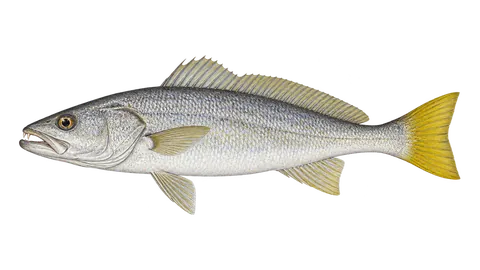
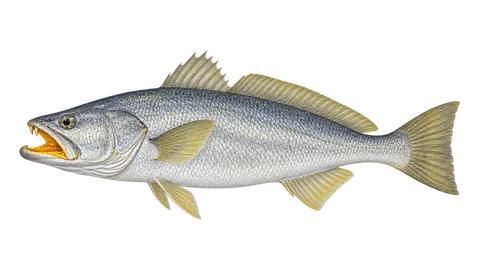
Elongated, deep, compressed body, silvery, with brownish wavy streaks on the back and flanks, lighter along the lateral line. Very oblique mouth, with the lower jaw strongly projecting and a pair of large canines at the tip of the upper jaw; no barbel. Body and head scales are rough, the tail is straight (pointed in juveniles), and the dorsal has 25 to 29 soft rays (20 to 22 in the corvina picuda). Yellowish fins, with a dark dorsal edge and a dark pectoral axil.
Also called: corvina-listrada, striped corvina, striped weakfish
don't confuse with:
where found
open on the large mapWhere to look: Shallow coastal waters with sand and mud bottoms, estuaries, lagoons and river mouths; adults also on the shelf.
Does not occur in Brazil. Eastern Pacific, from southern Baja California and the Gulf of California, in Mexico, to Colombia, through Guatemala, El Salvador, Honduras, Nicaragua, Costa Rica and Panama. FishBase stops at Panama and says it probably reaches northern Colombia; STRI records Colombia.
when to fish
best season
Fished all year in tropical areas; no documented season. Moon tides and the incoming tide at a river mouth with clear water concentrate the fish.
best time of day
Dawn and dusk. Most active at dawn, at dusk and at night, when it enters river mouths and channels to hunt. By day it tends to stay deeper, in pools and along channel edges.
what affects the striped corvina
cold and cold fronts
Cold upwelling shuts down activity in the shallows.
atmospheric pressure
A front with the sea turning hinders fishing at bar mouths and beaches.
moon
Full and new moon tides move the channels and activate the schools.
rain
Heavy rain muddies the estuary; afterward, murkier water helps with natural bait.
water level
Does not apply at sea. In the estuary, the incoming tide brings the fish in.
noise
Approach river mouths and shallow channels quietly.
wind
Strong wind raises the surf and hinders fishing from an anchored boat.
tide
A moving tide is best, especially the incoming tide in channels and river mouths.
depth
From the bottom of shallow channels, at about 30 m; found deeper on the shelf.
how to fish
lures
- jig head 1/2 to 1 oz with 10 to 15 cm shad
- swimbait
- mid-water jerkbait
- metal spoon
natural baits
- small live fish (sardine, mullet)
- large shrimp
- squid strips
tip from an angler
Stay at the mouth of the channel on the incoming tide and let the live bait drift along the bottom: the big ones wait for the fish to come out of the current.
- rod
- 7' to 9', 12 to 25 lb
- spinning / baitcasting reel
- spinning reel 4000 to 5000 or low-profile baitcasting reel
- line
- braided line 20 to 40 lb
- leader
- fluorocarbon 30 to 50 lb, 1 m (the canines wear thin leader)
- hook
- circle 3/0 to 5/0 on live bait; small treble hook on artificial lures
accessories
- sliding sinker, 40 to 120 g
- long-nose pliers
- boga
catch and release
Hold it by the jaw with a boga or pliers, watching the canines, and release it quickly. Large fish: support the belly and keep the body in the water while you remove the hook.
rules for the striped corvina
Rules change; before keeping or transporting fish, check with the state environmental agency.
Mexico: up to 5 per species and 10 saltwater fish per day
5 specimens of the species per angler per day, within the limit of 10 saltwater fish details
In federal waters of Mexico, recreational sport fishing allows each angler to keep up to 10 marine fish per day, no more than 5 of the same species. The striped corvina (corvina rayada) is not among the species reserved for sport fishing (marlins, sailfish, swordfish, tarpon (sábalo), roosterfish and dorado, up to 50 nautical miles from shore, item 0.3 of the standard) and has no quota of its own. Fish over the quota must go back alive, and sport-caught fish may not be sold. From shore you need no permit; from a boat, you do (permits under the Federal Duties Law, item 4.3).
how much it weighs without taking it out of the water
estimated weight
—
how we calculate
Length-weight relationship W = a·Lb (a = 0.00759, b = 2.99; FishBase (relação peso-comprimento bayesiana, estimativa da própria espécie)). It's an average: a fat or lean fish can vary by 10% to 20%.
more about the striped corvina
One of the largest croakers in the eastern tropical Pacific, from southern Baja California and the Gulf of California to Colombia. Lives in shallow coastal waters, estuaries and on the shelf, from 1 to 107 m according to STRI (FishBase gives 10 to 60 m), on sand and mud bottoms. Adults occupy areas of high salinity and eat fish, shrimp and other crustaceans. It reaches 90 cm. It has a small commercial fishery and is recognized as a sport fish: caught at river mouths, beaches and lagoons, from an anchored or drifting boat, with live fish, shrimp and midwater jigs.
Family: Sciaenidae · predator
fun facts
- In Panama it is called herrero; in Mexico, Nicaragua and Panama, corvina rayada.
- FishBase records a published maximum weight of 30 kg, a value that does not fit the length (the length-weight relationship gives about 5 kg at 90 cm).
in the kitchen
White, soft flesh; good fried, baked whole, grilled as fillets over coals or in ceviche.
similar species


sources and references (5)
The season weights (months), the time of day and the sensitivities (cold, pressure, moon, wind, rain, tide, strong light, murky water and noise) are the app's editorial estimates, based on the literature below and on the field experience of anglers and guides. They are not official data nor a measurement made for this species, and they may vary by region and year. Closed seasons and legal rules appear in the rules section, with the norm and a link.
- scientific FishBase: Cynoscion reticulatus (ficha da espécie)Size, length-weight relationship, depth, habitat, distribution, biology and IUCN status. Page checked Oct 13, 2026. The published maximum weight of 30 kg is not compatible with the maximum length of 90 cm (the length-weight relationship predicts about 5 kg); we kept FishBase's value, with no confirmation from another source.
- scientific FishBase: nomes populares de Cynoscion reticulatusNames by country and language.
- scientific Robertson, D. R. & Allen, G. R. (2024). Shorefishes of the Eastern Pacific online information system. Smithsonian Tropical Research Institute: Cynoscion reticulatusDescription, colors, size (up to 90 cm), depth (1 to 107 m) and distribution (southern Baja California and the Gulf of California to Colombia). It was the basis for including Colombia among the countries, which FishBase admits only as probable. Page checked Oct 13, 2026.
- scientific Chao, L. N. (1995). Sciaenidae. Corvinas, barbiches, bombaches, corvinatas, corvinetas, corvinillas, lambes, pescadillas, roncachos, verrugatos. In: Fischer, W. et al. (eds.). Guía FAO para la identificación de especies para los fines de la pesca. Pacífico centro-oriental. Vol. 3, p. 1427-1518. Roma: FAO.Main FishBase reference for feeding, habitat and description.
- official DOF: Modificação da NOM-017-PESC-1994, para regular a pesca deportivo-recreativa em águas de jurisdição federal do México (publicada em 25/11/2013)Species reserved for sport fishing (item 0.3), permits (4.3 and 4.14), rod and hooks (4.6), bait (4.7), daily quotas at sea (4.9.1) and in fresh water (4.9.2), catch and release (4.9.5), closed areas and seasons (4.10) and the ban on selling the fish (4.11). Text checked Oct 13, 2026. The text carries the signature date of Oct 14, 2013; the DOF publication date (Nov 25, 2013) is the one the catalog already uses.
how we calculatewhere each number comes from
The weather comes from three independent global models, cross-checked hour by hour: when they agree, confidence goes up; when they diverge, the band between them shows on the chart. Beyond 16 days, we use the GEFS ensemble of 31 simulations: if 20 of the 31 predict rain, the chance of rain is 65%. Sun and moon are calculated astronomically, with no uncertainty.
The index adds up, weighted for each species: time of day (species curve anchored to real sunrise and sunset), moon (transits, rise and set, phase), pressure (3 h trend and 24 h swing), water temperature (in rivers, estimated from air temperature; at sea, estimated by an ocean model), wind, rain, clouds, tide and the month in the species' cycle.
sources for this lookup
how accurate the forecast is
Accuracy measured in the reference project (4 regions, 93 days, forecast vs. observed): maximum temperature is off by 0.6 °C on average the next day and 1.7 °C at 7 days; rain of 5 mm or more is detected 76% of the time the next day and 57% at 7 days. Detection isn't everything: the false alarm rate isn't published here yet, and 93 days in 4 regions is still a small sample. We now also measure every day, at the app's destinations: