

- common size
- 60–120 cm
- maximum
- 160 cm
- common weight
- 10–40 kg
- record/max.
- 100.0 kg
- depth
- 3–25 m
- ideal water
- 25–30 °C

the right time
to be on the water
Choose the place and the species. The index, from 0 to 100, combines weather, sun, moon and tide with each fish's habits. Up to 28 days, with each day's confidence.
Loading the forecast…
—
Looking for alerts within 30 km…
Looking for what anglers have logged near here…
what you need to fish herelicense, certification and boat documents
fish likely at this spot
Tap a fish to see its forecast.
hour by hour
slide your finger or mouse over the chart to see each hoursee hour-by-hour table
why this index at —?
choose the day
the fishing month at a glance
what's the best window for the crew?
Choose how many fishing days. We compare each stretch by its average index, discount days with a warning or closed season, and show the 3 best.
trend for the coming weeks
Line: the middle value of 31 simulations of the American GEFS model. Band: where 8 out of 10 fall. Narrow, firm trend; wide, high uncertainty.
everything about the gilded catfish (jaú)
how to recognize it
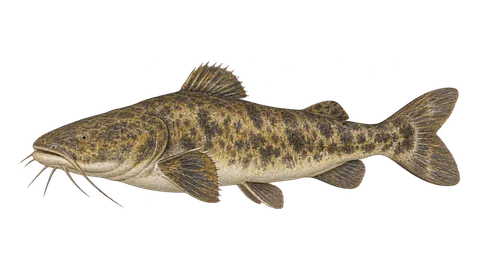
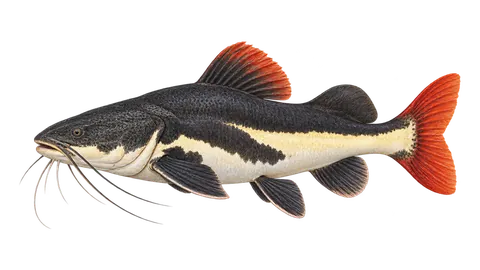
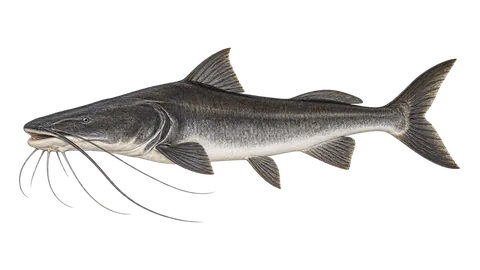
Thick, short body for its size, very wide and flat head, huge mouth. Brown to olive color with dark blotches and spots, more marked in juveniles; pale belly. Small eyes and long barbels. The redtail catfish has a red tail and yellow band. The piraíba is more elongated and grey. The jau of the Plata is another species, from the Paraná basin.
Also called: jaú
don't confuse with:
where found
open on the large mapWhere to look: Deep pools below rapids and waterfalls, channels with rocks and logs, deep backwaters.
Amazon and Araguaia-Tocantins basins, especially the rapids pools of the Araguaia, Tocantins, Xingu, Tapajós, Teles Pires and Madeira rivers.
native to the basins
states
Amazonas, Pará, Mato Grosso, Tocantins, Rondônia, Acre, Roraima, Amapá, Goiás
when to fish
best season
Dry season, June to October, when the pools below the rapids become well defined.
best time of day
Nighttime. Feeds mainly at night. By day it stays hidden and only takes a bait placed well in the pool.
what affects the gilded catfish (jaú)
cold and cold fronts
A cold snap (friagem) reduces activity.
atmospheric pressure
A pressure drop before rain can trigger it.
moon
Dark nights tend to produce more.
rain
Little effect.
water level
Low water concentrates jau in the pools.
noise
Not very sensitive in rapids.
wind
Little effect.
depth
Pool bottom, 5 to 25 m.
how to fish
lures
- not used
natural baits
- whole live or fresh fish (piau, curimatã, mandi, small payara)
tip from an angler
When the jau sticks to the bottom, don't give it slack: keep constant pressure and change the boat's angle to pull it off the rock.
- rod
- 7'0'', extra-heavy, 50 to 100 lb
- spinning / baitcasting reel
- high-profile baitcasting reel 400 to 500 or 14000 to 20000 spinning reel
- line
- braided line 80 to 100 lb
- leader
- monofilament 150 lb, 1.5 m
- hook
- circle hook 10/0 to 12/0; sinker 150 to 300 g
accessories
- fighting belt
- luvas
- large pliers
catch and release
Keep the jau in the water; a fish over 40 kg should not be lifted. Hold it by the mouth with a thick glove, support its belly and release it in the pool where it was caught.
kits and guides
rules for the gilded catfish (jaú)
Rules change; before keeping or transporting fish, check with the state environmental agency.
Zero transport in Mato Grosso
catch and release mandatory; transport, storage and sale bannedMT details
Until Dec 31, 2028, jau caught in rivers of Mato Grosso may not be transported, stored or sold. Recreational anglers may only practice catch and release.
Source: Lei estadual nº 12.434/2024 (MT), arts. 19-B and 19-C of Lei 9.096/2009
Size window in Tocantins
80 cm (maximum 120 cm)TO details
In Tocantins the jau may only be kept between 80 and 120 cm. Large ones go back into the water.
Source: Portaria NATURATINS/GABIN nº 47/2026 (annexes amended by Portaria nº 105/2026)
other rules that mention the gilded catfish (jaú) (3)
Mato Grosso: Zero Transport for 12 species
MT details
Transport, storage and sale are fully prohibited for 5 years from Jan 1, 2024 for: cachara, caparari, dorado, jaú, matrinchã (Brycon spp.), pintado/surubim (Pseudoplatystoma spp.), piraíba, piraputanga, pirarara, arapaima (pirarucu), trairão and peacock bass (tucunaré, Cichla spp.). For recreational anglers: catch and release only. These 12 species may not even be eaten on site, since the 2 kg or 1 fish limit excludes the art. 19-B list. The law cites jaú as Zungaro zungaro; we also include the Pantanal jaú (Z. jahu) out of caution. The list may still change: § 2 (exotic and predatory species), § 3 (review through study) and the 3-year assessment planned for 2027. A TJMT news report of Jun 2, 2026 confirms the 12 prohibited species. The STF denied a preliminary injunction in the ADIs against the law in 2024; we found no merits ruling.
Minimum size: 80 cm (max. 120 cm)
TO details
Source: Portaria Naturatins nº 47/2026, Annex I, as amended by Portaria nº 105/2026
Minimum size: 80 cm
GOTOPAMAMT details
Source: INIs MPA/MMA nº 12/2011 (Araguaia) and 13/2011 (Tocantins), minimum size annexes
piracema and closed seasons
Each bar is the period when fishing is prohibited or restricted. The green line is today. Tap the name to see what is still allowed.
Closed season in Goiás (state rule)
Allowed: Sport and guided fishing only in reservoirs, catch and release with barbless hooks (no keeping, transporting or eating). Subsistence: up to 5 kg per day, for household consumption only.
Spawning closure (piracema) in Mato Grosso (all basins)
Allowed: All fishing modalities are prohibited in rivers, including catch and release (Law 9.096/2009, art. 19-A). Exceptions: subsistence fishing from shore (3 kg or 1 fish, no transport or sale) and scientific fishing. Law 13.159/2025 now allows licensed sport fishing in UHE/PCH hydropower reservoirs, natural lakes and border rivers, subject to a scientific study and a license from the environmental agency. We have not confirmed whether these licenses are already being issued.
Spawning closure (piracema) in the Araguaia River basin
Allowed: Recreational fishing only in reservoirs, with handline, rod, or spinning or baitcasting reel. Fish may only be eaten on site, not transported. Competitions prohibited. Subsistence: 3 kg + 1 fish. State rules (GO and TO) may be stricter.
Spawning closure (piracema) in the Tocantins and Gurupi river basins
Allowed: Recreational fishing only in reservoirs, with on-site consumption. Subsistence: 5 kg + 1 fish. State rules may be stricter.
Spawning closure (piracema) in Tocantins (state rule)
Allowed: Recreational catch and release with barbless hooks and a recreational fishing card; subsistence fishing by riverside and artisanal fishers from the bank or a rowboat, with a cane pole, handline and hook, with no transport or sale.
Closed season in the Amazon basin in Amazonas
Allowed: Under Portaria 48/2007 (art. 2, II), the recreational angler who fishes with handline or rod, line and hook is outside the Annex II prohibitions, unless a stricter state rule applies. Recreational angler bag limit: 5 kg + 1 fish. Competitions prohibited.
Source: Portaria IBAMA nº 48/2007
Closed season in the Amazon basin in Acre
Allowed: Recreational anglers with handline or rod, line and hook are outside the Annex II prohibitions, with a bag limit of 5 kg + 1 fish, unless a stricter state rule applies. On the Acre River, no fishing of any species during the period.
Source: Portaria IBAMA nº 48/2007; IN IBAMA nº 205/2008 (Acre River)
Closed season in the Acre river
Allowed: IN Ibama 205/2008 prohibits fishing in the Acre river and its tributaries during the closed season, with no exception for recreational anglers: treat it as prohibited.
Source: IN IBAMA nº 205/2008
Closed season in the Amazon basin in Pará
Allowed: Recreational anglers with handline or rod, line and hook are outside the Annex II prohibitions, with a bag limit of 5 kg + 1 fish, unless a stricter state rule applies.
Source: Portaria IBAMA nº 48/2007
Closed season in the rivers of Marajó Island (PA)
Allowed: The same recreational-angler exceptions as in Portaria 48/2007 apply (handline or rod, 5 kg + 1 fish), unless a stricter state rule applies.
Source: Portaria IBAMA nº 48/2007
Amazon basin closed season in Rondônia
Allowed: In the Madeira, Mamoré, Jamari, Abunã, Machado and Roosevelt river basins and in the main channel of the Guaporé, licensed recreational anglers may fish only for non-protected species, using a single simple gear per person (handline, rod with or without a reel, or a simple pole with a single hook). The limit is up to 5 kg or 1 fish per week; if the fish is over 5 kg, you keep only that one. You may not sell, trade or give away the catch. Catch and release is allowed only with non-protected species. Fishing is always banned within 200 m of dams, rapids, waterfalls, fish ladders and river mouths.
Closed season in the Amazon basin in Amapá
Allowed: Recreational anglers with handline or rod, line and hook are outside the Annex II prohibitions, with a bag limit of 5 kg + 1 fish, unless a stricter state rule applies.
Source: Portaria IBAMA nº 48/2007
Closed season in Roraima
Border rivers MT/RO and MT/PA
Allowed: See the exceptions in Portaria 48/2007 and the state rules for each bank.
Source: Portaria IBAMA nº 48/2007
Conservation: Not on the national list (Portaria GM/MMA 1.667/2026). Slow growth makes large individuals vulnerable to fishing.
how much it weighs without taking it out of the water
estimated weight
—
how we calculate
Length-weight relationship W = a·Lb (a = 0.01514, b = 3.03; FishBase (bayesiano, espécie + forma do corpo da família)). It's an average: a fat or lean fish can vary by 10% to 20%.
more about the gilded catfish (jaú)
The jau is a stocky catfish with a huge head and thick body, living in deep pools below rapids and waterfalls and in channels of large rivers. It hunts fish at night and spends the day hidden among rocks. It grows slowly and lives many years, so big ones are rare and should be released. In sport fishing it is the toughest opponent: once hooked, it hugs the bottom and uses weight and current to its advantage, and the fight can last a long time. It requires very heavy tackle and patience. In the Amazon and Araguaia there are still specimens over 50 kg.
Family: Pimelodidae · predator
fun facts
- Juveniles have a handsome marbled pattern that fades with age.
- Large fish can live for decades in the same pool.
in the kitchen
Fatty flesh; in the Amazon many consider it "reimosa" (strong-tasting). A fish to release.
similar species
sources and references (6)
The season weights (months), the time of day and the sensitivities (cold, pressure, moon, wind, rain, tide, strong light, murky water and noise) are the app's editorial estimates, based on the literature below and on the field experience of anglers and guides. They are not official data nor a measurement made for this species, and they may vary by region and year. Closed seasons and legal rules appear in the rules section, with the norm and a link.
- scientific FishBase — Zungaro zungaro (ficha da espécie)Names, distribution, biology, length-weight relationship and references. Page checked on October 13, 2026.
- official Portaria GM/MMA nº 1.667, de 27 de abril de 2026 — Lista Nacional Oficial de Espécies da Fauna Ameaçadas de Extinção (peixes e invertebrados aquáticos)Most recent national list. The species is not on it (search by scientific name in the text published in the DOU, checked on October 13, 2026).
- official ICMBio/SALVE — Ficha de Zungaro zungaro (avaliação nacional do risco de extinção)National assessment by ICMBio, published in 2024. DOI verified on Crossref.
- scientific IUCN Red List — Zungaro zungaro (avaliação global: Pouco Preocupante, LC, 21/12/2020)Global assessment. Link given on the FishBase entry (Red List, version 2025-2).
- scientific Silfvergrip, A. M. C. (1992). Zungaro, a senior synonym of Paulicea (Teleostei: Pimelodidae). Ichthyological Exploration of Freshwaters 3(4): 305–310.Journal article with no DOI; the URL is the bibliographic record in FishBase.
- scientific Lundberg, J. G.; Littmann, M. W. (2003). Pimelodidae (long-whiskered catfishes). In: Reis, R. E.; Kullander, S. O.; Ferraris Jr., C. J. (orgs.). Check List of the Freshwater Fishes of South and Central America. Porto Alegre: EDIPUCRS, p. 432–446.Printed book chapter; the URL is the bibliographic record on FishBase, which cites the chapter for the species.
how we calculatewhere each number comes from
The weather comes from three independent global models, cross-checked hour by hour: when they agree, confidence goes up; when they diverge, the band between them shows on the chart. Beyond 16 days, we use the GEFS ensemble of 31 simulations: if 20 of the 31 predict rain, the chance of rain is 65%. Sun and moon are calculated astronomically, with no uncertainty.
The index adds up, weighted for each species: time of day (species curve anchored to real sunrise and sunset), moon (transits, rise and set, phase), pressure (3 h trend and 24 h swing), water temperature (in rivers, estimated from air temperature; at sea, estimated by an ocean model), wind, rain, clouds, tide and the month in the species' cycle.
sources for this lookup
how accurate the forecast is
Accuracy measured in the reference project (4 regions, 93 days, forecast vs. observed): maximum temperature is off by 0.6 °C on average the next day and 1.7 °C at 7 days; rain of 5 mm or more is detected 76% of the time the next day and 57% at 7 days. Detection isn't everything: the false alarm rate isn't published here yet, and 93 days in 4 regions is still a small sample. We now also measure every day, at the app's destinations: