

- common size
- 25–45 cm
- maximum
- 50 cm
- common weight
- 0.2–0.8 kg
- record/max.
- 1.3 kg
- depth
- 2–60 m
- ideal water
- 22–29 °C

the right time
to be on the water
Choose the place and the species. The index, from 0 to 100, combines weather, sun, moon and tide with each fish's habits. Up to 28 days, with each day's confidence.
Loading the forecast…
—
Looking for alerts within 30 km…
Looking for what anglers have logged near here…
what you need to fish herelicense, certification and boat documents
fish likely at this spot
Tap a fish to see its forecast.
hour by hour
slide your finger or mouse over the chart to see each hoursee hour-by-hour table
why this index at —?
choose the day
the fishing month at a glance
what's the best window for the crew?
Choose how many fishing days. We compare each stretch by its average index, discount days with a warning or closed season, and show the 3 best.
trend for the coming weeks
Line: the middle value of 31 simulations of the American GEFS model. Band: where 8 out of 10 fall. Narrow, firm trend; wide, high uncertainty.
everything about the spotted rose snapper
how to recognize it
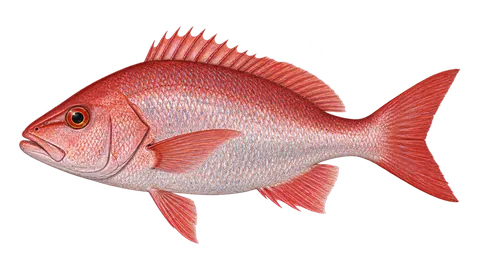
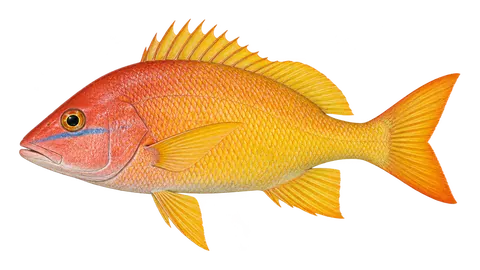
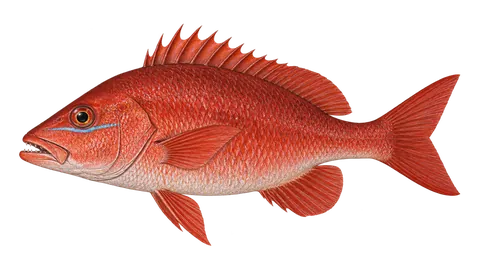
Light carmine flank with a silvery sheen and horizontal rows of bluish dots, golden-yellow belly, and a head with bluish dots and lines. The species' mark is a large dark spot high on the back, below the end of the spiny part of the dorsal fin (the lunar). The scale rows on the back rise diagonally above the lateral line. The Pacific red snapper is pinkish-red without the spot.
Also called: pargo-lunarejo, pargo-da-mancha, spotted rose snapper
don't confuse with:
where found
open on the large mapWhere to look: Hard bottoms and coastal reefs at 10 to 60 m; juveniles in estuaries and river mouths.
Not found in Brazil. Eastern Pacific, from Mexico (including the Gulf of California) to Peru, including the Galápagos Islands.
when to fish
best season
Fishable all year. Moderate current and clear water over the rock matter more than the month.
best time of day
Dawn and dusk. Feeds more at dawn, dusk and night; by day it bites well on natural bait on the bottom.
what affects the spotted rose snapper
cold and cold fronts
Cold upwelling shuts down activity.
atmospheric pressure
A front with the sea turning rough hampers bottom fishing.
moon
Strong moons move more water over the rocks.
rain
Little effect on the bottom; heavy rain muddies the estuaries.
water level
Not applicable at sea.
noise
Anchor upstream of the rock and let the bait drift down; noise over the school spooks it.
wind
Strong wind makes it hard to keep the boat over the rock.
tide
Moderate current is best.
depth
From 10 to 50 m over rocks and shoals.
how to fish
lures
- metal jig 30 to 60 g
- jig head with small shad
- slow jig
natural baits
- squid strips
- shrimp
- sardine fillet
tip from an angler
Use a small hook and bait in strips: the spotted rose snapper nibbles before swallowing. Keep the bait about 20 cm off the bottom.
- rod
- 6' to 7', 12 to 25 lb
- spinning / baitcasting reel
- spinning reel 3000 to 4000 or small baitcasting reel
- line
- braid 20 to 30 lb
- leader
- fluorocarbon 25 to 40 lb, 1 m
- hook
- circle 1/0 to 3/0
accessories
- sinker 40 to 120 g
- descender (fish descender)
- alicate
catch and release
Bottom fish can float up with an inflated swim bladder: use a descender to return it to depth. Respect the minimum sizes of each country.
rules for the spotted rose snapper
Rules change; before keeping or transporting fish, check with the state environmental agency.
Mexico: up to 5 per species and 10 saltwater fish per day
5 specimens of the species per angler per day, within the limit of 10 saltwater fish details
In recreational sport fishing in Mexican federal waters, each angler may keep up to 10 saltwater fish per day, no more than 5 of the same species. The spotted rose snapper (pargo lunarejo) is not among the species reserved for sport fishing under art. 68 of the General Law of Sustainable Fishing and Aquaculture, and has no quota of its own. Fish over the limit must be returned alive to the water, and sport-caught fish may not be sold. Anglers fishing from a boat need a Conapesca permit.
Costa Rica: minimum size of 32 cm
32 cm (total length)confirm with the agency details
Incopesca set, in AJDIP/026-2018 (which repealed AJDIP/102-2017), a legal first-catch size of 30 cm total length for the spotted rose snapper (pargo mancha) during the first two years (until February 2020). After that, art. 7, b requires applying the first-maturity size of 32 cm, which is the minimum to respect today. The rule covers all fishing activity, prohibits selling and transporting fish below the size, and allows a 10% tolerance in number and weight, only from catch to landing. We found no later agreement that changes this; check with Incopesca.
El Salvador: minimum size of 23 cm (rule not confirmed in full)
23 cm (total length)confirm with the agency details
Document from El Salvador's Ministry of Agriculture and Livestock (MAG) that prohibits, in snapper fishing, catching spotted rose snapper (lunarejo) under 23 cm total length. We did not confirm the number, date or validity of the rule: check with Cendepesca before keeping small fish.
Conservation: Old global assessment; it is one of the most commercially fished snappers in the region.
how much it weighs without taking it out of the water
estimated weight
—
how we calculate
Length-weight relationship W = a·Lb (a = 0.01349, b = 2.9; FishBase). It's an average: a fat or lean fish can vary by 10% to 20%.
more about the spotted rose snapper
Eastern Pacific snapper, from Mexico to Peru. Adults live over hard bottoms and coastal reefs, usually at 10 to 60 m, alone or in small groups, sometimes in large schools; juveniles stay in estuaries and river mouths. It eats invertebrates and fish. It is one of the most fished and sold snappers in the region, and in Mexico it is being tested in aquaculture. For sport anglers it is a bottom fish, caught from boats over rocks and shoals with natural bait, light jigs and silicone lures, and it gives good catches of numbers, with small to medium fish.
Family: Lutjanidae · predator
fun facts
- The black spot on its back gives the lunarejo its name (from lunar, spot).
- In Mexico the species is being studied for farming in ponds and cages.
in the kitchen
White, delicate and highly sought-after flesh; fried whole, roasted or in ceviche.
similar species
sources and references (8)
The season weights (months), the time of day and the sensitivities (cold, pressure, moon, wind, rain, tide, strong light, murky water and noise) are the app's editorial estimates, based on the literature below and on the field experience of anglers and guides. They are not official data nor a measurement made for this species, and they may vary by region and year. Closed seasons and legal rules appear in the rules section, with the norm and a link.
- scientific FishBase — Lutjanus guttatus (ficha da espécie)Names, distribution, biology, length-weight relationship, list of countries and references. Page checked 13/10/2026. FishBase cites up to 105 cm in landing data from Colombia (AUNAP, 2014), a value that does not match the recorded maximum weight (1.3 kg, IGFA record database). The entry uses the maximum length from the FAO catalog (about 50 cm).
- scientific IUCN Red List — Lutjanus guttatus (avaliação global: Pouco Preocupante, LC, 21/05/2007)Global assessment. Link given on the FishBase entry (Red List, version 2025-2).
- scientific Allen, G. R. (1985). FAO species catalogue. Vol. 6. Snappers of the world: an annotated and illustrated catalogue of lutjanid species known to date. FAO Fisheries Synopsis 125(6). Roma: FAO.Maximum total length of about 50 cm (p. 91).
- scientific Hernández-Álvarez, C. et al. (2020). Phylogeography of the Pacific red snapper (Lutjanus peru) and spotted rose snapper (Lutjanus guttatus) in the inshore Tropical Eastern Pacific. Copeia 108(1): 61-71.DOI checked in Crossref.
- official Incopesca (Costa Rica) — Acordo AJDIP/026-2018 da Junta Diretiva: tamanhos legais de primeira captura (12/01/2018; La Gaceta nº 22, de 06/02/2018), que revogou o AJDIP/102-2017Table for art. 1 (snappers: mancha 30 cm, seda 28 cm, coliamarilla 32 cm, with 10% tolerance; first-maturity sizes of 32, 43 and 33 cm). Art. 7, b requires applying the first-maturity size in full after two years from publication (Feb 6, 2018); art. 8 repeals AJDIP/102-2017. Text checked 13/10/2026. We found no later agreement that changes these values.
- official Procuraduría General de la República (Costa Rica), SCIJ — AJDIP/102-2017, registro de norma derrogadaThe record carries a notice that the rule was repealed by agreement AJDIP/026-2018, of January 12, 2018. Page checked 13/10/2026.
- official MAG/Cendepesca (El Salvador) — documento sobre a pesca de pargos publicado no Portal de Transparência do governoWe only checked the section that prohibits, in snapper fishing, sizes below 23 cm (L. guttatus) and 30 cm (L. peru) total length. Number, date and validity of the rule not confirmed; the site blocks automatic access.
- official DOF — Modificação da NOM-017-PESC-1994, para regular a pesca deportivo-recreativa em águas de jurisdição federal do México (publicada em 25/11/2013)Daily limits at sea (item 4.9.1) and in fresh water (4.9.2), one rod in inland waters (4.6 b), ban on live fish as bait in inland waters (4.7 c) and on fishing in closed areas and seasons (4.10).
how we calculatewhere each number comes from
The weather comes from three independent global models, cross-checked hour by hour: when they agree, confidence goes up; when they diverge, the band between them shows on the chart. Beyond 16 days, we use the GEFS ensemble of 31 simulations: if 20 of the 31 predict rain, the chance of rain is 65%. Sun and moon are calculated astronomically, with no uncertainty.
The index adds up, weighted for each species: time of day (species curve anchored to real sunrise and sunset), moon (transits, rise and set, phase), pressure (3 h trend and 24 h swing), water temperature (in rivers, estimated from air temperature; at sea, estimated by an ocean model), wind, rain, clouds, tide and the month in the species' cycle.
sources for this lookup
how accurate the forecast is
Accuracy measured in the reference project (4 regions, 93 days, forecast vs. observed): maximum temperature is off by 0.6 °C on average the next day and 1.7 °C at 7 days; rain of 5 mm or more is detected 76% of the time the next day and 57% at 7 days. Detection isn't everything: the false alarm rate isn't published here yet, and 93 days in 4 regions is still a small sample. We now also measure every day, at the app's destinations: