

- common size
- 25–45 cm
- maximum
- 58 cm
- common weight
- 0.2–1 kg
- record/max.
- 2.1 kg
- depth
- 5–100 m
- ideal water
- 14–22 °C

the right time
to be on the water
Choose the place and the species. The index, from 0 to 100, combines weather, sun, moon and tide with each fish's habits. Up to 28 days, with each day's confidence.
Loading the forecast…
—
Looking for alerts within 30 km…
Looking for what anglers have logged near here…
what you need to fish herelicense, certification and boat documents
fish likely at this spot
Tap a fish to see its forecast.
hour by hour
slide your finger or mouse over the chart to see each hoursee hour-by-hour table
why this index at —?
choose the day
the fishing month at a glance
what's the best window for the crew?
Choose how many fishing days. We compare each stretch by its average index, discount days with a warning or closed season, and show the 3 best.
trend for the coming weeks
Line: the middle value of 31 simulations of the American GEFS model. Band: where 8 out of 10 fall. Narrow, firm trend; wide, high uncertainty.
everything about the striped weakfish (pescada-olhuda)
how to recognize it
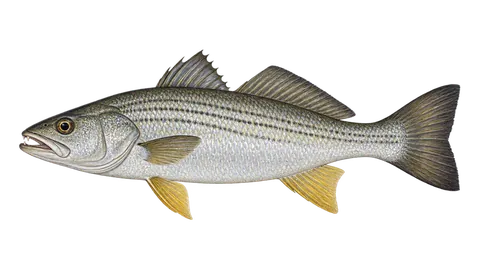
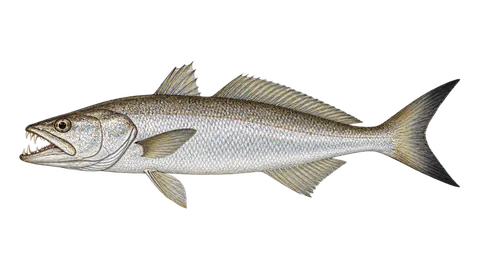
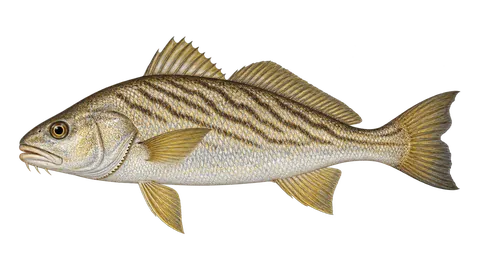
Elongated, silver body with a blue-gray back and oblique lines of dark spots above the lateral line. Large eyes, which give it its name. Large mouth with a pair of canines at the tip of the upper jaw. Differs from the vermilion seatrout by its larger eyes and the spotted lines on its back, and from the pescada-foguete by its blunt, not pointed, tail.
Also called: pescada-olhuda, maria-mole, pescada-maria-mole, pescada
don't confuse with:
where found
open on the large mapWhere to look: Continental shelf over sand and mud bottoms, from shallow coastal waters down to about 50 m, sometimes deeper.
From Rio de Janeiro to Rio Grande do Sul, continuing to Uruguay and Argentina; most abundant in the South.
coast
states
Rio de Janeiro, São Paulo, Paraná, Santa Catarina, Rio Grande do Sul
when to fish
best season
Present all year in the South; schools shift depth with temperature and current.
best time of day
Any time. In deep water it bites throughout the day; near the coast, best at dawn and dusk.
what affects the striped weakfish (pescada-olhuda)
cold and cold fronts
Tolerates cold water better than tropical weakfish.
atmospheric pressure
A strong cold front scatters the schools for a few days.
moon
Small effect.
rain
Not very sensitive.
water level
Not dependent on water level; follows water masses on the shelf.
noise
Not very sensitive at depth.
wind
Rough sea prevents boat fishing.
tide
Moderate current helps spread the bait's scent.
depth
From 10 to 50 m in most boat catches.
how to fish
lures
- 40 to 100 g jigs
- shads on 20 to 50 g jig heads
natural baits
- sardinha
- squid strips
- shrimp
tip from an angler
Chill the weakfish right after catching: the flesh softens fast in heat.
- rod
- 6'0" to 7'0", 12 to 25 lb
- spinning / baitcasting reel
- spinning reel 3000 to 5000 or small baitcasting reel
- line
- braided line 15 to 25 lb
- leader
- monofilament 30 to 40 lb
- hook
- circle 1/0 to 3/0
accessories
- sinker 60 to 200 g
- insulated cooler with ice
catch and release
Brought up from depth, it suffers barotrauma: release it quickly and use a descender if it floats.
rules for the striped weakfish (pescada-olhuda)
Rules change; before keeping or transporting fish, check with the state environmental agency.
Minimum size 30 cm (ES to RS)
30 cm (TL)ESRJSPPRSCRS details
On the coast from ES to RS it is banned to fish for, keep on board or land pescada-olhuda under 30 cm total length. The 20% tolerance of the catch (by weight) provided in the rule is for enforcement at landings; recreational anglers must release the small ones. The rule does not apply to trawling.
Source: IN MMA nº 53/2005, Annex II (pescada-olhuda or maria-mole / striped weakfish, Cynoscion striatus)
Conservation: Not on the national list (Portaria GM/MMA 1.667/2026). Minimum size of 30 cm from ES to RS (IN MMA 53/2005, as Cynoscion striatus).
how much it weighs without taking it out of the water
estimated weight
—
how we calculate
Length-weight relationship W = a·Lb (a = 0.00871, b = 3.06; FishBase (estimativa bayesiana, comprimento total)). It's an average: a fat or lean fish can vary by 10% to 20%.
more about the striped weakfish (pescada-olhuda)
The pescada-olhuda, also called maria-mole, is a weakfish of subtropical and temperate waters, from Rio de Janeiro to Argentina. It is more oceanic than other weakfish: it lives near the bottom on the shelf, usually at less than 50 m, but reaches nearly 200 m. It eats small fish and shrimp. It is one of the main demersal resources of commercial fishing in southern Brazil, Uruguay and Argentina, caught by trawl and gillnet. Recreational anglers catch it in bottom fishing from boats, on reef banks and on the shallow shelf, with sardine, squid and shrimp baits. The meat is soft and spoils quickly unless chilled right after capture. For a long time it was called Cynoscion striatus, a name that still appears in legislation.
Family: Sciaenidae · predator
fun facts
- The legislation still uses the old name Cynoscion striatus.
- It is one of the most important weakfish for commercial fishing in southern Brazil.
in the kitchen
Soft, light meat, good fried, as fillets or in stew. Needs ice right away.
similar species
sources and references (9)
The season weights (months), the time of day and the sensitivities (cold, pressure, moon, wind, rain, tide, strong light, murky water and noise) are the app's editorial estimates, based on the literature below and on the field experience of anglers and guides. They are not official data nor a measurement made for this species, and they may vary by region and year. Closed seasons and legal rules appear in the rules section, with the norm and a link.
- scientific FishBase — Cynoscion guatucupa (ficha da espécie)Names, distribution, biology, length-weight relationship and references. Page checked on October 13, 2026.
- official Portaria GM/MMA nº 1.667, de 27 de abril de 2026 — Lista Nacional Oficial de Espécies da Fauna Ameaçadas de Extinção (peixes e invertebrados aquáticos)Most recent national list. The species is not on it (search by scientific name in the text published in the DOU, checked on October 13, 2026).
- official ICMBio/SALVE — Ficha de Cynoscion guatucupa (avaliação nacional do risco de extinção)ICMBio national assessment, published in 2025. DOI checked on Crossref.
- scientific IUCN Red List — Cynoscion guatucupa (avaliação global: Pouco Preocupante, LC, 04/09/2019)Global assessment. Link given on the FishBase entry (Red List, version 2025-2).
- official Instrução Normativa MMA nº 53, de 22 de novembro de 2005 — tamanho mínimo de captura de espécies marinhas e estuarinas do litoral Sudeste e SulText reproduced from the DOU of Nov 24, 2005, checked on Oct 13, 2026. Annex II; § 2 of art. 2 (exemption in competitions) was revoked by IN MMA nº 3/2006.
- scientific Carpenter, K. E. (org.) (2002). The living marine resources of the Western Central Atlantic. Vol. 3: Bony fishes part 2 (Opistognathidae to Molidae). FAO Species Identification Guide for Fishery Purposes. Roma: FAO.Sciaenidae chapter (Chao, N. L.), cited by FishBase for the species.
- scientific Figueiredo, J. L.; Santos, A. P.; Yamaguti, N.; Bernardes, R. A.; Rossi-Wongtschowski, C. L. D. B. (2002). Peixes da zona econômica exclusiva da região Sudeste-Sul do Brasil: levantamento com rede de meia-água. São Paulo: Edusp; Imprensa Oficial. 242 p.Printed work; the URL is the bibliographic record on FishBase, which cites this work for the species.
- scientific Haimovici, M.; Velasco, G. (2000). Length-weight relationships of marine fishes from southern Brazil. Naga, ICLARM Quarterly 23(1): 19–23.Length-weight relationships measured in southern Brazil. Printed work; the URL is the bibliographic record in FishBase, which cites this work for the species.
- scientific Cousseau, M. B.; Perrotta, R. G. (1998). Peces marinos de Argentina: biología, distribución, pesca. Mar del Plata: INIDEP. 163 p.Printed work; the URL is the bibliographic record on FishBase, which cites this work for the species.
how we calculatewhere each number comes from
The weather comes from three independent global models, cross-checked hour by hour: when they agree, confidence goes up; when they diverge, the band between them shows on the chart. Beyond 16 days, we use the GEFS ensemble of 31 simulations: if 20 of the 31 predict rain, the chance of rain is 65%. Sun and moon are calculated astronomically, with no uncertainty.
The index adds up, weighted for each species: time of day (species curve anchored to real sunrise and sunset), moon (transits, rise and set, phase), pressure (3 h trend and 24 h swing), water temperature (in rivers, estimated from air temperature; at sea, estimated by an ocean model), wind, rain, clouds, tide and the month in the species' cycle.
sources for this lookup
how accurate the forecast is
Accuracy measured in the reference project (4 regions, 93 days, forecast vs. observed): maximum temperature is off by 0.6 °C on average the next day and 1.7 °C at 7 days; rain of 5 mm or more is detected 76% of the time the next day and 57% at 7 days. Detection isn't everything: the false alarm rate isn't published here yet, and 93 days in 4 regions is still a small sample. We now also measure every day, at the app's destinations: