Arawana closed season (AM, AC, AP)
capture, transport and sale banned15/11 to 15/03AMACAPAmazon
In Amazonas, Acre and Amapá the arawana is on the list of species whose catch, transport, storage and sale are banned from Nov 15 to Mar 15.
Osteoglossum bicirrhosum
Long silver fish that hunts at the surface and leaps to catch insects and even small animals on branches.
Also called: aruanã, macaco-d'água

The arawana is an ancient relative of the arapaima. It lives at the surface of lakes, igapós and calm shorelines. It has a huge upturned mouth and two barbels on its chin that help it sense prey on the water surface. It eats insects, spiders, small fish and even young birds and bats, and it is famous for leaping out of the water to catch prey on low branches. The male incubates eggs and larvae in his mouth for weeks. In sport fishing it strikes small surface lures and flies, but its bony, hard mouth means many fish are lost on the hookset.
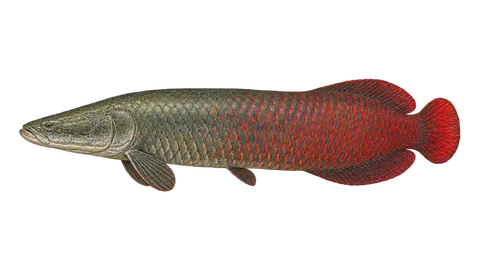
Very long body, flattened on the sides like a ribbon, with large silvery scales that reflect pink or blue. Large upturned mouth with two short barbels at the tip of the chin. Long dorsal and anal fins, almost touching the tail. The arapaima is much bigger, rounder and has a red tail end. No other fish in the region has two barbels on its chin.
Loading the next 7 days…
Each card shows the day's index (0 to 100) and, below it, a strip with the index for each hour, from 0h to 23h. from poor to excellent.
Floodplain (várzea) lakes, igapós and backwaters of the Amazon basin and the Araguaia-Tocantins, where it is common in the Araguaia lagoons.
Habitat: Water surface of lakes, igapós, backwaters and shorelines with low branches and floating vegetation.
native to the basins
states
Amazonas, Pará, Amapá, Acre, Rondônia, Roraima, Mato Grosso, Tocantins, Goiás
Falling water and the dry season, from August to November, concentrate the arawana in lakes and shorelines. During high water it moves into the igapó.
Daytime, with peaks at dawn and dusk. Hunts at the surface during the day, most active early in the morning and late in the afternoon.
A cold snap (friagem) pulls the fish away from the surface.
Stable weather favors surface hunting.
Little effect.
Heavy rain churns the surface and gets in the way.
A falling lake concentrates fish; repiquete spreads them out.
Sensitive: it sinks at the noise and takes a while to resurface.
Strong wind ruffles the water and reduces surface hunting.
Almost always in the top 50 cm of water.
lures
natural baits
accessories
The arawana bites a lot but hooks poorly. Wait until you feel the weight before setting the hook, and keep the treble hook always sharp.
Summary of the regulations we found, with the source for each. Rules change; before keeping or transporting fish, check with the state environmental agency.
Conservation: Not on the national list (Portaria GM/MMA 1.667/2026). Larvae and young are heavily exploited for the aquarium trade.
In Amazonas, Acre and Amapá the arawana is on the list of species whose catch, transport, storage and sale are banned from Nov 15 to Mar 15.
In the Negro River basin, from the border with Colombia to the mouth of the Branco River, commercial arawana fishing is banned. Recreational, sport and ornamental fishing remain allowed.
Ipaam enforces a 50 cm minimum size for arawana. Confirm the rule with the state agency (Ipaam).
In Tocantins the arawana may only be kept if it is 50 cm or longer.
Source: Portaria NATURATINS/GABIN nº 47/2026 (annexes amended by Portaria nº 105/2026)
Annual closed season in AM for the species in Annex II of Portaria 48/2007: pirapitinga, mapará, sardine, pacu, aruanã and matrinxã. Tambaqui and arapaima (pirarucu) have their own rules (see the specific items and "prohibitions").
Source: Portaria IBAMA nº 48/2007
Annual closed season in AC for the species in Annex II: dourada, piraíba, pirapitinga, caparari, aruanã, jaraqui, mapará, sardine, matrinxã and pacu. On the Acre River, the closed season applies to all species (IN IBAMA 205/2008).
Source: Portaria IBAMA nº 48/2007; IN IBAMA nº 205/2008 (Acre River)
Source: IN Semad-GO nº 17/2026, Annex I, Araguaia-Tocantins basin (on-site consumption only; zero transport)
Source: Portaria Naturatins nº 47/2026, Annex I, as amended by Portaria nº 105/2026
Source: INIs MPA/MMA nº 12/2011 (Araguaia) and 13/2011 (Tocantins), minimum size annexes
Allowed: Sport and guided fishing only in reservoirs, catch and release with barbless hooks (no keeping, transporting or eating). Subsistence: up to 5 kg per day, for household consumption only.
Allowed: All fishing modalities are prohibited in rivers, including catch and release (Law 9.096/2009, art. 19-A). Exceptions: subsistence fishing from shore (3 kg or 1 fish, no transport or sale) and scientific fishing. Law 13.159/2025 now allows licensed sport fishing in UHE/PCH hydropower reservoirs, natural lakes and border rivers, subject to a scientific study and a license from the environmental agency. We have not confirmed whether these licenses are already being issued.
Allowed: Recreational fishing only in reservoirs, with handline, rod, or spinning or baitcasting reel. Fish may only be eaten on site, not transported. Competitions prohibited. Subsistence: 3 kg + 1 fish. State rules (GO and TO) may be stricter.
Allowed: Recreational fishing only in reservoirs, with on-site consumption. Subsistence: 5 kg + 1 fish. State rules may be stricter.
Allowed: In 2025/26: catch and release with barbless hooks and recreational fishing card; subsistence fishing on foot or from a rowboat, with simple pole or handline.
Source: Portaria Naturatins nº 244/2025 (2025/26 season); INIs MPA/MMA nº 12 and 13/2011
Allowed: The same recreational-angler exceptions as in Portaria 48/2007 apply (handline or rod, 5 kg + 1 fish), unless a stricter state rule applies.
Source: Portaria IBAMA nº 48/2007
Allowed: Recreational anglers with handline or rod, line and hook are outside the Annex II prohibitions, with a bag limit of 5 kg + 1 fish, unless a stricter state rule applies.
Source: Portaria IBAMA nº 48/2007
Allowed: Subsistence fishing only.
Source: Portaria IBAMA nº 48/2007
Allowed: See the exceptions in Portaria 48/2007 and the state rules for each bank.
Source: Portaria IBAMA nº 48/2007
Long body and loose scales: hold it with both wet hands, supporting the whole body, and release it quickly.
White flesh with bones. Eaten fried or grilled locally, but it is valued more as a sport and ornamental fish.
Length-weight relationship W = a·Lb (a = 0.00417, b = 3.1; FishBase (bayesiano, espécie + forma do corpo da família)). It's an average: a fat or lean fish can vary by 10% to 20%.
estimated weight
—
The season weights (months), the time of day and the sensitivities (cold, pressure, moon, wind, rain, tide, strong light, murky water and noise) are the app's editorial estimates, based on the literature below and on the field experience of anglers and guides. They are not official data nor a measurement made for this species, and they may vary by region and year. Closed seasons and legal rules appear in the rules section, with the norm and a link.
Your location is saved only on this device and feeds the forecast, the map and the "today" on the home page.