

arapaima
Arapaima gigas
One of the largest scaled freshwater fish in the world. It breathes air and can only be fished in managed areas across most of the Amazon.
- common size
- 120–200 cm
- maximum
- 300 cm
- common weight
- 30–90 kg
- record/max.
- 200.0 kg
- depth
- 0.5–6 m
- ideal water
- 26–31 °C
how to recognize it
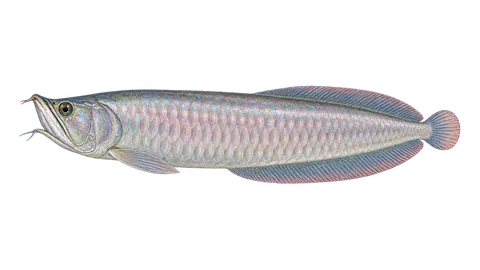
Huge, cylindrical and elongated body, flat bony head, large thick scales. The dorsal and anal fins sit far back, near the tail, forming a paddle. Scales on the rear half with a strong red edge. The arowana is much slimmer and silver, and has barbels on the chin. No other Amazonian fish has that red at the rear at that size.
Also called: pirarucu, pirosca (Tocantins), bodeco (jovem)
don't confuse with:
where found
open on the large mapWhere to look: Várzea lakes, igapós, eddies and still-water channels with vegetation; avoids strong current.
Várzea and igapó lakes of the Amazon basin and of the Araguaia-Tocantins (Bananal Island). Introduced to dams in the Northeast, in the Baixada Maranhense, to Lake Paranoá (DF), to rivers in Goiás and to the upper Madeira, above Santo Antônio (RO).
native to the basins
introduced in
states
Amazonas, Pará, Amapá, Acre, Rondônia, Roraima, Tocantins, Mato Grosso, Maranhão, Ceará, Rio Grande do Norte, Paraíba, Goiás, Distrito Federal
when to fish
next 7 days
Loading the next 7 days…
best season
In the dry season, from August to November, arapaima are trapped in the lakes, which is when counting and managed fishing take place. Spawning occurs at the start of high water.
best time of day
Daytime, with peaks at dawn and dusk. Feeds most early in the morning and late in the afternoon, but surfaces to breathe all day. The boiada shows where it is.
what affects the arapaima
cold and cold fronts
Friagem reduces its feeding, but it keeps surfacing.
atmospheric pressure
Moderate effect.
moon
Little effect.
rain
Heavy rain makes the boiada hard to see.
water level
An isolated lake in the dry season concentrates many fish; in high water they spread through the flooded forest.
noise
Extremely wary. A motor, hard paddling or loud talk sends the fish down for a long time.
wind
Strong wind hides the boiada in the chop.
depth
It stays 1 to 5 m deep, but rises to the surface to breathe all the time.
how to fish
lures
- large mid-water lure 14 to 18 cm
- large zara
- silicone shad 15 to 20 cm
natural baits
- live fish (acará, piau, branquinha)
- fresh whole fish
tip from an angler
Cast a bit ahead of where it surfaced, in the direction the ripple moved, and wait: it usually feeds right after breathing.
- rod
- 6'0'' to 7'0'', fast and heavy action, 40 to 80 lb
- spinning / baitcasting reel
- high-profile baitcasting reel 300 to 400 or spinning reel 8000 to 10000, drag above 10 kg
- line
- braid 65 to 100 lb
- leader
- mono 100 to 130 lb, about 1 m
- hook
- circle hook 8/0 to 10/0, barbless, for natural bait; reinforced treble hooks 5/0 on artificial lures
accessories
- leather gloves
- long-nose pliers
- large landing net or a line to guide the fish in the water
catch and release
Don't lift the fish out of the water or by the mouth or gills: the weight injures the spine and organs. Keep it in the water, let it breathe and release it quickly. An exhausted fish needs to be able to surface to breathe air.
kits and guides
rules for the arapaima
Rules change; before keeping or transporting fish, check with the state environmental agency.
Fishing only in authorized management in Amazonas
banned year-round outside managementAM details
In Amazonas, capture, transport and sale of arapaima are banned year-round (December to May under the federal rule and June to November under the Ibama rule in the state). The only exception is fishing under an approved management plan, with a quota of up to 30% of counted adults, sealed fish and a transport permit. Catch and release also requires authorization from the area.
Fishing only in authorized management in Acre
banned year-round outside managementAC details
In Acre, capture, transport and sale of arapaima are banned year-round (December to May under the federal rule and June to November under the Ibama rule in the state). The only exception is lake fishing under a plan authorized by Ibama/AC, with a quota, sealed fish and a transport permit. For the recreational angler, treat it as prohibited.
Arapaima closed season (AM, PA, AC, AP)
capture, transport and sale banned01/12 to 31/05AMPAACAP details
In the Amazon basin, in the states of Amazonas, Pará, Acre and Amapá, it is banned to catch, sell and transport arapaima from December 1 to May 31. Fish from registered fish farms, with proof of origin, is allowed.
Arapaima (pirarucu) closed season in Rondônia
capture, transport and sale banned01/11 to 30/04RO details
In Rondônia the arapaima closed season runs from November 1 to April 30. Above the Santo Antônio dam, on the upper Madeira, the invasive-species rule applies.
Arapaima (pirarucu) closed season in Roraima
capture, transport and sale banned01/03 to 31/08RR details
In Roraima, with a different flood regime, the arapaima closed season runs from March 1 to August 31.
Minimum size in the Amazon basin
1.50 m (whole); 1.20 m fresh manta; 1.10 m dried mantaAmazon details
Where fishing is allowed, a whole arapaima must be at least 1.50 m in total length. Fresh manta, 1.20 m; dried manta, 1.10 m. It is banned to cut wet manta horizontally.
Closed season in the Araguaia-Tocantins
capture, transport, sale and storage banned01/10 to 31/03TOPAMTGOMA details
In the Araguaia-Tocantins basin, arapaima has its own closed season from October 1 to March 31.
Minimum size in the Araguaia-Tocantins
1.55 m (whole); 1.20 m fresh manta; 1.10 m dried mantaTOPAMTGOMA details
In the Araguaia-Tocantins the federal minimum is 1.55 m for a whole fish. In Tocantins the state ordinance sets a 120 to 180 cm window; combining both rules, only fish between 1.55 and 1.80 m may be kept.
Source: Instrução Normativa MMA nº 24/2005; Portaria NATURATINS/GABIN nº 47/2026 (TO)
Zero transport in Mato Grosso
catch and release mandatory; transport, storage and sale bannedMT details
Until December 31, 2028, arapaima caught in Mato Grosso rivers may not be transported, stored or sold. Amateur anglers may only practice catch and release. The law is being challenged at the STF, but the injunction was denied in 2024.
Source: Lei estadual nº 12.434/2024 (MT), arts. 19-B and 19-C of Lei 9.096/2009
Invasive species outside the Amazon: mandatory kill
no quota and no size limit; release bannedWestern Northeast AtlanticParnaíbaEastern Northeast AtlanticSão FranciscoEast AtlanticSoutheast AtlanticParanáUruguaySouth AtlanticParaguay (Pantanal) details
Outside its natural range, including the upper Madeira above the Santo Antônio dam (RO), arapaima is an invasive exotic species. Fishing allowed year-round, with no quota or minimum size. Catch and release is banned: the fish caught must be killed. Sale only within the state of capture.
other rules that mention the arapaima (10)
Arapaima (pirarucu) closed season in Amapá and Pará
01/12 to 31/05APPA details
Arapaima (pirarucu) closed season in Rondônia
01/11 to 30/04RO details
In the stretch of the Madeira River downstream of the Santo Antônio dam, the arapaima (pirarucu) has a closed season from Nov 1 to Apr 30: capture, transport and sale are prohibited. Upstream of the dam, in the upper Madeira River, the arapaima is treated as an invasive alien species and may be caught year-round, with mandatory retention (releasing the fish back into the water is prohibited).
Arapaima (pirarucu) closed season in Roraima
01/03 to 31/08RR details
Arapaima (pirarucu) closed season in the Araguaia-Tocantins
01/10 to 31/03Tocantins-Araguaia details
Annual arapaima (pirarucu) closed season across the Araguaia-Tocantins basin.
Source: IN MMA nº 24/2005
Mato Grosso: Zero Transport for 12 species
MT details
Transport, storage and sale are fully prohibited for 5 years from Jan 1, 2024 for: cachara, caparari, dorado, jaú, matrinchã (Brycon spp.), pintado/surubim (Pseudoplatystoma spp.), piraíba, piraputanga, pirarara, arapaima (pirarucu), trairão and peacock bass (tucunaré, Cichla spp.). For recreational anglers: catch and release only. These 12 species may not even be eaten on site, since the 2 kg or 1 fish limit excludes the art. 19-B list. The law cites jaú as Zungaro zungaro; we also include the Pantanal jaú (Z. jahu) out of caution. The list may still change: § 2 (exotic and predatory species), § 3 (review through study) and the 3-year assessment planned for 2027. A TJMT news report of Jun 2, 2026 confirms the 12 prohibited species. The STF denied a preliminary injunction in the ADIs against the law in 2024; we found no merits ruling.
Arapaima (pirarucu) in Amazonas: only in managed areas
AM details
In Amazonas, arapaima (pirarucu) fishing is allowed only in authorized managed areas, with a quota. Outside them, it is prohibited year-round. Minimum size: 150 cm.
Arapaima (pirarucu) in Acre: only in managed areas
AC details
In Acre, arapaima (pirarucu) fishing is prohibited year-round: December 1 to May 31 under the federal rule (IN IBAMA nº 34/2004) and June 1 to November 30 under the Ibama rule in the state (IN Ibama-AC nº 1/2008). The only exception is lake fishing under a plan authorized by Ibama/AC, with a quota, sealed fish and a transport permit. For the recreational angler, treat it as prohibited. Minimum size where fishing is allowed: 150 cm.
Minimum size: 120 cm (max. 180 cm)
TO details
Source: Portaria Naturatins nº 47/2026, Annex I, as amended by Portaria nº 105/2026
Minimum size: 150 cm
GOTOPAMAMT details
Source: INIs MPA/MMA nº 12/2011 (Araguaia) and 13/2011 (Tocantins), minimum size annexes
Minimum size: 150 cm
Amazon details
piracema and closed seasons
Each bar is the period when fishing is prohibited or restricted. The green line is today. Tap the name to see what is still allowed.
Closed season in Goiás (state rule)
Allowed: Sport and guided fishing only in reservoirs, catch and release with barbless hooks (no keeping, transporting or eating). Subsistence: up to 5 kg per day, for household consumption only.
Spawning closure (piracema) in Mato Grosso (all basins)
Allowed: All fishing modalities are prohibited in rivers, including catch and release (Law 9.096/2009, art. 19-A). Exceptions: subsistence fishing from shore (3 kg or 1 fish, no transport or sale) and scientific fishing. Law 13.159/2025 now allows licensed sport fishing in UHE/PCH hydropower reservoirs, natural lakes and border rivers, subject to a scientific study and a license from the environmental agency. We have not confirmed whether these licenses are already being issued.
Spawning closure (piracema) in the Araguaia River basin
Allowed: Recreational fishing only in reservoirs, with handline, rod, or spinning or baitcasting reel. Fish may only be eaten on site, not transported. Competitions prohibited. Subsistence: 3 kg + 1 fish. State rules (GO and TO) may be stricter.
Spawning closure (piracema) in the Tocantins and Gurupi river basins
Allowed: Recreational fishing only in reservoirs, with on-site consumption. Subsistence: 5 kg + 1 fish. State rules may be stricter.
Spawning closure (piracema) in Tocantins (state rule)
Allowed: Recreational catch and release with barbless hooks and a recreational fishing card; subsistence fishing by riverside and artisanal fishers from the bank or a rowboat, with a cane pole, handline and hook, with no transport or sale.
Closed season in the Amazon basin in Amazonas
Allowed: Under Portaria 48/2007 (art. 2, II), the recreational angler who fishes with handline or rod, line and hook is outside the Annex II prohibitions, unless a stricter state rule applies. Recreational angler bag limit: 5 kg + 1 fish. Competitions prohibited.
Source: Portaria IBAMA nº 48/2007
Closed season in the Amazon basin in Acre
Allowed: Recreational anglers with handline or rod, line and hook are outside the Annex II prohibitions, with a bag limit of 5 kg + 1 fish, unless a stricter state rule applies. On the Acre River, no fishing of any species during the period.
Source: Portaria IBAMA nº 48/2007; IN IBAMA nº 205/2008 (Acre River)
Closed season in the Acre river
Allowed: IN Ibama 205/2008 prohibits fishing in the Acre river and its tributaries during the closed season, with no exception for recreational anglers: treat it as prohibited.
Source: IN IBAMA nº 205/2008
Closed season in the Amazon basin in Pará
Allowed: Recreational anglers with handline or rod, line and hook are outside the Annex II prohibitions, with a bag limit of 5 kg + 1 fish, unless a stricter state rule applies.
Source: Portaria IBAMA nº 48/2007
Closed season in the rivers of Marajó Island (PA)
Allowed: The same recreational-angler exceptions as in Portaria 48/2007 apply (handline or rod, 5 kg + 1 fish), unless a stricter state rule applies.
Source: Portaria IBAMA nº 48/2007
Amazon basin closed season in Rondônia
Allowed: In the Madeira, Mamoré, Jamari, Abunã, Machado and Roosevelt river basins and in the main channel of the Guaporé, licensed recreational anglers may fish only for non-protected species, using a single simple gear per person (handline, rod with or without a reel, or a simple pole with a single hook). The limit is up to 5 kg or 1 fish per week; if the fish is over 5 kg, you keep only that one. You may not sell, trade or give away the catch. Catch and release is allowed only with non-protected species. Fishing is always banned within 200 m of dams, rapids, waterfalls, fish ladders and river mouths.
Closed season in the Amazon basin in Amapá
Allowed: Recreational anglers with handline or rod, line and hook are outside the Annex II prohibitions, with a bag limit of 5 kg + 1 fish, unless a stricter state rule applies.
Source: Portaria IBAMA nº 48/2007
Closed season in Roraima
Border rivers MT/RO and MT/PA
Allowed: See the exceptions in Portaria 48/2007 and the state rules for each bank.
Source: Portaria IBAMA nº 48/2007
Conservation: Not on the national list (Portaria GM/MMA 1.667/2026). Listed in Appendix II of CITES. Populations have recovered where community management exists.
how much it weighs without taking it out of the water
estimated weight
—
how we calculate
Length-weight relationship W = a·Lb (a = 0.01096, b = 2.94; FishBase (bayesiano, espécie + forma do corpo da família)). It's an average: a fat or lean fish can vary by 10% to 20%.
more about the arapaima
A scaled giant of the Amazon, the arapaima breathes air and must surface every 10 to 20 minutes, the so-called boiada. It lives in várzea lakes, igapós and still-water eddies, where it hunts fish, shrimp and crabs. Pushed close to collapse by harpoon and gillnet fishing, it has recovered thanks to community management, in which the annual quota depends on counting adult fish in the lakes. Fishing is tightly regulated and, in Amazonas, happens only under authorized management. Outside the Amazon it was released into dams and reservoirs and is treated as an invasive species.
Family: Arapaimidae · predator
fun facts
- The tongue is bony and covered in small teeth; once dried, it was used as a guaraná grater.
- The male carries the young near its head and releases a secretion that feeds and protects them.
- The scales are so hard they resist piranha bites.
in the kitchen
White, boneless and highly valued flesh: arapaima de casaca, breaded cutlets, dried and salted like cod. Buy only with the management or fish farm seal.
similar species
sources and references (6)
The season weights (months), the time of day and the sensitivities (cold, pressure, moon, wind, rain, tide, strong light, murky water and noise) are the app's editorial estimates, based on the literature below and on the field experience of anglers and guides. They are not official data nor a measurement made for this species, and they may vary by region and year. Closed seasons and legal rules appear in the rules section, with the norm and a link.
- scientific FishBase — Arapaima gigas (ficha da espécie)Names, distribution, biology, length-weight relationship and references. Page checked on October 13, 2026.
- official Portaria GM/MMA nº 1.667, de 27 de abril de 2026 — Lista Nacional Oficial de Espécies da Fauna Ameaçadas de Extinção (peixes e invertebrados aquáticos)Most recent national list. The species is not on it (search by scientific name in the text published in the DOU, checked on October 13, 2026).
- scientific IUCN Red List — Arapaima gigas (avaliação global: Dados Insuficientes, DD, 01/08/1996)Global assessment. Link given on the FishBase entry (Red List, version 2025-2).
- scientific Castello, L. (2004). A method to count pirarucu Arapaima gigas: fishers, assessment, and management. North American Journal of Fisheries Management 24: 379–389.Basis of the counting method used in community arapaima management.
- scientific Castello, L.; Arantes, C. C.; McGrath, D. G.; Stewart, D. J.; Sousa, F. S. (2015). Understanding fishing-induced extinctions in the Amazon. Aquatic Conservation: Marine and Freshwater Ecosystems 25(5): 587–598.Analyzes arapaima (Arapaima spp.) overfishing and recovery where there is management.
- scientific Ferreira, E. J. G.; Zuanon, J. A. S.; Santos, G. M. (1998). Peixes comerciais do médio Amazonas: região de Santarém, Pará. Brasília: Ibama. 211 p.Printed work; the URL is the bibliographic record on FishBase, which cites this work for the species.