Skip to content
catalog Pimelodidae · predator

gilded catfish (jaú)

Zungaro zungaro

Freshwater

Giant, stocky catfish of deep pools and rapids. One of the strongest freshwater fish in Brazil.

Also called: jaú

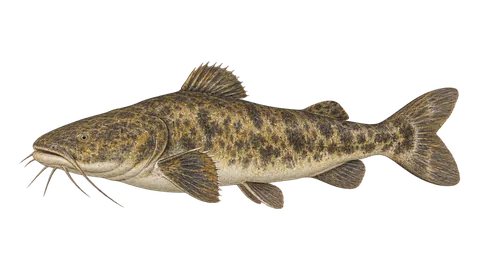
Scientific illustration of Gilded catfish (jaú)
common size
60–120 cm
maximum
160 cm
common weight
10–40 kg
record/max.
100.0 kg
depth
3–25 m
ideal water
25–30 °C
overview

who is the gilded catfish (jaú)

The jau is a stocky catfish with a huge head and thick body, living in deep pools below rapids and waterfalls and in channels of large rivers. It hunts fish at night and spends the day hidden among rocks. It grows slowly and lives many years, so big ones are rare and should be released. In sport fishing it is the toughest opponent: once hooked, it hugs the bottom and uses weight and current to its advantage, and the fight can last a long time. It requires very heavy tackle and patience. In the Amazon and Araguaia there are still specimens over 50 kg.

fun facts

  • Juveniles have a handsome marbled pattern that fades with age.
  • Large fish can live for decades in the same pool.
how to recognize it

identification

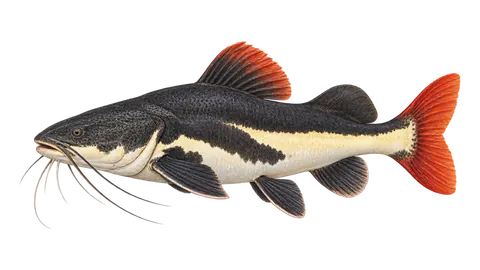
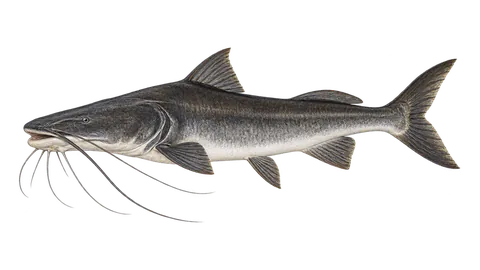
Thick, short body for its size, very wide and flat head, huge mouth. Brown to olive color with dark blotches and spots, more marked in juveniles; pale belly. Small eyes and long barbels. The redtail catfish has a red tail and yellow band. The piraíba is more elongated and grey. The jau of the Plata is another species, from the Paraná basin.

how gilded catfish (jaú) fishing looks

Loading the next 7 days…

Each card shows the day's index (0 to 100) and, below it, a strip with the index for each hour, from 0h to 23h. from poor to excellent.

distribution

where found

open on the large map

Amazon and Araguaia-Tocantins basins, especially the rapids pools of the Araguaia, Tocantins, Xingu, Tapajós, Teles Pires and Madeira rivers.

Habitat: Deep pools below rapids and waterfalls, channels with rocks and logs, deep backwaters.

native to the basins

AmazonTocantins-Araguaia

states

Amazonas, Pará, Mato Grosso, Tocantins, Rondônia, Acre, Roraima, Amapá, Goiás

calendar and clock

when to fish

best season

time of yearbest: Jul–Oct
JanFebSeaAprMayJunJulAugSepOctNovDec

Dry season, June to October, when the pools below the rapids become well defined.

best time of day

0h6h12h18h sunrise ~6amsunset ~6pm

Nighttime. Feeds mainly at night. By day it stays hidden and only takes a bait placed well in the pool.

weather, water and behavior

what affects the gilded catfish (jaú)
sensitivity The little bars show how much each factor affects this species. Five full: it feels it a lot.

cold and cold fronts

A cold snap (friagem) reduces activity.

atmospheric pressure

A pressure drop before rain can trigger it.

moon

Dark nights tend to produce more.

rain

Little effect.

water level

Low water concentrates jau in the pools.

noise

Not very sensitive in rapids.

wind

Little effect.

depth

Pool bottom, 5 to 25 m.

technique, gear and bait

how to fish

rod
7'0'', extra-heavy, 50 to 100 lb
spinning / baitcasting reel
high-profile baitcasting reel 400 to 500 or 14000 to 20000 spinning reel
line
braided line 80 to 100 lb
leader
monofilament 150 lb, 1.5 m
hook
circle hook 10/0 to 12/0; sinker 150 to 300 g

lures

  • not used

natural baits

  • whole live or fresh fish (piau, curimatã, mandi, small payara)

accessories

  • fighting belt
  • luvas
  • large pliers

tip from an angler

When the jau sticks to the bottom, don't give it slack: keep constant pressure and change the boat's angle to pull it off the rock.

what the law says

rules for the gilded catfish (jaú)

Summary of the regulations we found, with the source for each. Rules change; before keeping or transporting fish, check with the state environmental agency.
Conservation: Not on the national list (Portaria GM/MMA 1.667/2026). Slow growth makes large individuals vulnerable to fishing.

Mato Grosso: Zero Transport for 12 species

MTParaguay (Pantanal)AmazonTocantins-Araguaia

Transport, storage and sale are fully prohibited for 5 years from Jan 1, 2024 for: cachara, caparari, dorado, jaú, matrinchã (Brycon spp.), pintado/surubim (Pseudoplatystoma spp.), piraíba, piraputanga, pirarara, arapaima (pirarucu), trairão and peacock bass (tucunaré, Cichla spp.). For recreational anglers: catch and release only. These 12 species may not even be eaten on site, since the 2 kg or 1 fish limit excludes the art. 19-B list. The law cites jaú as Zungaro zungaro; we also include the Pantanal jaú (Z. jahu) out of caution. The list may still change: § 2 (exotic and predatory species), § 3 (review through study) and the 3-year assessment planned for 2027. A TJMT news report of Jun 2, 2026 confirms the 12 prohibited species. The STF denied a preliminary injunction in the ADIs against the law in 2024; we found no merits ruling.

Source: Lei estadual MT nº 9.096/2009, arts. 19-A, 19-B and 19-C, as amended by Leis nº 12.197/2023 and 12.434/2024

piracema closures in the basins where the species lives

Closed season in Goiás (state rule)

01/11 to 28/02GO

Allowed: Sport and guided fishing only in reservoirs, catch and release with barbless hooks (no keeping, transporting or eating). Subsistence: up to 5 kg per day, for household consumption only.

Source: IN Semad-GO nº 17/2026, arts. 8º to 11

Spawning closure (piracema) in Mato Grosso (all basins)

01/10 to 31/01MT

Allowed: All fishing modalities are prohibited in rivers, including catch and release (Law 9.096/2009, art. 19-A). Exceptions: subsistence fishing from shore (3 kg or 1 fish, no transport or sale) and scientific fishing. Law 13.159/2025 now allows licensed sport fishing in UHE/PCH hydropower reservoirs, natural lakes and border rivers, subject to a scientific study and a license from the environmental agency. We have not confirmed whether these licenses are already being issued.

Source: IN Interministerial MAPA/MMA nº 10/2017; Resolução Cepesca-MT nº 1/2026; Lei estadual MT nº 9.096/2009, arts. 19-A and 27 (Leis 12.434/2024 and 13.159/2025)

Spawning closure (piracema) in the Araguaia River basin

01/11 to 28/02GOTOPAMT

Allowed: Recreational fishing only in reservoirs, with handline, rod, or spinning or baitcasting reel. Fish may only be eaten on site, not transported. Competitions prohibited. Subsistence: 3 kg + 1 fish. State rules (GO and TO) may be stricter.

Source: IN Interministerial MPA/MMA nº 12/2011

Spawning closure (piracema) in the Tocantins and Gurupi river basins

01/11 to 28/02TOPAMAGO

Allowed: Recreational fishing only in reservoirs, with on-site consumption. Subsistence: 5 kg + 1 fish. State rules may be stricter.

Source: IN Interministerial MPA/MMA nº 13/2011

Closed season in the rivers of Marajó Island (PA)

01/01 to 30/04PA

Allowed: The same recreational-angler exceptions as in Portaria 48/2007 apply (handline or rod, 5 kg + 1 fish), unless a stricter state rule applies.

Source: Portaria IBAMA nº 48/2007

Closed season in the Amazon basin in Amapá

15/11 to 15/03AP

Allowed: Recreational anglers with handline or rod, line and hook are outside the Annex II prohibitions, with a bag limit of 5 kg + 1 fish, unless a stricter state rule applies.

Source: Portaria IBAMA nº 48/2007

Border rivers MT/RO and MT/PA

05/11 to 28/02MTROPA

Allowed: See the exceptions in Portaria 48/2007 and the state rules for each bank.

Source: Portaria IBAMA nº 48/2007

catch and release
catch and release Releasing the fish alive, quickly and with a wet hand. During a closed season it isn't always allowed: what the regulation says applies.

Keep the jau in the water; a fish over 40 kg should not be lifted. Hold it by the mouth with a thick glove, support its belly and release it in the pool where it was caught.

in the kitchen

Fatty flesh; in the Amazon many consider it "reimosa" (strong-tasting). A fish to release.

calculator

how much it weighs without taking it out of the water

Length-weight relationship W = a·Lb (a = 0.01514, b = 3.03; FishBase (bayesiano, espécie + forma do corpo da família)). It's an average: a fat or lean fish can vary by 10% to 20%.

estimated weight

—

sources and references

The season weights (months), the time of day and the sensitivities (cold, pressure, moon, wind, rain, tide, strong light, murky water and noise) are the app's editorial estimates, based on the literature below and on the field experience of anglers and guides. They are not official data nor a measurement made for this species, and they may vary by region and year. Closed seasons and legal rules appear in the rules section, with the norm and a link.

  1. scientific FishBase — Zungaro zungaro (ficha da espécie)Names, distribution, biology, length-weight relationship and references. Page checked on October 13, 2026.
  2. official Portaria GM/MMA nº 1.667, de 27 de abril de 2026 — Lista Nacional Oficial de Espécies da Fauna Ameaçadas de Extinção (peixes e invertebrados aquáticos)Most recent national list. The species is not on it (search by scientific name in the text published in the DOU, checked on October 13, 2026).
  3. official ICMBio/SALVE — Ficha de Zungaro zungaro (avaliação nacional do risco de extinção)National assessment by ICMBio, published in 2024. DOI verified on Crossref.
  4. scientific IUCN Red List — Zungaro zungaro (avaliação global: Pouco Preocupante, LC, 21/12/2020)Global assessment. Link given on the FishBase entry (Red List, version 2025-2).
  5. scientific Silfvergrip, A. M. C. (1992). Zungaro, a senior synonym of Paulicea (Teleostei: Pimelodidae). Ichthyological Exploration of Freshwaters 3(4): 305–310.Journal article with no DOI; the URL is the bibliographic record in FishBase.
  6. scientific Lundberg, J. G.; Littmann, M. W. (2003). Pimelodidae (long-whiskered catfishes). In: Reis, R. E.; Kullander, S. O.; Ferraris Jr., C. J. (orgs.). Check List of the Freshwater Fishes of South and Central America. Porto Alegre: EDIPUCRS, p. 432–446.Printed book chapter; the URL is the bibliographic record on FishBase, which cites the chapter for the species.
don't confuse

similar species