overview
who is the longfin yellowtail
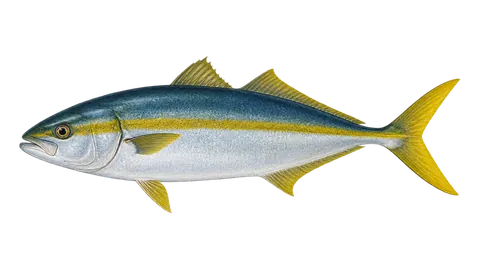
For a long time it was treated as the same species as the southern hemisphere yellowtail (Seriola lalandi). Genetic studies in 2015 split out three species, and the northeastern Pacific one, from southern California to the Pacific coast of Baja California and the Gulf of California, became S. dorsalis. It lives in schools or small groups near islands, rocky shores, kelp forests and reefs, and sometimes enters bays. It eats sardines, anchovies, mackerel, squid and pelagic crabs. It is one of the most sought-after sport fish in northwestern Mexico: caught from boats with metal jigs, surface lures and live sardines, it fights hard and tries to cut the line on the rocks.
fun facts
- In 2015 genetics showed that the 'yellowtail' known worldwide was actually three species: S. lalandi in the southern hemisphere, S. aureovittata in the northwestern Pacific and S. dorsalis in the northeastern Pacific.
- It is raised in captivity in California and Mexico for aquaculture.
how to recognize it
identification
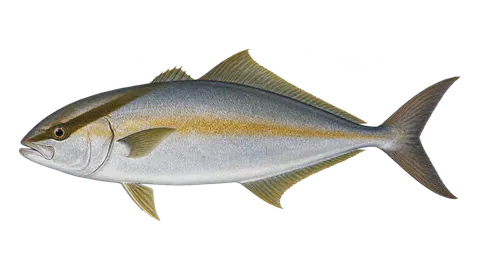
Fusiform, elongated body, dark blue to olive-green back, silvery flank, a yellow stripe from snout to tail and a deeply forked yellow tail. No scutes on the lateral line. It is identical to the southern hemisphere yellowtail (S. lalandi), from which it was separated by genetics; in practice, the difference is geographic. The longfin yellowtail (S. rivoliana), common in Mexico, has a deeper body, a dark diagonal band on the nape and longer dorsal and anal fin lobes.
how longfin yellowtail fishing looks
Loading the next 7 days…
Each card shows the day's index (0 to 100) and, below it, a strip with the index for each hour, from 0h to 23h. from poor to excellent.