


the right time
to be on the water
Choose the place and the species. The index, from 0 to 100, combines weather, sun, moon and tide with each fish's habits. Up to 28 days, with each day's confidence.
Loading the forecast…
—
hour by hour
slide your finger or mouse over the chart to see each hoursee hour-by-hour table
why this index at —?
choose the day
the fishing month at a glance
what's the best window for the crew?
Choose how many fishing days. We compare each stretch by its average index, discount days with a warning or closed season, and show the 3 best.
trend for the coming weeks
Line: the middle value of 31 simulations of the American GEFS model. Band: where 8 out of 10 fall. Narrow, firm trend; wide, high uncertainty.
everything about the black skipjack
how to recognize it
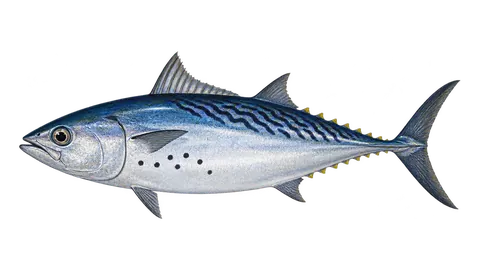
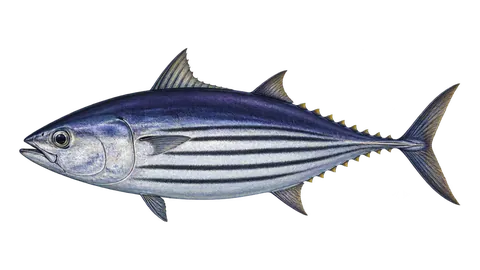
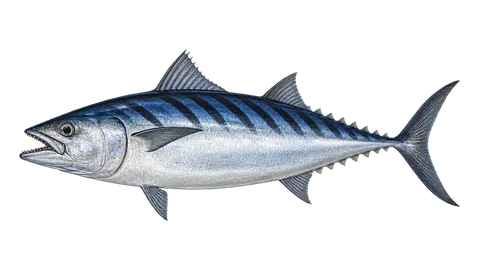
Fusiform body, iridescent dark blue above, with 5 to 6 nearly horizontal black stripes only on the rear of the back, running down below the start of the first dorsal; flanks and belly silvery-white, with some dark spots between the pectorals and pelvics. The front of the first dorsal is high, with a concave outline, and the body is scaleless behind the corselet. It has 33 to 39 gill rakers. Skipjack (Katsuwonus pelamis) has stripes on the belly; the Eastern Pacific bonito (sarda oriental) has many stripes over the whole back, large teeth and an all-black second dorsal.
Also called: bonito-negro, black skipjack, black skipjack tuna
don't confuse with:
where found
open on the large mapWhere to look: Coastal and offshore waters, near the surface, along reefs and islands, in schools that mix with other tunas.
Does not occur in Brazil. Eastern Pacific, from California (USA) to northern Peru, including the Gulf of California, Central America and all the oceanic islands, such as the Galápagos. Two stray individuals were caught in Hawaii.
when to fish
best season
No documented season. Prefers warm water: it rarely occurs where the surface drops below 23 °C, so it does best in the warmer months of each region.
best time of day
Daytime. Hunts by day, at the surface and just below, in schools that follow sardines and plankton; dawn and dusk usually bring the most intense attacks.
what affects the black skipjack
cold and cold fronts
Surface water below 23 °C drives the fish off; cold upwelling empties the area.
atmospheric pressure
Little direct effect; a front with the sea turning breaks up bait schools.
moon
Little effect.
rain
Little effect in open sea.
water level
Not applicable at sea.
noise
A motor near the school makes it sink; approach with the motor low and cast from a distance.
wind
Choppy sea hinders casting and spotting the birds and fish jumping.
tide
Little effect; currents that gather bait near islands and rocks attract the school.
depth
Surface and the top 40 m.
how to fish
lures
- metal jig, 30 to 80 g
- metal spoon
- popper
- trolling feather
natural baits
- live or dead sardine
- lula
- small anchovy
tip from an angler
Cast the metal past the school and reel in fast: the black skipjack chases the lure at speed and, if the first pass misses, the school usually comes back.
- rod
- 6'6" to 7'6", fast action, 15 to 30 lb
- spinning / baitcasting reel
- 4000 to 6000 spinning reel with good line capacity
- line
- braided line 20 to 40 lb
- leader
- fluorocarbon 30 to 50 lb, 1 m
- hook
- treble hook 1/0 to 3/0 on lures; single hook 2/0 to 4/0 on natural bait
accessories
- long-nose pliers
- boga
- ice to bleed and chill the fish right away
catch and release
Keep the fish in the water, remove the hook with pliers and release it quickly; skipjack suffer when handled out of the water. If you're keeping it, bleed it and put it on ice right away.
rules for the black skipjack
Rules change; before keeping or transporting fish, check with the state environmental agency.
Mexico: up to 5 per species and 10 saltwater fish per day
5 specimens of the species per angler per day, within the limit of 10 saltwater fish details
In federal waters of Mexico, recreational sport fishing allows each angler to keep up to 10 marine fish per day, no more than 5 of the same species. The black skipjack (barrilete negro) is not among the species reserved for sport fishing (marlins, sailfish, swordfish, tarpon (sábalo), roosterfish and dorado, up to 50 nautical miles from shore, item 0.3 of the standard) and has no quota of its own. Fish over the quota must go back alive, and sport-caught fish may not be sold. From shore you need no permit; from a boat, you do (permits under the Federal Duties Law, item 4.3).
how much it weighs without taking it out of the water
estimated weight
—
how we calculate
Length-weight relationship W = a·Lb (a = 0.01122, b = 3.08; FishBase (relação peso-comprimento bayesiana, estimativa da própria espécie)). It's an average: a fat or lean fish can vary by 10% to 20%.
more about the black skipjack
Small tuna of the eastern Pacific, from California to northern Peru, including the oceanic islands; a few stray individuals have reached Hawaii. Lives near the surface, in coastal waters and near reefs and offshore islands, and forms schools that mix with yellowfin tuna and skipjack. It rarely occurs where surface water drops below 23 °C, and larvae appear at water above 26 °C. It is an opportunistic hunter and competes for food with tunas, dolphins and other bonitos. The common size is around 60 cm; it reaches 92.5 cm and a line-class record of 11.8 kg. It has a small commercial fishery and is a good sport fish for casting and trolling.
Family: Scombridae · predator
fun facts
- In Peru and Ecuador it is called bonito negro, and in Ecuador also pata seca.
- Forms schools with yellowfin tuna and skipjack, so it turns up alongside tuna anglers.
in the kitchen
Dark, strong-flavored flesh, less prized than that of the larger tunas; best with the fish bled and chilled right away, in grilled steaks, ceviche or canned.
similar species

sources and references (5)
The season weights (months), the time of day and the sensitivities (cold, pressure, moon, wind, rain, tide, strong light, murky water and noise) are the app's editorial estimates, based on the literature below and on the field experience of anglers and guides. They are not official data nor a measurement made for this species, and they may vary by region and year. Closed seasons and legal rules appear in the rules section, with the norm and a link.
- scientific FishBase: Euthynnus lineatus (ficha da espécie)Size, length-weight relationship, depth, habitat, distribution, biology and IUCN status. Page checked Oct 13, 2026. FishBase gives 84 cm and 9.1 kg as maximums; the entry uses the higher STRI values (92.5 cm and a line-class record of 11.8 kg).
- scientific FishBase: nomes populares de Euthynnus lineatusNames by country and language.
- scientific Robertson, D. R. & Allen, G. R. (2024). Shorefishes of the Eastern Pacific online information system. Smithsonian Tropical Research Institute: Euthynnus lineatusDescription, colors, size (up to 92.5 cm; line-class record of 11.8 kg), depth (1 to 40 m) and distribution (California to Peru, all oceanic islands; stray individuals in Hawaii). Size values adopted in the entry in place of FishBase's. Page checked Oct 13, 2026.
- scientific Collette, B. B.; Nauen, C. E. (1983). FAO Species Catalogue. Vol. 2. Scombrids of the world. An annotated and illustrated catalogue of tunas, mackerels, bonitos and related species known to date. FAO Fisheries Synopsis 125(2). Roma: FAO.Main FishBase reference for the description and biology.
- official DOF: Modificação da NOM-017-PESC-1994, para regular a pesca deportivo-recreativa em águas de jurisdição federal do México (publicada em 25/11/2013)Species reserved for sport fishing (item 0.3), permits (4.3 and 4.14), rod and hooks (4.6), bait (4.7), daily quotas at sea (4.9.1) and in fresh water (4.9.2), catch and release (4.9.5), closed areas and seasons (4.10) and the ban on selling the fish (4.11). Text checked Oct 13, 2026. The text carries the signature date of Oct 14, 2013; the DOF publication date (Nov 25, 2013) is the one the catalog already uses.
how we calculatewhere each number comes from
The weather comes from three independent global models, cross-checked hour by hour: when they agree, confidence goes up; when they diverge, the band between them shows on the chart. Beyond 16 days, we use the GEFS ensemble of 31 simulations: if 20 of the 31 predict rain, the chance of rain is 65%. Sun and moon are calculated astronomically, with no uncertainty.
The index adds up, weighted for each species: time of day (species curve anchored to real sunrise and sunset), moon (transits, rise and set, phase), pressure (3 h trend and 24 h swing), water temperature (in rivers, estimated from air temperature; at sea, estimated by an ocean model), wind, rain, clouds, tide and the month in the species' cycle.
sources for this lookup
how accurate the forecast is
Accuracy measured in the reference project (4 regions, 93 days, forecast vs. observed): maximum temperature is off by 0.6 °C on average the next day and 1.7 °C at 7 days; rain of 5 mm or more is detected 76% of the time the next day and 57% at 7 days. Detection isn't everything: the false alarm rate isn't published here yet, and 93 days in 4 regions is still a small sample. We now also measure every day, at the app's destinations: