

- common size
- 80–130 cm
- maximum
- 160 cm
- common weight
- 15–50 kg
- record/max.
- 100.0 kg
- depth
- 4–25 m
- ideal water
- 24–30 °C

the right time
to be on the water
Choose the place and the species. The index, from 0 to 100, combines weather, sun, moon and tide with each fish's habits. Up to 28 days, with each day's confidence.
Loading the forecast…
—
Looking for alerts within 30 km…
Looking for what anglers have logged near here…
what you need to fish herelicense, certification and boat documents
fish likely at this spot
Tap a fish to see its forecast.
hour by hour
slide your finger or mouse over the chart to see each hoursee hour-by-hour table
why this index at —?
choose the day
the fishing month at a glance
what's the best window for the crew?
Choose how many fishing days. We compare each stretch by its average index, discount days with a warning or closed season, and show the 3 best.
trend for the coming weeks
Line: the middle value of 31 simulations of the American GEFS model. Band: where 8 out of 10 fall. Narrow, firm trend; wide, high uncertainty.
everything about the jaú
how to recognize it
Very thick, heavy body, broad, flat head, huge mouth. Relatively short barbels. Thick dark-brown to greyish skin, with dark marbled patches in juveniles and more uniform in adults. The redtail catfish has a red tail. The pintado has a spade-shaped head and spots. The barbado is silver, with ribbon-like barbels.
Also called: jaú, jaú-do-pantanal, jaú-do-paraná
don't confuse with:
where found
open on the large mapWhere to look: Very deep pools below rapids and waterfalls, crevices, rocky stretches and the base of dams.
Pools of the Paraguay River and large Pantanal tributaries, Paraná River (free-flowing stretches and below dams), Grande, Paranaíba and Paranapanema; Uruguay River.
native to the basins
states
Mato Grosso do Sul, Mato Grosso, São Paulo, Paraná, Goiás, Minas Gerais
when to fish
best season
Dry season (July to October): low river and fish trapped in pools. In high water it is hard to locate.
best time of day
Nighttime. Night fishing, from dusk until dawn. By day, only with bait held still on the pool bottom.
what affects the jaú
cold and cold fronts
A strong cold snap reduces activity; it returns as the water warms.
atmospheric pressure
Muggy nights before a cold front tend to produce.
moon
Dark moon tends to be better.
rain
Little effect on the bottom.
water level
Low water keeps the jaú in known pools.
noise
Anchor upstream of the pool, without noise on the hull.
wind
Almost no effect.
depth
Pool bottom, 6 to 25 m.
how to fish
natural baits
- whole live or dead fish (piau, curimbatá, where permitted)
- muçum
- minhocuçu ball
tip from an angler
Bait on the pool bottom and drag set firm. In the first seconds, hold tight: if the jaú gets into its hole, the fight is over.
- rod
- 6' to 7', heavy action, 40 to 80 lb
- spinning / baitcasting reel
- large round baitcasting reel size 400 to 500 or 8000 to 10000 spinning reel
- line
- braided line 80 to 100 lb
- leader
- monofilament 150 lb or wire leader 90 to 120 lb, 60 cm
- hook
- reinforced 10/0 to 14/0 or circle hook; sinker of 100 to 300 g depending on the current
accessories
- luva
- large pliers
- fighting belt
- knife for cutting line
catch and release
Don't lift it by the mouth: support the whole body, keep it in the water and release it only when it swims on its own. It may take minutes to recover.
rules for the jaú
Rules change; before keeping or transporting fish, check with the state environmental agency.
MS: minimum 95 cm
95 cmMS details
Minimum size for jaú in MS. Counts as the only native fish in the recreational bag limit.
Source: Decreto estadual MS nº 15.375/2020 (amends Decreto nº 15.166/2019), art. 9º - Semadesc/Imasul
MS: maximum 130 cm
130 cmMS details
Above 130 cm catching is banned in MS.
Source: Decreto estadual MS nº 15.375/2020 (amends Decreto nº 15.166/2019), art. 9º - Semadesc/Imasul
Zero transport in MT: jaú (genus Zungaro) on the banned list
transport, storage and trade banned until Dec 31, 2028MT details
Art. 19-B bans for 5 years (since Jan 1, 2024) transporting, storing and trading jaú (genus Zungaro) caught in rivers of MT. Recreational anglers may only keep up to 2 kg or 1 fish for consumption on site (within 500 m of the river), and art. 19-C excludes the species from art. 19-B: in practice, for this species, catch and release only. The law provides for an evaluation after 3 years (2027) that may revise the list. List checked in the consolidated text published by Sema-MT on May 29, 2026; Law 13.159/2025 did not change the list.
Source: Lei estadual MT nº 9.096/2009, arts. 19-B and 19-C (added by Lei nº 12.434/2024) - Sema-MT
PR: catch and release only
possession, keeping and transport bannedPR details
In PR the jaú is among the species with possession, keeping and transport banned in inland waters.
Paraná basin: minimum 90 cm
90 cmSPMGGO details
Federal minimum size for jaú in the Paraná basin (the rule uses the name Zungaro zungaro).
Source: Instrução Normativa Ibama nº 26/2009 (fishing rules for the Paraná River basin), Annex
other rules that mention the jaú (5)
Mato Grosso: Zero Transport for 12 species
MT details
Transport, storage and sale are fully prohibited for 5 years from Jan 1, 2024 for: cachara, caparari, dorado, jaú, matrinchã (Brycon spp.), pintado/surubim (Pseudoplatystoma spp.), piraíba, piraputanga, pirarara, arapaima (pirarucu), trairão and peacock bass (tucunaré, Cichla spp.). For recreational anglers: catch and release only. These 12 species may not even be eaten on site, since the 2 kg or 1 fish limit excludes the art. 19-B list. The law cites jaú as Zungaro zungaro; we also include the Pantanal jaú (Z. jahu) out of caution. The list may still change: § 2 (exotic and predatory species), § 3 (review through study) and the 3-year assessment planned for 2027. A TJMT news report of Jun 2, 2026 confirms the 12 prohibited species. The STF denied a preliminary injunction in the ADIs against the law in 2024; we found no merits ruling.
Paraná: jaú, pintado, cachara, dorado and piracanjuba catch and release only
PR details
Possession, killing and transport of these species are prohibited in Paraná's inland waters (Paraná and Atlantic Southeast basins, except the Iguaçu River and the coast). Catch and release only, with immediate release at the same spot.
Minimum size: 95 cm (max. 130 cm)
MS details
Source: Decreto estadual MS nº 15.166/2019, art. 9º (as amended by Decreto nº 15.375/2020)
Minimum size: 95 cm
MT details
Minimum size: 90 cm
SPPRMGGOMSDF details
piracema and closed seasons
Each bar is the period when fishing is prohibited or restricted. The green line is today. Tap the name to see what is still allowed.
Spawning closure (piracema) in the Paraná River basin
Allowed: Recreational fishing only for non-native species and hybrids (peacock bass, tilapia, black bass, carp, croaker, etc.; piauçu remains prohibited), with handline, simple pole, or rod with spinning or baitcasting reel, up to 10 kg + 1 fish. In rivers, from shore only; in reservoirs, from a boat or from shore. Prohibited: floodplain lakes, aquatic-animal bait, within 1,500 m of dams and waterfalls, and within 500 m of confluences. Tournaments only in reservoirs and only with non-native species.
Source: IN IBAMA nº 25/2009
Spawning closure (piracema) in Minas Gerais (state rule)
Allowed: Only exotic or hybrid species, 3 kg plus one fish per day or outing, with handline, rod or pole with spinning or baitcasting reel (at most 5 per angler). Nets prohibited. Respect the minimum distances from dams, waterfalls and rapids and the marginal lagoons.
Source: Portarias IEF nº 154/2011 (São Francisco), 155/2011 (East) and 156/2011 (Grande/Paranaíba)
Closed season in Goiás (state rule)
Allowed: Sport and guided fishing only in reservoirs, catch and release with barbless hooks (no keeping, transporting or eating). Subsistence: up to 5 kg per day, for household consumption only.
Spawning closure (piracema) in the Pantanal of Mato Grosso do Sul
Allowed: Subsistence by riverside and artisanal fishers: on land or in a rowboat, with a pole, handline and hook, up to 3 kg or 1 fish per day, with no sale or transport.
Spawning closure (piracema) in Mato Grosso (all basins)
Allowed: All fishing modalities are prohibited in rivers, including catch and release (Law 9.096/2009, art. 19-A). Exceptions: subsistence fishing from shore (3 kg or 1 fish, no transport or sale) and scientific fishing. Law 13.159/2025 now allows licensed sport fishing in UHE/PCH hydropower reservoirs, natural lakes and border rivers, subject to a scientific study and a license from the environmental agency. We have not confirmed whether these licenses are already being issued.
Spawning closure (piracema) in the Uruguay River basin
Allowed: Recreational fishing from shore, or from a boat without motor. Only handline or rod, line and hook, one gear per angler, up to 5 kg. Prohibited in floodplain lakes, within 1,500 m of dams, within 500 m of confluences, and in stretches listed in the rule (e.g., Turvo River).
Source: IN IBAMA nº 193/2008
Conservation: Slow growth and late maturity make the species vulnerable to fishing. IUCN global: NT · near threatened.
how much it weighs without taking it out of the water
estimated weight
—
how we calculate
Length-weight relationship W = a·Lb (a = 0.014697, b = 3.1; FishBase (estimativa bayesiana pela forma da subfamília); coeficiente a ajustado ao porte máximo registrado). It's an average: a fat or lean fish can vary by 10% to 20%.
more about the jaú
The largest catfish of the Pantanal and upper Paraná. It lives in very deep pools below rapids and waterfalls, in holes and rocky stretches, and comes out at night to hunt large fish. The pull is brute force: the jaú holds the bottom and tries to get back to its hole. It grows slowly and takes years to reproduce, so it suffers badly from fishing. In MS it may only be kept between 95 and 130 cm; in MT it is on the zero-transport list and in PR keeping is banned. With a large specimen, the right thing is to release it.
Family: Pimelodidae · predator
fun facts
- Large jaús can live for decades in the same pool.
- In older laws it appears as Paulicea luetkeni or Zungaro zungaro; the jaú of the Plata is Zungaro jahu.
in the kitchen
Fatty, strong flesh; large fish can taste strong. Keep fish only within the MS window.
similar species
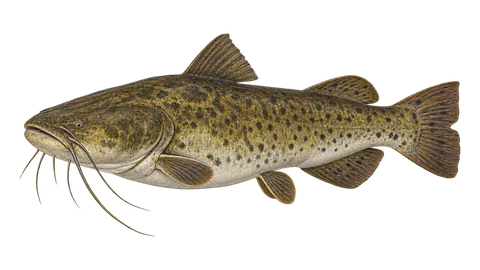
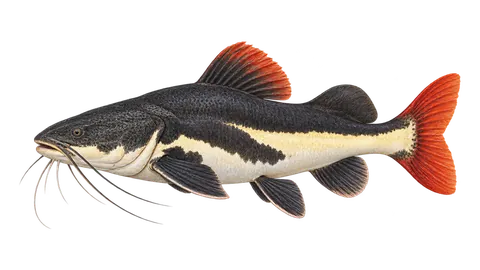
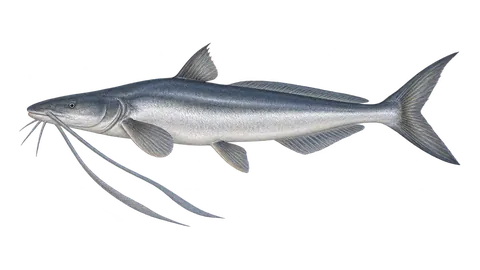
sources and references (7)
The season weights (months), the time of day and the sensitivities (cold, pressure, moon, wind, rain, tide, strong light, murky water and noise) are the app's editorial estimates, based on the literature below and on the field experience of anglers and guides. They are not official data nor a measurement made for this species, and they may vary by region and year. Closed seasons and legal rules appear in the rules section, with the norm and a link.
- scientific FishBase — Zungaro jahu (ficha da espécie)Names, distribution, biology, length-weight relationship and references. Page checked on October 13, 2026.
- official Portaria GM/MMA nº 1.667, de 27 de abril de 2026 — Lista Nacional Oficial de Espécies da Fauna Ameaçadas de Extinção (peixes e invertebrados aquáticos)Most recent national list. The species is not on it (search by scientific name in the text published in the DOU, checked on October 13, 2026).
- official ICMBio/SALVE — Ficha de Zungaro jahu (avaliação nacional do risco de extinção)National assessment by ICMBio, published in 2024. DOI verified on Crossref.
- scientific IUCN Red List — Zungaro jahu (avaliação global: Quase Ameaçada, NT, 21/12/2020)Global assessment. Link given on the FishBase entry (Red List, version 2025-2).
- scientific Alves, C. B. M.; Silva, L. G. M.; Godinho, A. L. (2007). Radiotelemetry of a female jaú, Zungaro jahu (Ihering, 1898) (Siluriformes: Pimelodidae), passed upstream of Funil Dam, rio Grande, Brazil. Neotropical Ichthyology 5(2): 229–232.
- scientific Ota, R. R.; Deprá, G. C.; Graça, W. J.; Pavanelli, C. S. (2018). Peixes da planície de inundação do alto rio Paraná e áreas adjacentes: revised, annotated and updated. Neotropical Ichthyology 16(2): e170094.Annotated list of species of the upper Paraná River, indicating native and non-native ones. Open access; species name checked in the text.
- scientific Lundberg, J. G.; Littmann, M. W. (2003). Pimelodidae (long-whiskered catfishes). In: Reis, R. E.; Kullander, S. O.; Ferraris Jr., C. J. (orgs.). Check List of the Freshwater Fishes of South and Central America. Porto Alegre: EDIPUCRS, p. 432–446.Printed book chapter; the URL is the bibliographic record on FishBase, which cites the chapter for the species.
how we calculatewhere each number comes from
The weather comes from three independent global models, cross-checked hour by hour: when they agree, confidence goes up; when they diverge, the band between them shows on the chart. Beyond 16 days, we use the GEFS ensemble of 31 simulations: if 20 of the 31 predict rain, the chance of rain is 65%. Sun and moon are calculated astronomically, with no uncertainty.
The index adds up, weighted for each species: time of day (species curve anchored to real sunrise and sunset), moon (transits, rise and set, phase), pressure (3 h trend and 24 h swing), water temperature (in rivers, estimated from air temperature; at sea, estimated by an ocean model), wind, rain, clouds, tide and the month in the species' cycle.
sources for this lookup
how accurate the forecast is
Accuracy measured in the reference project (4 regions, 93 days, forecast vs. observed): maximum temperature is off by 0.6 °C on average the next day and 1.7 °C at 7 days; rain of 5 mm or more is detected 76% of the time the next day and 57% at 7 days. Detection isn't everything: the false alarm rate isn't published here yet, and 93 days in 4 regions is still a small sample. We now also measure every day, at the app's destinations: