


the right time
to be on the water
Choose the place and the species. The index, from 0 to 100, combines weather, sun, moon and tide with each fish's habits. Up to 28 days, with each day's confidence.
Loading the forecast…
—
hour by hour
slide your finger or mouse over the chart to see each hoursee hour-by-hour table
why this index at —?
choose the day
the fishing month at a glance
what's the best window for the crew?
Choose how many fishing days. We compare each stretch by its average index, discount days with a warning or closed season, and show the 3 best.
trend for the coming weeks
Line: the middle value of 31 simulations of the American GEFS model. Band: where 8 out of 10 fall. Narrow, firm trend; wide, high uncertainty.
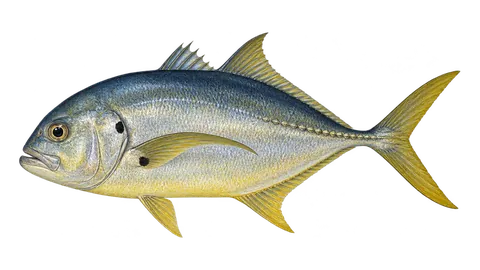
everything about the pacific crevalle jack
how to recognize it
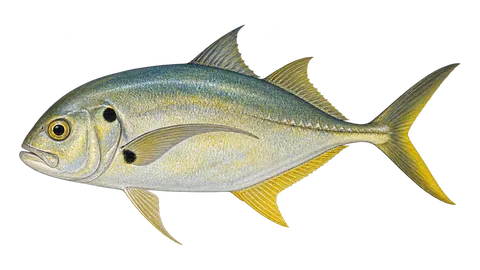
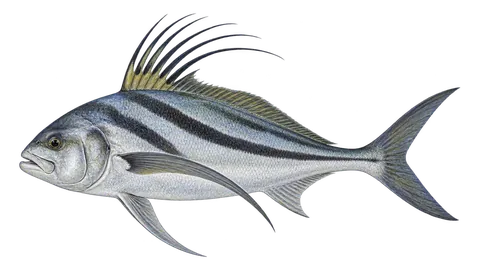
Tall, compressed body, blue to dark blue back, white, silvery or yellowish belly. Black spot on the gill cover and another on the pectoral fin. Chest almost without scales, with only a small plate in front of the pectoral fins. 35 to 42 strong bony scutes on the lateral line near the tail. In practice it is the same as the Atlantic crevalle jack; the roosterfish has a crest of long spines and no scutes.
Also called: xaréu-do-pacífico, jurel, Pacific crevalle jack
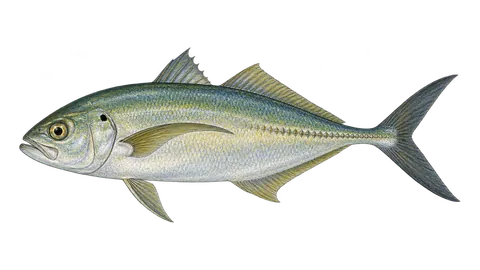
don't confuse with:
where found
open on the large mapWhere to look: Beaches, rock points, bays, estuaries and river mouths; large ones also in open sea and over reef flats.
Does not occur in Brazil (in the Atlantic lives the crevalle jack, Caranx hippos). Eastern Pacific, from San Diego (California) to Peru, including the Gulf of California and the Galápagos.
when to fish
best season
Fished all year along the tropical Pacific coast. The presence of bait schools near the beach matters more than the month.
best time of day
Daytime, with peaks at dawn and dusk. Feeds by day, with schooling bursts at dawn and dusk near shore.
what affects the pacific crevalle jack
cold and cold fronts
Cold upwelling water pushes the schools away.
atmospheric pressure
Little direct effect.
moon
Full and new moon tides move more water through the mouths and points.
rain
Little effect; tolerates muddy water from river mouths.
water level
Does not apply at sea. The equivalent is bait at the surface and diving birds.
noise
The sound of the popper attracts; an engine over the school sinks it.
wind
Swell helps the popper; strong wind hampers casting.
tide
A running tide at points and river mouths concentrates the schools.
depth
Surface and mid-water; large ones also on the bottom over reef flats.
how to fish
lures
- popper 12 to 18 cm
- stickbait
- metal jig 40 to 120 g
- mid-water
natural baits
- live sardine or mackerel
- live small mullet
tip from an angler
Fast popper with hard strikes where the school breaks. After the hookset, the crevalle jack turns sideways and uses its broad body: keep the rod low and pump short.
- rod
- 7' to 8', 20 to 50 lb; 9' to 11' on rocks and the beach
- spinning / baitcasting reel
- 6000 to 10000 spinning reel with strong drag
- line
- braid 40 to 65 lb
- leader
- fluorocarbon or monofilament 60 to 80 lb, 1.5 m
- hook
- reinforced treble hooks or single 5/0 to 7/0
accessories
- alicate
- luvas
- fighting belt for large fish
catch and release
A tough fish; unhook quickly and release it head-down in the water so it swims off.
rules for the pacific crevalle jack
Rules change; before keeping or transporting fish, check with the state environmental agency.
We found no species-specific rule beyond the region's general rules.
how much it weighs without taking it out of the water
estimated weight
—
how we calculate
Length-weight relationship W = a·Lb (a = 0.01445, b = 2.95; FishBase). It's an average: a fat or lean fish can vary by 10% to 20%.
more about the pacific crevalle jack
Eastern Pacific carangid, from San Diego, California, to Peru, including the Gulf of California and the Galápagos. It is so similar to the Atlantic crevalle jack (Caranx hippos) that FishBase itself considers them probably the same species. It lives in coastal and oceanic waters, in medium to large schools; the biggest ones travel alone and dive down to 350 m. It enters estuaries and sometimes swims up rivers, and juveniles are common at river mouths. It eats fish, shrimp and other invertebrates. In sport fishing it is the target of poppers, stickbaits and jigs on beaches, rocks and bays, and it fights hard and stubbornly. It grunts when it comes out of the water.
Family: Carangidae · predator
fun facts
- It makes an audible grunt when taken out of the water.
- FishBase considers it probably the same species as the Atlantic crevalle jack, separated by the Isthmus of Panama.
in the kitchen
Dark, strong meat; best bled right after the catch, smoked or in stews.
similar species
sources and references (4)
The season weights (months), the time of day and the sensitivities (cold, pressure, moon, wind, rain, tide, strong light, murky water and noise) are the app's editorial estimates, based on the literature below and on the field experience of anglers and guides. They are not official data nor a measurement made for this species, and they may vary by region and year. Closed seasons and legal rules appear in the rules section, with the norm and a link.
- scientific FishBase — Caranx caninus (ficha da espécie)Names, distribution, biology, length-weight relationship, country list and references. Page checked on Oct 13, 2026.
- scientific IUCN Red List — Caranx caninus (avaliação global: Pouco Preocupante, LC, 30/04/2008)Global assessment. Link given on the FishBase entry (Red List, version 2025-2).
- scientific Fischer, W. et al. (eds.) (1995). Guía FAO para la identificación de especies para los fines de la pesca. Pacífico centro-oriental. Vol. II: Vertebrados, parte 1. Roma: FAO.Regional identification guide; volume II covers the families Centropomidae, Carangidae and Istiophoridae.
- scientific Sandoval-Ramírez et al. (2025). Feeding habits of the Pacific crevalle jack Caranx caninus (Teleostei: Carangidae). New Zealand Journal of Marine and Freshwater Research 59: 816-835.DOI checked in Crossref.
how we calculatewhere each number comes from
The weather comes from three independent global models, cross-checked hour by hour: when they agree, confidence goes up; when they diverge, the band between them shows on the chart. Beyond 16 days, we use the GEFS ensemble of 31 simulations: if 20 of the 31 predict rain, the chance of rain is 65%. Sun and moon are calculated astronomically, with no uncertainty.
The index adds up, weighted for each species: time of day (species curve anchored to real sunrise and sunset), moon (transits, rise and set, phase), pressure (3 h trend and 24 h swing), water temperature (in rivers, estimated from air temperature; at sea, estimated by an ocean model), wind, rain, clouds, tide and the month in the species' cycle.
sources for this lookup
how accurate the forecast is
Accuracy measured in the reference project (4 regions, 93 days, forecast vs. observed): maximum temperature is off by 0.6 °C on average the next day and 1.7 °C at 7 days; rain of 5 mm or more is detected 76% of the time the next day and 57% at 7 days. Detection isn't everything: the false alarm rate isn't published here yet, and 93 days in 4 regions is still a small sample. We now also measure every day, at the app's destinations: