

- common size
- 20–40 cm
- maximum
- 61 cm
- common weight
- 0.2–1.5 kg
- record/max.
- 4.0 kg
- depth
- 0.5–6 m
- ideal water
- 18–26 °C

the right time
to be on the water
Choose the place and the species. The index, from 0 to 100, combines weather, sun, moon and tide with each fish's habits. Up to 28 days, with each day's confidence.
Loading the forecast…
—
Looking for alerts within 30 km…
Looking for what anglers have logged near here…
what you need to fish herelicense, certification and boat documents
fish likely at this spot
Tap a fish to see its forecast.
hour by hour
slide your finger or mouse over the chart to see each hoursee hour-by-hour table
why this index at —?
choose the day
the fishing month at a glance
what's the best window for the crew?
Choose how many fishing days. We compare each stretch by its average index, discount days with a warning or closed season, and show the 3 best.
trend for the coming weeks
Line: the middle value of 31 simulations of the American GEFS model. Band: where 8 out of 10 fall. Narrow, firm trend; wide, high uncertainty.
everything about the south american catfish
how to recognize it
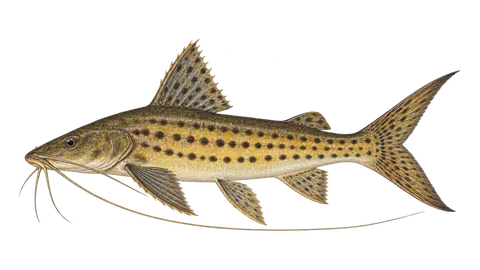
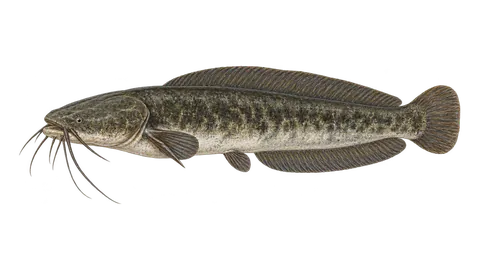
Elongated, scaleless body, grey to olive-brown, sometimes mottled, with a light belly. Three pairs of long barbels; the jaws reach close to the tail. Long adipose fin. The mandi is yellowish with rows of spots and has stronger spines. The African catfish has a broad bony head, four pairs of barbels and no adipose fin.
Also called: jundiá, jundiá-cinza, bagre
don't confuse with:
where found
open on the large mapWhere to look: Bottoms with rocks, logs and holes; slack water, cutbanks and small farm ponds.
Rivers, streams, lagoons and farm ponds of the South and Southeast, the Pantanal and the São Francisco; very common in RS, SC and PR.
native to the basins
states
Rio Grande do Sul, Santa Catarina, Paraná, São Paulo, Minas Gerais, Mato Grosso do Sul, Goiás
when to fish
best season
Spring and summer are the best, but it keeps biting in autumn and on mild winter days.
best time of day
Nighttime. Active at night, mostly in the first hours after dusk. Cloudy days and murky water help during the day.
what affects the south american catfish
cold and cold fronts
Tolerates the cold, but stops on freezing winter nights.
atmospheric pressure
Little effect.
moon
Dark nights produce more.
rain
Water turning murky after rain often activates the jundiá.
water level
A river rising slowly brings food and gets fish moving.
noise
Not very sensitive.
wind
Almost no effect.
depth
Bottom, 0.5 to 4 m.
how to fish
natural baits
- minhoca
- minhocuçu
- chicken heart
- liver
- piece of lambari
tip from an angler
At night, bait on the bottom near rocks and snags, with little slack in the line. The jundiá swallows the bait: strike quickly so you don't injure the fish.
- rod
- 1.8 to 2.1 m, 8 to 15 lb, or bamboo rod
- spinning / baitcasting reel
- spinning reel 1000 to 2500
- line
- monofilament 0.25 to 0.30 mm
- leader
- optional
- hook
- #1 to 1/0; olive sinker 5 to 15 g
accessories
- alicate
- cloth to grip
- lanterna
catch and release
Hold it behind the pectoral spines with a damp cloth. If it swallowed the hook, cut the line close to the hook.
rules for the south american catfish
Rules change; before keeping or transporting fish, check with the state environmental agency.
Minimum size: 30 cm
PR details
Source: Portaria IAT nº 650/2025, Annex I (interior basins of PR, except Iguazu and coastal)
Minimum size: 15 cm
TO details
Source: Portaria Naturatins nº 47/2026, Annex I, as amended by Portaria nº 105/2026
piracema and closed seasons
Each bar is the period when fishing is prohibited or restricted. The green line is today. Tap the name to see what is still allowed.
Spawning closure (piracema) in the Paraná River basin
Allowed: Recreational fishing only for non-native species and hybrids (peacock bass, tilapia, black bass, carp, croaker, etc.; piauçu remains prohibited), with handline, simple pole, or rod with spinning or baitcasting reel, up to 10 kg + 1 fish. In rivers, from shore only; in reservoirs, from a boat or from shore. Prohibited: floodplain lakes, aquatic-animal bait, within 1,500 m of dams and waterfalls, and within 500 m of confluences. Tournaments only in reservoirs and only with non-native species.
Source: IN IBAMA nº 25/2009
Spawning closure (piracema) in Minas Gerais (state rule)
Allowed: Only exotic or hybrid species, 3 kg plus one fish per day or outing, with handline, rod or pole with spinning or baitcasting reel (at most 5 per angler). Nets prohibited. Respect the minimum distances from dams, waterfalls and rapids and the marginal lagoons.
Source: Portarias IEF nº 154/2011 (São Francisco), 155/2011 (East) and 156/2011 (Grande/Paranaíba)
Closed season in Goiás (state rule)
Allowed: Sport and guided fishing only in reservoirs, catch and release with barbless hooks (no keeping, transporting or eating). Subsistence: up to 5 kg per day, for household consumption only.
Spawning closure (piracema) in the Pantanal of Mato Grosso do Sul
Allowed: Subsistence by riverside and artisanal fishers: on land or in a rowboat, with a pole, handline and hook, up to 3 kg or 1 fish per day, with no sale or transport.
Spawning closure (piracema) in Mato Grosso (all basins)
Allowed: All fishing modalities are prohibited in rivers, including catch and release (Law 9.096/2009, art. 19-A). Exceptions: subsistence fishing from shore (3 kg or 1 fish, no transport or sale) and scientific fishing. Law 13.159/2025 now allows licensed sport fishing in UHE/PCH hydropower reservoirs, natural lakes and border rivers, subject to a scientific study and a license from the environmental agency. We have not confirmed whether these licenses are already being issued.
Spawning closure (piracema) in the São Francisco River basin (rivers and reservoirs)
Allowed: Recreational fishing from a boat or from shore with handline, rod, spinning or baitcasting reel, up to 5 kg + 1 fish. Prohibited within 1,000 m of dams, waterfalls and rapids, and within 500 m of confluences. Floodplain lakes have a longer closed season (see next item).
Source: Portaria IBAMA nº 50/2007
São Francisco: floodplain lakes
Allowed: No fishing in the floodplain lakes during the period.
Source: Portaria IBAMA nº 50/2007
Spawning closure (piracema) in the Uruguay River basin
Allowed: Recreational fishing from shore, or from a boat without motor. Only handline or rod, line and hook, one gear per angler, up to 5 kg. Prohibited in floodplain lakes, within 1,500 m of dams, within 500 m of confluences, and in stretches listed in the rule (e.g., Turvo River).
Source: IN IBAMA nº 193/2008
Spawning closure (piracema) in the southern basins (RS and SC, outside the Uruguay)
Allowed: Recreational fishing from a boat or from shore, with a single hook, one gear per angler, up to 5 kg.
Source: IN IBAMA nº 197/2008
Spawning closure (piracema) in the Southeast basins
Allowed: In rivers, shore fishing only; in reservoirs, from a boat or from shore. Only non-native species, hybrids, and giant river prawn (camarão-gigante-da-malásia), up to 10 kg + 1 fish. Prohibited in floodplain lakes and within 1,000 m of dams.
Source: IN IBAMA nº 195/2008
Spawning closure (piracema) in the East basins
Allowed: Same rules as the Southeast basins: only non-native species and hybrids, up to 10 kg + 1 fish; in rivers, shore fishing only.
Source: IN IBAMA nº 196/2008
Conservation: Rhamdia quelen is treated as a species complex.
how much it weighs without taking it out of the water
estimated weight
—
how we calculate
Length-weight relationship W = a·Lb (a = 0.00912, b = 3.02; FishBase). It's an average: a fat or lean fish can vary by 10% to 20%.
more about the south american catfish
Scaleless catfish, small to medium size, common in rivers, streams, lagoons and farm ponds of the South and Southeast. It tolerates cold water better than the Pantanal catfish, which is why it is one of the most-caught fish in RS, SC and PR. Eats just about anything: small fish, insects, worms, crustaceans and scraps. Comes out at night and stays near rocks, logs and cutbanks. Raised in fish farms in the South. Fights little, but bites well on worms on the bottom at night. Has a pectoral spine that wounds the hand: be careful when handling it.
Family: Heptapteridae · omnivore
fun facts
- It is one of the main native species in fish farming in the South.
- The pectoral spine causes a painful wound: the anglers' saying is never to pick up a jundiá with an open hand.
in the kitchen
White meat with no intramuscular bones, very tasty; fried, stewed or grilled over coals.
similar species
sources and references (7)
The season weights (months), the time of day and the sensitivities (cold, pressure, moon, wind, rain, tide, strong light, murky water and noise) are the app's editorial estimates, based on the literature below and on the field experience of anglers and guides. They are not official data nor a measurement made for this species, and they may vary by region and year. Closed seasons and legal rules appear in the rules section, with the norm and a link.
- scientific FishBase — Rhamdia quelen (ficha da espécie)Names, distribution, biology, length-weight relationship and references. Page checked on October 13, 2026.
- official Portaria GM/MMA nº 1.667, de 27 de abril de 2026 — Lista Nacional Oficial de Espécies da Fauna Ameaçadas de Extinção (peixes e invertebrados aquáticos)Most recent national list. The species is not on it (search by scientific name in the text published in the DOU, checked on October 13, 2026).
- official ICMBio/SALVE — Ficha de Rhamdia quelen (avaliação nacional do risco de extinção)National assessment by ICMBio, published in 2024. DOI verified on Crossref.
- scientific IUCN Red List — Rhamdia quelen (avaliação global: Pouco Preocupante, LC, 19/03/2018)Global assessment. Link given on the FishBase entry (Red List, version 2025-2).
- scientific Bockmann, F. A.; Guazzelli, G. M. (2003). Heptapteridae (heptapterids). In: Reis, R. E.; Kullander, S. O.; Ferraris Jr., C. J. (orgs.). Check List of the Freshwater Fishes of South and Central America. Porto Alegre: EDIPUCRS, p. 406–431.Printed book chapter; the URL is the bibliographic record on FishBase, which cites the chapter for the species.
- scientific Ota, R. R.; Deprá, G. C.; Graça, W. J.; Pavanelli, C. S. (2018). Peixes da planície de inundação do alto rio Paraná e áreas adjacentes: revised, annotated and updated. Neotropical Ichthyology 16(2): e170094.Annotated list of species of the upper Paraná River, indicating native and non-native ones. Open access; species name checked in the text.
- scientific Zaniboni Filho, E.; Meurer, S.; Shibatta, O. A.; Nuñer, A. P. O. (2004). Catálogo ilustrado de peixes do alto rio Uruguai. Florianópolis: Editora da UFSC; Tractebel Energia. 128 p.Printed work; the URL is the bibliographic record on FishBase, which cites this work for the species.
how we calculatewhere each number comes from
The weather comes from three independent global models, cross-checked hour by hour: when they agree, confidence goes up; when they diverge, the band between them shows on the chart. Beyond 16 days, we use the GEFS ensemble of 31 simulations: if 20 of the 31 predict rain, the chance of rain is 65%. Sun and moon are calculated astronomically, with no uncertainty.
The index adds up, weighted for each species: time of day (species curve anchored to real sunrise and sunset), moon (transits, rise and set, phase), pressure (3 h trend and 24 h swing), water temperature (in rivers, estimated from air temperature; at sea, estimated by an ocean model), wind, rain, clouds, tide and the month in the species' cycle.
sources for this lookup
how accurate the forecast is
Accuracy measured in the reference project (4 regions, 93 days, forecast vs. observed): maximum temperature is off by 0.6 °C on average the next day and 1.7 °C at 7 days; rain of 5 mm or more is detected 76% of the time the next day and 57% at 7 days. Detection isn't everything: the false alarm rate isn't published here yet, and 93 days in 4 regions is still a small sample. We now also measure every day, at the app's destinations: