Federal minimum size (30 cm) in the Southeast and South
30 cm (TL)ESRJSPPRSCRSSoutheast CoastSouth Coast
Prohibited to fish for, keep on board or land peva snook under 30 cm total length on the coast of ES, RJ, SP, PR, SC and RS.
Centropomus parallelus · Centropomidae · predator
The most common snook in estuaries. A classic for night fishing with live shrimp, and excellent on shrimp lures and jig heads.
Also called: robalo-peva, robalo-peba, camurim (Nordeste), robalo-gordo (Centropomus mexicanus, sinônimo)


Choose the place and the species. The index, from 0 to 100, combines weather, sun, moon and tide with each fish's habits. Up to 28 days, with each day's confidence.
Reading the weather across 3 global models and 31 simulations…
Each card shows the day's index (0 to 100) and, below it, a strip with the index for each hour, from 0h to 23h. from poor to excellent.
Choose how many fishing days. We compare each stretch by its average index, discount days with a warning or closed season, and show the 3 best.
Line: the middle value of 31 simulations of the American GEFS model. Band: where 8 out of 10 fall. Narrow, firm trend; wide, high uncertainty.
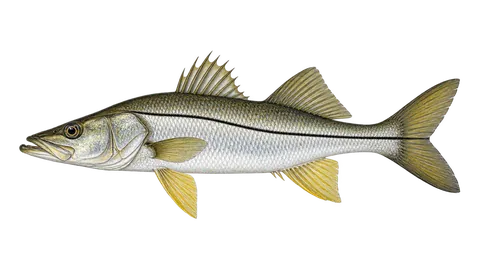
The peva snook is the most common snook in estuaries and the most fished by recreational anglers. Smaller and sturdier than the fleche, it lives in mangroves, coastal rivers, channels, marinas and under bridges, going well into fresh water. It forms loose groups at current and shade spots and eats shrimp, small fish and crabs. It is the classic night fishing with live shrimp under a float, but it also responds very well to shrimp lures and jig heads worked slowly. Fish of 1 to 2 kg are already good; over 3 kg are rare. The fight is short and strong, with head shakes, and it seeks roots and pilings to cut the line.
Deeper and more compact body than the fleche, smaller head and large eye. The same black lateral line down to the tail. Grey-olive to brown back, silver flanks with a golden sheen, small scales. Difference from the fleche: the peva is more "pot-bellied", with a short snout, and rarely exceeds 60 cm and 3 kg; the fleche is long and slender and passes 1 m.
The whole coast from Amapá to Santa Catarina, with great abundance in the estuaries of the Southeast and Paraná (Cananéia-Iguape, Santos, Paranaguá, Guaratuba). It goes up coastal rivers and does well in fresh water.
Habitat: Mangrove creeks and channels, coastal rivers, marinas, bridge pilings and jetties, shaded rocky edges.
native to the basins
coast
states
Amapá, Pará, Maranhão, Piauí, Ceará, Rio Grande do Norte, Paraíba, Pernambuco, Alagoas, Sergipe, Bahia, Espírito Santo, Rio de Janeiro, São Paulo, Paraná, Santa Catarina
In the Southeast and South the best period runs from spring to autumn. In winter it concentrates in deeper channels and rivers, and fishing becomes slow but possible on stable days. In the Northeast, all year. Paraná has a closed season in November and December.
Night and twilight. Bites well at night, especially at spots with light on the water, and at dawn and dusk. By day, fish in the shade of bridges, roots and rocks, with the tide running.
A cold front shuts it down for 2 to 3 days; look for deep channels and upriver, where the water warms more slowly and stays steadier.
Steady pressure favors it. A drop before the front gives a short window of good bites.
Big-tide moons move more shrimp. A clear full moon makes the fish wary in shallow water; prefer spots with shade.
Light rain doesn't bother it and even helps. A flood with very muddy water shuts it down.
A high river pushes the peva down toward the inlet; in drought it moves up the river.
Very sensitive to a flashlight in the water and to hull noise. Approach quietly and fish from a distance.
Wind disrupts the drift of the float and the reading of the bite; look for sheltered banks.
Fish with the tide running. On the rising tide it enters the mangrove and the creeks; on the falling tide it waits for shrimp at the mouths of the channels and at the pilings. The start of the falling tide is usually the best time. At slack water the bites drop off sharply.
Shallow, 0.5 to 3 m along the edge; 4 to 8 m in channels and holes in cold weather and strong sun.
lures
natural baits
accessories
Set the float so the bait sits a hand's width off the bottom, and let it drift with the tide close to the piling or root. On the shrimp, work it slowly, almost still: the peva takes it on the fall.
Boat or kayak fishing in mangroves, channels, brackish rivers and under bridges, with artificial lures and live shrimp, following the tide.
guideFrom a properly filled spool to drag set with a scale: the basics for the reel to work for you and last for years.
guideHow to choose gear by its number, rig the backing, line, leader and tippet, make a basic cast, and which flies to use for peacock bass, golden dorado and snook.
guideSpring and neap tides, high and low tide, slack water, rising and falling tide, tide tables and solunar theory: what really matters and how to use it without fanaticism.
Summary of the regulations we found, with the source for each. Rules change; before keeping or transporting fish, check with the state environmental agency.
Conservation: Not on the national list of threatened species (Portaria GM/MMA nº 1.667/2026).
Prohibited to fish for, keep on board or land peva snook under 30 cm total length on the coast of ES, RJ, SP, PR, SC and RS.
On the coast and in the inland waters of Paraná, it is prohibited to kill and keep fleche snook (robalo-flecha) and peva snook (robalo-peva) in November and December. Outside the closed season, peva snook may only be kept between 40 and 50 cm (recreational), and the recreational quota is 7 fish per species. Professional: minimum 40 cm.
Source: Resolução CEMA nº 91/2013 (State Environment Council of Paraná)
Snook fishing is prohibited on the coast and in the inland waters of Espírito Santo from May 1 to June 30. Dates taken from a summary of the text; confirm with Ibama-ES before fishing.
The Bahia government announces a snook closed season running to July 31. It was not possible to confirm the start date or the rule number: confirm with the competent agency (SEMA/INEMA-BA).
Source: Government of Bahia (official notice; rule not confirmed)
In federal waters off the coast of Tamaulipas, Veracruz, Tabasco and Campeche, catching prieto snook, fleche snook (robalo blanco) and peva snook (chucumite) is prohibited from July 1 to August 15 each year, during spawning. The sport fishing rule prohibits fishing in closed areas and seasons, so the rule also applies to recreational anglers.
Catching, transporting and selling snook (robalo) in Bahia are prohibited.
Source: Portaria IBAMA nº 49-N/1992; 2026 closed-season calendar of Sema-BA
Snook (robalo) closed season in ES for any gear. Tournaments targeting snook are prohibited from May 1 to Aug 31. In April, July and August, only the gear listed in the IN may be used.
Source: IN IBAMA nº 10/2009
Source: IN MMA nº 53/2005 (coast from ES to RS; total length)
Lip grip, hand under the belly, no finger on the serrated gill cover. Release quickly, facing the current.
White, tender and very tasty meat. Fried fillet, grilled or in moqueca.
Length-weight relationship W = a·Lb (a = 0.00813, b = 3.05; FishBase (estimativa bayesiana, comprimento total)). It's an average: a fat or lean fish can vary by 10% to 20%.
estimated weight
—
The season weights (months), the time of day and the sensitivities (cold, pressure, moon, wind, rain, tide, strong light, murky water and noise) are the app's editorial estimates, based on the literature below and on the field experience of anglers and guides. They are not official data nor a measurement made for this species, and they may vary by region and year. Closed seasons and legal rules appear in the rules section, with the norm and a link.
The weather comes from three independent global models, cross-checked hour by hour: when they agree, confidence goes up; when they diverge, the band between them shows on the chart. Beyond 16 days, we use the GEFS ensemble of 31 simulations: if 20 of the 31 predict rain, the chance of rain is 65%. Sun and moon are calculated astronomically, with no uncertainty.
The index adds up, weighted for each species: time of day (species curve anchored to real sunrise and sunset), moon (transits, rise and set, phase), pressure (3 h trend and 24 h swing), water temperature (in rivers, estimated from air temperature; at sea, estimated by an ocean model), wind, rain, clouds, tide and the month in the species' cycle.
Accuracy measured in the reference project (4 regions, 93 days, forecast vs. observed): maximum temperature is off by 0.6 °C on average the next day and 1.7 °C at 7 days; rain of 5 mm or more is detected 76% of the time the next day and 57% at 7 days. Detection isn't everything: the false alarm rate isn't published here yet, and 93 days in 4 regions is still a small sample. We now also measure every day, at the app's destinations:
Your location is saved only on this device and feeds the forecast, the map and the "today" on the home page.