Skip to content
fishing forecast

black pacu

Colossoma macropomum · Serrasalmidae · omnivore

Freshwaternational list: VU · vulnerable

A major eater of Amazonian fruits and seeds and a mainstay of national fish farming. Since 2026 it is listed as Vulnerable on the national list.

Also called: tambaqui, ruelo (jovem)

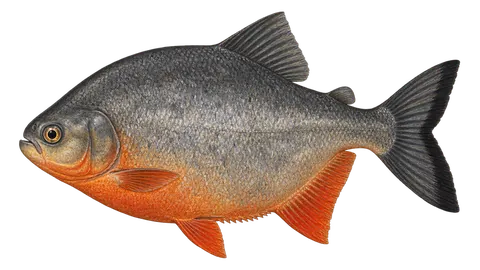
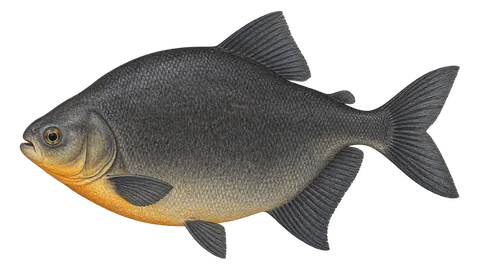
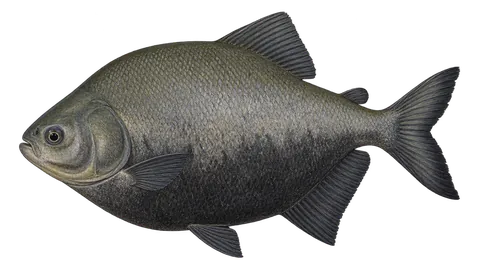
Scientific illustration of Black pacu
common size
50–80 cm
maximum
108 cm
common weight
3–15 kg
record/max.
40.0 kg
depth
0.5–8 m
ideal water
26–31 °C
location

Sample location: choose yours to see the forecast for where you fish.

period

Reading the weather across 3 global models and 31 simulations…

the species

everything about the black pacu

overview

who is the black pacu

Tambaqui is the largest scaled fish in the pacu and piranha family. In high water it enters the flooded forest and eats fruits and seeds that fall from trees, helping to spread those plants. In the dry season it lives in lakes and channels and feeds on zooplankton with its long gill rakers. It spawns at the start of high water, in schools that swim upriver. It was heavily fished and large specimens became rare in the wild; in 2026 it was listed as Vulnerable on the national list. In sport fishing it fights with brute force, and at fish farms it is among the most sought-after species. Nearly all tambaqui sold today comes from aquaculture.

fun facts

  • By eating fruit and dropping seeds far away, it helps regenerate the flooded forest.
  • It is the most farmed native fish in Brazil.
  • Tambaqui crossed with pacu gives tambacu; with pirapitinga, tambatinga.
how to recognize it

identification

Tall, rhomboid body. Adults have an olive-yellow upper half and a nearly black lower half and fins. Strong molar teeth. The adipose fin has rays, a detail only it has in the group. Pirapitinga is more silvery, has a smooth adipose fin, and juveniles have a red chest. Pacu is smaller and paler. Tambacu has intermediate traits.

distribution

where found

open on the large map

Solimões-Amazon channel and whitewater tributaries, várzea lakes, Madeira, Guaporé and Araguaia. Farmed across almost all of Brazil; farm escapes show up in rivers of other basins.

Habitat: Flooded forest and igapó in high water; várzea lakes, channels and rivers in the dry season. At fish farms, year-round.

native to the basins

AmazonTocantins-Araguaia

states

Amazonas, Pará, Amapá, Acre, Rondônia, Roraima, Mato Grosso, Tocantins, Goiás, Maranhão

calendar and clock

when to fish

best season

time of yearbest: Apr–May
JanFebSeaAprMayJunJulAugSepOctNovDec

In high water, March to June, it eats fruit in the igapó and responds to fruit baits. In the dry season it stays in lakes and channels. Fish farms work year-round, best in heat.

best time of day

0h6h12h18h sunrise ~6amsunset ~6pm

Daytime. Feeds by day, mainly when fruit is falling. At fish farms it feeds all day.

weather, water and behavior

what affects the black pacu
sensitivity The little bars show how much each factor affects this species. Five full: it feels it a lot.

cold and cold fronts

At fish farms in the South and Southeast, cold water shuts activity down.

atmospheric pressure

Moderate effect.

moon

Little effect.

rain

Little effect; rain knocks fruit down and can get the fish going.

water level

High water takes tambaqui into the flooded forest; find a tree with fruit falling.

noise

Wary in its natural habitat; avoid noise under the trees.

wind

Wind knocks fruit down and can help.

depth

Surface and mid-water under fruit trees; channel bottom in the dry season.

technique, gear and bait

how to fish

rod
6'0'' to 7'0'', medium action, 20 to 40 lb
spinning / baitcasting reel
baitcasting reel 200 to 300 or spinning reel 4000 to 5000
line
braid 40 to 50 lb or mono 0.45 to 0.50 mm
leader
mono or fluorocarbon 60 to 80 lb (teeth crush thin line)
hook
4/0 to 6/0 reinforced, chinu or circle type

lures

  • EVA fruit imitation
  • fly imitating fruit or seed

natural baits

  • local fruits (seringa, jauari, munguba, camu-camu)
  • dough and feed at fish farms
  • boiled corn

accessories

  • heavy-duty pliers
  • luva
  • large landing net

tip from an angler

In high water, tap the rod tip on the water under the fruiting tree to mimic falling fruit; this is the tapping technique (batida).

what the law says

rules for the black pacu

Summary of the regulations we found, with the source for each. Rules change; before keeping or transporting fish, check with the state environmental agency.
Conservation: Listed on the national list in April 2026, with a projected population decline of about 43% over three generations.

Tambaqui closed season in the Amazon basin

fishing, transport, storage and sale banned01/10 to 31/03Amazon

Throughout the Amazon River basin (main river, tributaries, lakes and reservoirs) it is banned to fish for, transport, store, process and sell tambaqui from October 1 to March 31. Fish from licensed aquaculture, with proof of origin, is allowed.

Source: Instrução Normativa MMA nº 35/2005

Tambaqui on the national list of threatened species (Vulnerable)

capture, transport and sale of wild fish banned after the transition period

Tambaqui was listed as Vulnerable on the national list. For a newly listed species, capture, transport, storage and sale of wild specimens are banned 180 days after publication (end of October 2026), unless a Recovery Plan approved by the MMA authorizes sustainable use. Fish from licensed aquaculture falls outside the ban. The situation is changing: there is a request for a transition rule and a PDL in Congress. Confirm with the MMA or Ibama before fishing.

Source: Portaria GM/MMA nº 1.667/2026 (list) and Portaria GM/MMA nº 1.666/2026, art. 3º and art. 12

Tambaqui closed season in the Amazon basin

01/10 to 31/03Amazon

Annual tambaqui closed season across the Amazon basin. WARNING: from about Oct 25, 2026, catching wild tambaqui is banned all year across the country, as it is a threatened species (see "prohibitions").

Source: IN MMA nº 35/2005

Tambaqui becomes a threatened species: catching prohibited

The new national list (Portaria GM/MMA 1.667/2026, DOU of Apr 28, 2026) classifies tambaqui (Colossoma macropomum) as Vulnerable (VU). Under Portaria GM/MMA 1.666/2026 (art. 3), VU, EN and CR species receive full protection: catching, transport, storage, processing and sale are prohibited. For species that were not on the previous list, such as tambaqui, the bans start 180 days after publication (art. 12), that is, around Oct 25, 2026. Exceptions: fish from licensed aquaculture (art. 3, § 2) and incidental catch released alive immediately (§ 4). Bills in the Chamber seek to overturn the portarias (PDLs 352, 385 and 490/2026), which as of Oct 2026 were awaiting referral and have no effect. Note: outside the Amazon, tambaqui is an exotic species, and state rules (MS, GO) allow it with no limit; the federal portaria makes no such exception. If in doubt, release it and confirm with the environmental agency.

Source: Portaria GM/MMA nº 1.666/2026 (arts. 3º and 12) and Portaria GM/MMA nº 1.667/2026 (Annex I)

Mato Grosso: fishing for threatened species absolutely prohibited

MTconfirm with the agency

Section 10 of art. 19-A of Law 9.096/2009 absolutely prohibits fishing for any species that is, or comes to be, on official lists of threatened or overexploited species. This covers pintado (VU) and, from about Oct 25, 2026, tambaqui.

Source: Lei estadual MT nº 9.096/2009, art. 19-A, §10 (Lei nº 12.434/2024)

piracema closures in the basins where the species lives

Closed season in Goiás (state rule)

01/11 to 28/02GO

Allowed: Sport and guided fishing only in reservoirs, catch and release with barbless hooks (no keeping, transporting or eating). Subsistence: up to 5 kg per day, for household consumption only.

Source: IN Semad-GO nº 17/2026, arts. 8º to 11

Spawning closure (piracema) in Mato Grosso (all basins)

01/10 to 31/01MT

Allowed: All fishing modalities are prohibited in rivers, including catch and release (Law 9.096/2009, art. 19-A). Exceptions: subsistence fishing from shore (3 kg or 1 fish, no transport or sale) and scientific fishing. Law 13.159/2025 now allows licensed sport fishing in UHE/PCH hydropower reservoirs, natural lakes and border rivers, subject to a scientific study and a license from the environmental agency. We have not confirmed whether these licenses are already being issued.

Source: IN Interministerial MAPA/MMA nº 10/2017; Resolução Cepesca-MT nº 1/2026; Lei estadual MT nº 9.096/2009, arts. 19-A and 27 (Leis 12.434/2024 and 13.159/2025)

Spawning closure (piracema) in the Araguaia River basin

01/11 to 28/02GOTOPAMT

Allowed: Recreational fishing only in reservoirs, with handline, rod, or spinning or baitcasting reel. Fish may only be eaten on site, not transported. Competitions prohibited. Subsistence: 3 kg + 1 fish. State rules (GO and TO) may be stricter.

Source: IN Interministerial MPA/MMA nº 12/2011

Spawning closure (piracema) in the Tocantins and Gurupi river basins

01/11 to 28/02TOPAMAGO

Allowed: Recreational fishing only in reservoirs, with on-site consumption. Subsistence: 5 kg + 1 fish. State rules may be stricter.

Source: IN Interministerial MPA/MMA nº 13/2011

Closed season in the rivers of Marajó Island (PA)

01/01 to 30/04PA

Allowed: The same recreational-angler exceptions as in Portaria 48/2007 apply (handline or rod, 5 kg + 1 fish), unless a stricter state rule applies.

Source: Portaria IBAMA nº 48/2007

Closed season in the Amazon basin in Amapá

15/11 to 15/03AP

Allowed: Recreational anglers with handline or rod, line and hook are outside the Annex II prohibitions, with a bag limit of 5 kg + 1 fish, unless a stricter state rule applies.

Source: Portaria IBAMA nº 48/2007

Border rivers MT/RO and MT/PA

05/11 to 28/02MTROPA

Allowed: See the exceptions in Portaria 48/2007 and the state rules for each bank.

Source: Portaria IBAMA nº 48/2007

catch and release
catch and release Releasing the fish alive, quickly and with a wet hand. During a closed season it isn't always allowed: what the regulation says applies.

Keep the fish in the water as long as possible, hold it by the base of the tail and support the belly. Watch the teeth: they bite hard.

in the kitchen

One of Brazil's most flavorful fish: tambaqui ribs grilled over coals, roasted banda, fish stew. Prefer farmed tambaqui.

calculator

how much it weighs without taking it out of the water

Length-weight relationship W = a·Lb (a = 0.02239, b = 2.99; FishBase (bayesiano, espécie + forma do corpo da família)). It's an average: a fat or lean fish can vary by 10% to 20%.

estimated weight

—

sources and references

The season weights (months), the time of day and the sensitivities (cold, pressure, moon, wind, rain, tide, strong light, murky water and noise) are the app's editorial estimates, based on the literature below and on the field experience of anglers and guides. They are not official data nor a measurement made for this species, and they may vary by region and year. Closed seasons and legal rules appear in the rules section, with the norm and a link.

  1. scientific FishBase — Colossoma macropomum (ficha da espécie)Names, distribution, biology, length-weight relationship and references. Page checked on October 13, 2026.
  2. official Portaria GM/MMA nº 1.667, de 27 de abril de 2026 — Lista Nacional Oficial de Espécies da Fauna Ameaçadas de Extinção (peixes e invertebrados aquáticos)The species is listed as VU (checked in the text published in the DOU of April 28, 2026, section 1, p. 96).
  3. official ICMBio/SALVE — Ficha de Colossoma macropomum (avaliação nacional do risco de extinção)ICMBio national assessment, published in 2026. DOI checked on Crossref.
  4. scientific IUCN Red List — Colossoma macropomum (avaliação global: Quase Ameaçada, NT, 17/12/2020)Global assessment. Link given on the FishBase entry (Red List, version 2025-2).
  5. scientific Goulding, M.; Carvalho, M. L. (1982). Life history and management of the tambaqui (Colossoma macropomum, Characidae): an important Amazonian food fish. Revista Brasileira de Zoologia 1(2): 107–133.
  6. scientific Goulding, M. (1980). The fishes and the forest: explorations in Amazonian natural history. Berkeley: University of California Press. 280 p.Printed work; the URL is the bibliographic record on FishBase, which cites this work for the species.
  7. scientific Jégu, M. (2003). Serrasalminae (pacus and piranhas). In: Reis, R. E.; Kullander, S. O.; Ferraris Jr., C. J. (orgs.). Check List of the Freshwater Fishes of South and Central America. Porto Alegre: EDIPUCRS, p. 182–196.Printed book chapter; the URL is the bibliographic record on FishBase, which cites the chapter for the species.
don't confuse

similar species