Federal minimum size (35 cm) in the Southeast and South
35 cm (TL)ESRJSPPRSCRSSoutheast CoastSouth Coast
It is banned to fish for, keep on board or land bluefish under 35 cm total length on the coast of ES, RJ, SP, PR, SC and RS.
Pomatomus saltatrix
The winter fish of the South and Southeast. It hits jig and sardine hard, jumps, and has teeth that cut line.
Also called: anchova, enchova, anchovinha (jovem), anchovão (grande)

The bluefish is the winter fish of the South and Southeast. A fast predator, it moves in schools that chase sardines, manjubas and young mullets in the surf zone, at inlets and around islands and ledges. It comes inshore with cold water, mainly from May to September in Santa Catarina and Rio Grande do Sul, and follows cold fronts. It hits bait violently, jumps, and has razor-sharp teeth that cut line and the hand. The big ones, over 5 kg, are called jumbo bluefish. It is a fish of jetties, beaches, rocky shores and boats. The meat is oily and tasty, excellent over coals, but it spoils fast: bleed and chill it right away.
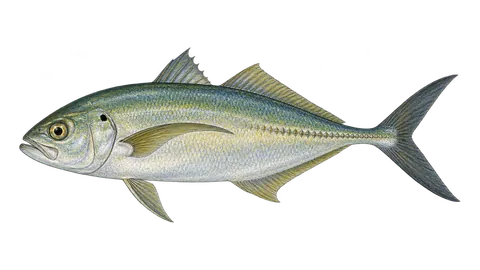
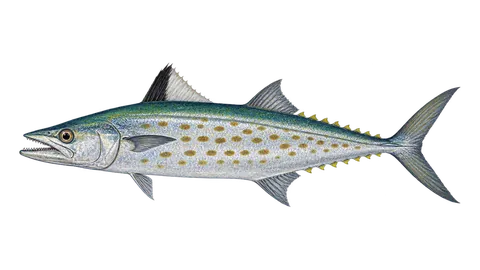
Elongated, sturdy body, blue-green back, silver flanks and a black spot at the base of the pectoral fin. Large mouth with sharp triangular teeth and a protruding lower jaw. First dorsal low and short, second long. Difference from crevalle jack and blue runner: bluefish has no bony scutes on the lateral line, a more fusiform body and cutting teeth. Versus Spanish mackerel: Spanish mackerel has yellow spots and finlets behind the dorsal fin.
Loading the next 7 days…
Each card shows the day's index (0 to 100) and, below it, a strip with the index for each hour, from 0h to 23h. from poor to excellent.
From Espírito Santo to Rio Grande do Sul, with the best season in Santa Catarina and Rio Grande do Sul in winter; also important at Cabo Frio, the islands of Rio de Janeiro and the São Paulo coast.
Habitat: Surf zone of beaches, jetties and inlets, rocky shores, islands, ledges and coastal offshore reefs.
coast
states
Espírito Santo, Rio de Janeiro, São Paulo, Paraná, Santa Catarina, Rio Grande do Sul
Winter is the season: in the South, from May to September, peaking in June and July. In the Southeast it shows up from autumn to spring, more so in cold-water years. In summer, coastal fishing drops off a lot.
Daytime, with peaks at dawn and dusk. Strikes are strongest at dawn and dusk; at night it also bites on the beach and at the jetty.
Cold-water fish: cold fronts bring bluefish to the coast. Unseasonal heat delays the season.
After the front, with south wind and the sea going down, it's usually excellent.
Spring tides move bait at inlets and jetties.
Rain doesn't hurt; very muddy water at the inlet drives it off.
Heavy surf prevents fishing at the jetty and rocky shore; two days later, with greenish water, is the time.
Moderate; a school feeding at the surface tolerates a boat, but a motor over the school makes the fish sink.
A moderate south wind helps; a strong northeast wind and warm water shut the bite down.
At inlets and jetties, the ebb concentrates bait leaving the estuary, and it's the most cited tide. On the beach, the flood and mid-tide with foam produce. At slack tide the school scatters.
Surface to 15 m inshore; down to 60 m on the offshore reefs.
lures
natural baits
accessories
At the jetty and rocky shore, cast a metal jig far and retrieve it fast with jerks. When one strikes, cast again in the same spot: it's a school.
Walk-in fishing on rocky shores, with natural bait on the bottom and artificial lures in the foam, always in calm sea.
guideFind troughs, sandbars and rip currents, choose tide and time, and fish the rocky shore without risking your life.
guideZara, prop bait, popper, jerkbait, shad, jig, spoon and spinnerbait: the right movement for each and how to adjust the rhythm to water temperature and fish activity.
Summary of the regulations we found, with the source for each. Rules change; before keeping or transporting fish, check with the state environmental agency.
Conservation: Not on the national list of threatened species (Portaria GM/MMA nº 1.667/2026).
It is banned to fish for, keep on board or land bluefish under 35 cm total length on the coast of ES, RJ, SP, PR, SC and RS.
Article 4 prohibits, every year, "the catching of bluefish (anchova) on the country's southern coast." The rest of the rule covers authorized vessels (coastal purse seine and surface gillnet), which may only start fishing from Apr 1. During the period, transport and sale are allowed only for declared stock or for bluefish caught as bycatch in other authorized fisheries.
Source: Instrução Normativa Interministerial MPA/MMA nº 02/2009, art. 4º
Source: IN MMA nº 53/2005 (coast from ES to RS; total length)
Use pliers: the teeth cut deep. Hold firmly by the body, release quickly and avoid touching the gills.
Dark, oily and very tasty meat, good grilled over coals, baked or smoked. Bleed and chill right after catching.
Length-weight relationship W = a·Lb (a = 0.01072, b = 2.97; FishBase (estimativa bayesiana, comprimento total)). It's an average: a fat or lean fish can vary by 10% to 20%.
estimated weight
—
The season weights (months), the time of day and the sensitivities (cold, pressure, moon, wind, rain, tide, strong light, murky water and noise) are the app's editorial estimates, based on the literature below and on the field experience of anglers and guides. They are not official data nor a measurement made for this species, and they may vary by region and year. Closed seasons and legal rules appear in the rules section, with the norm and a link.
Your location is saved only on this device and feeds the forecast, the map and the "today" on the home page.